

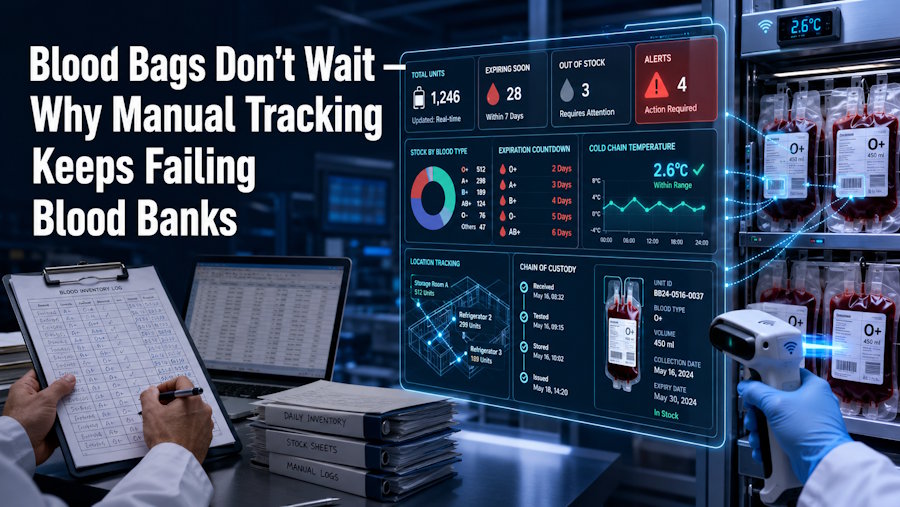
Blood banks operate under a level of scrutiny most hospital departments never see. Every unit of blood has to be traceable from donor to patient, temperature has to stay within a narrow range the entire time, and expired units need to be pulled before they end up near a transfusion. Doing all of that with barcode scans and paper logs works until volume climbs or staff turnover hits, at which point small errors start compounding into real risk. RFID tagging is increasingly the tool blood banks and central supply departments turn to when they need that level of accuracy without adding headcount.
Why Blood and Liquid Supplies Are Uniquely Hard to Track
Tracking a blood bag isn't the same problem as tracking a wheelchair or a monitor. Blood bags move constantly between storage, satellite refrigerators, and bedside delivery, often under tight time windows where a delay has clinical consequences. They also can't just sit and wait for someone to scan a barcode; a unit pulled for one patient and later canceled has to get back into inventory immediately or it risks expiring unused.
There's a technical wrinkle here too that doesn't come up with dry equipment: liquid-filled containers absorb and scatter radio signals in ways solid objects don't, which historically made RFID unreliable around blood products and IV fluids. Manufacturers have addressed this with tag designs and frequency choices built specifically for the challenge, and properly engineered RFID tags for liquid containers now perform reliably even in refrigerated storage packed with hundreds of units side by side. That engineering detail matters if a facility is evaluating vendors, since a generic tag built for dry goods often underperforms badly in a blood bank environment.
What Real-Time Tracking Changes on the Floor
Once a blood bank tags its inventory, staff stop relying on physical counts to know what's on hand. A reader at the refrigerator door logs every unit entering or leaving automatically, and dashboards show current stock by blood type without anyone walking the aisle with a clipboard. When a unit needs to move to a satellite fridge on another floor, the system tracks that transfer the same way, so nobody has to guess whether a specific unit made it to where it's supposed to be.
Temperature monitoring is where this really pays off. Many RFID tags built for cold-chain use can log temperature exposure alongside location, which means a brief door-open event or a refrigeration failure gets flagged immediately instead of discovered hours later during a routine check. For blood products, catching that kind of exposure early is often the difference between safely using a unit and having to discard it.
Where the Risk Reduction Shows Up Most Clearly
Blood banks and supply managers tend to see the biggest impact from RFID in a handful of specific situations:
- Expiration management, where automated alerts catch units approaching their use-by date before they're wasted or, worse, used past expiration
- Recall response, where a contamination alert requires pulling every affected unit quickly and RFID data can identify exact location instead of a facility-wide manual search
- Chain-of-custody documentation, where regulators expect a clear record of every hand a unit passed through from donation to transfusion
Facilities that have struggled with any of these three areas tend to be the ones that see the fastest payoff after adoption.
Getting Lab and Clinical Staff on Board
Blood bank technologists are understandably cautious about new systems touching something as high-stakes as transfusion medicine, and that caution is healthy. The rollouts that go smoothly tend to involve lab staff early, testing the tagging workflow on a small subset of inventory before expanding it facility-wide. Skipping that step and mandating a full switch overnight is a reliable way to generate resistance and mistakes during the transition.
Documentation habits matter just as much as the technology itself. A blood bank that adopts RFID but keeps parallel paper logs "just in case" ends up with two systems that can drift apart, defeating much of the purpose. Committing fully to the electronic record, once staff trust it, is usually what determines whether the investment actually pays off.
The Bottom Line for Supply Managers
For a blood bank or central supply department handling significant volume, RFID tagging isn't an experimental upgrade anymore; it's closer to a baseline expectation given the regulatory stakes involved. The upfront cost of readers and properly engineered tags is real, but so is the cost of a missed expiration, a failed recall response, or a temperature excursion nobody caught in time.

