

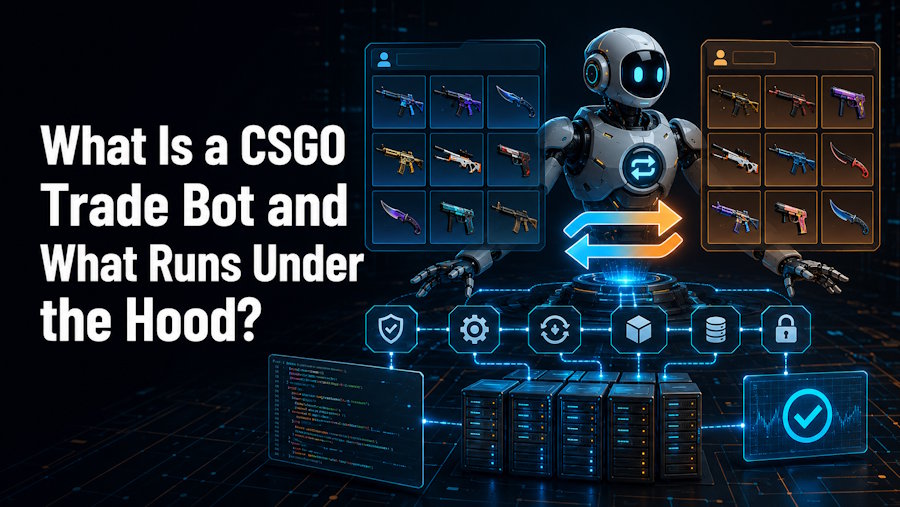
A CSGO trade bot is a real Steam account, stocked by a trading platform and driven by software, that exchanges skins with users instead of another player.
Every "instant" skin exchange on the internet has something unglamorous behind it: an ordinary Steam account doing exactly what a person would do, only thousands of times a day and without sleep. Understanding that machinery explains both why bot trading became the default way to move Counter-Strike items and where its limits sit.
The short answer
The bot is not a hack, an exploit or a special API privilege granted by Valve. It is a standard account with an enormous inventory, operated programmatically by the platform that owns it. When a user connects, the software reads their tradable items, calculates an exchange, and sends a normal Steam trade offer. The user reviews the offer, confirms it, and the swap is done. From Valve's perspective, two accounts traded. From the user's perspective, a vending machine dispensed a skin.
A real account driven by software
Peel back the first layer and the anatomy is familiar. The bot account has a profile, a level and a trade history like anyone else. What differs is the operator: a service composes trade offers through automated tooling, tracks their state, and confirms outgoing trades with the same mobile-confirmation step a human would perform, executed by the platform's infrastructure.
This design has a useful consequence. Because the bot lives inside Steam's normal trading system, every rule that governs person-to-person trades governs the bot too. There is no side channel where items move outside Valve's oversight, and the full contents of every offer stay visible to the user before anything is accepted.
Where the skins come from
A platform's inventory is a rolling warehouse rather than a mint. Every item a bot can offer arrived from an earlier user who traded it in, which means the catalogue is a live snapshot of what the community has been depositing. Popular rifle finishes cycle through quickly; oddities can sit for months.
This is also where the model shows its face to the user. On the exchange page of a csgo trade bot you pick items from that warehouse, the engine values both sides, and the difference is settled by adding or removing items until the balance closes. Services built on this model, SkinsMonkey among them, advertise completing the whole cycle in under two minutes precisely because no human needs to approve anything on the platform's side.
How the pricing engine thinks
The second layer is valuation. The engine ingests market data for each item, adjusts for wear and demand signals, and produces two numbers: what the platform credits for incoming skins and what it asks for outgoing ones. The gap between those numbers is the spread, and it is the revenue model. There is usually no separate fee line; the margin is already inside the quote.
The catalogue this engine prices stretches across the whole value range, from entries on lists like the cheapest covert skins up to knives worth more than the rest of an inventory combined. The engineering challenge is keeping those valuations current enough that neither side of the spread drifts away from reality.
The safety rails Valve builds in
The third layer belongs to Valve, and the bot cannot opt out of it. Items received in certain transactions carry a trade lock of 7 days before they can move again, which throttles rapid item cycling by design. Outgoing trades require confirmation, and Steam renders the complete contents of an offer, both sides, before acceptance.
For the user these rails mean one practical thing: a bot platform cannot take anything that was not explicitly listed in an offer the user approved. The risks that remain are commercial rather than mechanical, which is why a platform's reputation matters more than its technology.
The lock deserves a second look from an engineering angle, too. Because recently received items sit frozen for a week, a platform's warehouse always contains stock it cannot ship yet. Inventory management around those frozen items, deciding what to display, what to reserve and what to price ahead of unlock, is a genuine operational problem that separates well-run services from improvised ones.
What automation still cannot do
A pricing engine values what its data can see. Rare pattern indexes, aged tournament stickers and collector-grade float values often trade between humans at multiples of any formula's estimate, because their worth is narrative as much as numeric. Bots also do not negotiate: the quote is the quote.
So the honest summary is that automation solved the coordination problem of trading, finding a counterparty who wants your exact item, and left the connoisseur problems to people. For most swaps that trade-off favors the machine.
The stack at a glance
The four layers of a trade bot stacked as a tower
| Layer | Job | What the user sees |
|---|---|---|
| Steam account | Owns the inventory, sends offers | A profile like any other |
| Offer automation | Builds and confirms trades | A quote in seconds |
| Pricing engine | Values both sides of the swap | The exchange rate |
| Valve's rails | Locks, confirmations, visibility | The same rules as human trades |
Four layers, one effect: an exchange that behaves like a vending machine while remaining, underneath, a perfectly ordinary Steam trade.

