

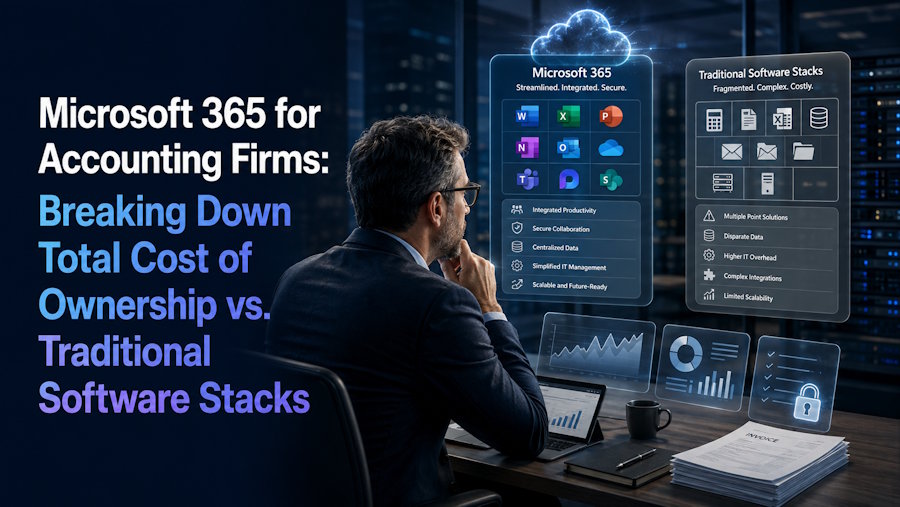
Readers of this site tend to be builders and technical decision-makers who evaluate software the way an engineer evaluates architecture: not just by sticker price, but by maintenance burden, integration debt, and long-term scalability. Accounting firms face a strikingly similar calculus when they weigh Microsoft 365 against a patchwork of legacy accounting, document management, and communication tools. The decision looks like a simple licensing comparison on the surface, but underneath it is a systems question, and that makes it relevant to anyone who has ever migrated a stack and discovered the "hidden" costs only after go-live.
Firms considering a move often start by comparing sticker prices, but the real story shows up in operational line items that never appear on a vendor's homepage. Working with a dedicated Microsoft 365 for accounting firms provider tends to surface these costs earlier in the planning process, because implementation partners have already seen where firms overspend on legacy add-ons or under budget for training and migration labor. That visibility alone can reshape a firm's three-year technology budget before a single license is purchased.
The True Cost of Microsoft 365 for Accounting Firms: Beyond the Per-User Price
Microsoft 365 Business Premium lists at roughly $22 per user per month when billed annually, and that figure is the one most firms anchor their budgeting to. But a per-seat price is only the entry point into a much longer cost equation that includes migration labor, data cleanup, staff retraining, and the inevitable overlap period where old and new systems run in parallel. For accounting firms evaluating alternatives to standard Microsoft 365 deployments, hosted Microsoft 365 for accounting firms can provide a managed environment designed around remote access, security, and accounting workflows. Accounting firms in particular carry extra weight here because client data migration must satisfy retention rules, audit trails, and sometimes state-specific compliance requirements that generic office migrations do not have to consider. According to this article, software licensing list prices typically represent only 25% to 35% of the real cost of owning and running an enterprise system, with the remainder hidden inside data migrations, API integrations, compliance adjustments, and customization debt. That ratio should reframe how firms build their budgets, since a $22 line item can easily represent less than a third of the actual per-user cost once implementation and ongoing support are factored in.
Traditional software stacks carry their own version of this problem, just distributed differently. A firm running separate tools for tax prep, document storage, email, and internal chat pays for each renewal, each vendor's support contract, and each integration that breaks when one vendor pushes an update the others were not built to handle. Those integration failures rarely show up as a line item, but they consume staff hours, delay client deliverables, and occasionally require a consultant to patch things back together. The comparison is less about which platform is cheaper on paper and more about which one concentrates its costs where a firm can actually plan for them.
Where Spending Pays Off: Compliance, Security, and Collaboration Features That Justify Investment
Cloud-based accounting software now accounts for roughly 68% of accounting software revenue, a shift that reflects how firms have already voted with their budgets on centralized, cloud-first platforms. Microsoft 365's value proposition for accounting firms rests heavily on built-in compliance tooling, data loss prevention, and identity management that would otherwise require separate point solutions stitched together with varying degrees of success. When those features live inside one licensing tier instead of three separate vendor contracts, firms reduce the coordination overhead that eats into billable hours during audit season or client onboarding spikes.
The return on that investment tends to show up quickly rather than gradually. Small and midsize businesses adopting cloud accounting tools report an average ROI of 347% within twelve months, and a meaningful share of that gain traces back to reduced IT infrastructure spending, with businesses reporting a 28% reduction in infrastructure costs after migrating to the cloud. For a firm still running on-premises servers for document storage or a locally hosted practice management tool, that reduction alone can offset a significant portion of the migration cost within the first year, which is a faster payback period than most firms expect going in.
Hidden Costs and Add-Ons: Compliance Tools, Copilot, and Integration Expenses
Base licensing rarely covers everything a firm actually needs. Advanced compliance add-ons, e-discovery tools, and AI features like Copilot are typically priced separately, and firms that skip this line item in early budgeting often find themselves negotiating a second contract mid-year once staff start requesting the features competitors already have. Integration expenses follow a similar pattern, since connecting Microsoft 365 to a firm's existing tax software or client portal frequently requires custom API work that a generic implementation quote does not include. Firms that have gone through a cash-flow-conscious technology rollout in another context, similar to the tradeoffs explored in top 5 corporate cards to manage recurring operational costs, tend to recognize this pattern quickly: the recurring, smaller charges add up faster than the headline expense.
Smart Economizing: Tiered Licensing, External Accountant Licenses, and Avoiding Unnecessary Add-Ons
Firms that control costs most effectively tend to treat licensing as a tiered decision rather than a blanket purchase. Not every staff member needs the same feature set, and mixing Business Basic, Business Standard, and Business Premium licenses across roles can meaningfully lower per-user spend without sacrificing the tools that partners and senior accountants actually rely on. External accountant licenses, often overlooked, let firms extend limited access to outside bookkeepers or seasonal contractors without paying full seat prices for temporary help. Given that 54% of accounting buyers already anticipate client acquisition challenges heading into 2026, keeping technology costs lean and predictable is not just an IT concern, it is a competitive necessity that affects how much room a firm has to invest in growth rather than overhead.
| Metric | Figure |
|---|---|
| Cloud-based accounting software market share (2025) | 68% of accounting software revenue |
| Microsoft 365 Business Premium base cost | $22 per user/month (annual billing) |
| Average ROI for SMB cloud accounting adopters | 347% within 12 months |
| IT infrastructure cost reduction post-migration | 28% reduction reported |
| Firms expecting client acquisition challenges (2026) | 54% |
| Typical licensing cost as share of true TCO | 25% to 35% |

