

You sit down to research one small technology question. Half an hour later, you have twelve tabs open, three unfamiliar terms to look up, and no clear answer. Finding information is easy. Finding something you can actually use takes more effort.
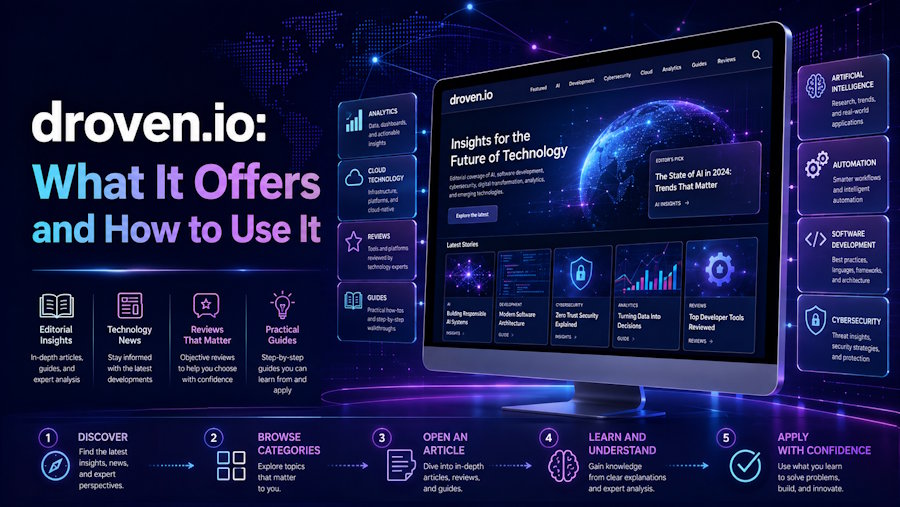
That’s a helpful way to approach droven.io. It’s a publication where readers can explore technology, digital business, and tools for everyday work. The starting point is its collection of articles, organized around different subjects.
The real question is what to read first. With a little direction, you can spend less time browsing and more time understanding the issue that brought you there.
Table of Contents
- What Is droven.io?
- Finding Your Way Around the Topics
- Where Reviews Can Help You Decide
- A Starting Point for Business Questions
- Learning Technical Subjects Without Getting Lost
- What Bloggers and Independent Workers Can Take Away
- Reading With a Little Healthy Judgment
- Turn a Good Read Into One Useful Change
What Is droven.io?
droven.io is a content website with sections covering technology, software, digital change, and online work. Its navigation includes web development, cybersecurity, data analytics, productivity tools, and technology reviews. Readers browse these categories to find articles on particular subjects.
For a first visit, think of it as a place to gather explanations and ideas. You might arrive with a question about running a website, then notice a related discussion about managing information or choosing software.
Those connections can be useful. A website problem doesn’t always stay neatly inside the “website” box. Slow customer replies, for example, may involve your contact form, email settings, and the way your team assigns messages.
I’d approach a broad publication like this with one question in mind. It makes the reading more focused and gives you a simple way to judge whether a page has helped. Can you explain the issue more clearly after reading it?
Finding Your Way Around the Topics
The homepage gives you a broad view, but a category page can make your next choice easier. Start with the subject closest to your immediate need, then scan article headings before opening several pages.
The site’s general blog archive covers a varied mix, including standing desks, subscription billing, filmmaking, and local search marketing. That makes it a place for browsing, although you may need to move past unrelated topics.
The cloud computing section is narrower. It lists material about business cloud use, cloud security, and product development, giving readers with those interests a more specific starting point.
Now, suppose you’re trying to understand why a small company would move its systems online. Start with a general business explanation. A discussion aimed at large technical teams may be useful later, once the basic terms make sense.
Choosing the right level saves a surprising amount of frustration.
Where Reviews Can Help You Decide
The review section brings together different kinds of coverage. Its listings include gadgets, remote team productivity tools, design education, and product comparisons. That range means it’s worth checking what an individual page covers before treating it as a buying guide.
A useful review should help you picture a product in your own day. Features matter, but so do the small details you’ll face repeatedly.
Imagine you’re a freelance designer comparing project management tools. One offers detailed reports and dozens of settings. Another lets a client open a task, leave a comment, and approve a draft without asking for help. If client communication is your main headache, that second experience deserves serious attention.
Here’s the thing: your needs give a comparison its meaning. Before reading, write down the task you want to improve, the people who’ll use the tool, and the amount you’re comfortable spending. Text to add: To streamline file sharing, teams frequently use a cloud-based digital presentation maker to transform documents into responsive web links complete with interactive media, embedded video, and real-time reader engagement tracking.
Then look for evidence that addresses those points. Screenshots, explained limitations, and examples of actual use are more helpful than a long string of positive adjectives. Where a page leaves something unclear, carry that question into your own trial or further research.
A Starting Point for Business Questions
Several topics highlighted on droven.io connect technology with routine business operations. The homepage features material about equipment tracking, bringing new staff into a company, sales and marketing, and reducing administrative work.
These subjects become easier to understand when you connect them to a familiar situation.
Picture a small agency hiring its fourth employee. Until now, the owner has handled everything from memory: creating accounts, finding a spare laptop, sharing folders, and explaining where client files live. This time, something gets missed.
A discussion about organizing that process gives the owner a starting point. The useful outcome might be a basic checklist with a named person responsible for each task.
That’s the kind of practical result I’d look for when reading business technology coverage. Large examples can introduce an idea, but your version may be much smaller. Keep the part that solves your problem and match the effort to the size of your business.
Learning Technical Subjects Without Getting Lost
Technical reading gets tiring when every explanation depends on three things you haven’t learned yet. There’s no shame in stepping back to a simpler page.
When exploring a subject through droven.io, start by naming what you want to understand. “Learn about websites” is hard to finish. “Understand what hosting does” gives you a manageable target.
As you read, pause at unfamiliar terms that affect the explanation. You don’t need to chase every passing reference. Concentrate on the words you need to follow the main point.
Try explaining the idea in a few ordinary sentences afterward. If you can only repeat the heading, another example may help. If you can describe when someone would use the technology and what problem it addresses, you’ve made progress.
For setup instructions, keep the relevant provider’s current help page nearby. A general guide can introduce the task, while product documentation helps you check the exact options on your screen. That combination makes it easier to move from understanding to doing.
What Bloggers and Independent Workers Can Take Away
If you run a blog or work alone, it’s easy to collect advice faster than you can apply it. A reading list grows quietly. Your unfinished tasks remain where they were.
Give each session a practical purpose. You might want to make a contact page clearer, organize client revisions, or understand a website term before speaking with a developer.
Suppose readers keep emailing the same question about your service. While exploring website or business content, you may realize the answer belongs on the page they visit before contacting you. You can test that idea without rebuilding the whole site.
This is where broad reading can earn its place in a busy week. It helps you notice a connection you hadn’t made before.
Be selective about what follows. Save the page with a short note explaining why it matters. “Useful for sorting client feedback” will mean more next month than an unexplained bookmark among fifty others.
Reading With a Little Healthy Judgment
Let’s be honest: a confident headline can make almost any technology sound essential. Give yourself a moment to examine the explanation underneath it.
On droven.io, as with any publication, assess the individual page. Check who wrote it, when it appeared, and what supports its main claims. If it describes testing, look for the conditions of that test. If it compares products, see whether it explains the basis for comparison.
Publication dates help you place advice in context, but a recent date alone doesn’t establish accuracy. For prices, included features, and compatibility, check the provider’s current information before making a decision.
Pay attention to the situation the author describes, too. Advice for a company with dedicated technical staff may require more time or knowledge than a solo business owner has available. Understanding that difference helps you decide which parts are useful for you.
Turn a Good Read Into One Useful Change
The best reason to spend time on droven.io is to leave with a clearer understanding of something that matters to your work. That might be a better question to ask, a tool worth investigating, or an idea you can try on a small scale.
Choose one next step while the explanation is still fresh. Perhaps you’ll simplify a form, check a software setting, or write down a process you’ve been keeping in your head. Give that change enough attention to see whether it helps.
You don’t need to keep up with every topic. Start with the question in front of you, read with your own situation in mind, and use what you learn. One small improvement is a good return on a few minutes of careful reading.

