

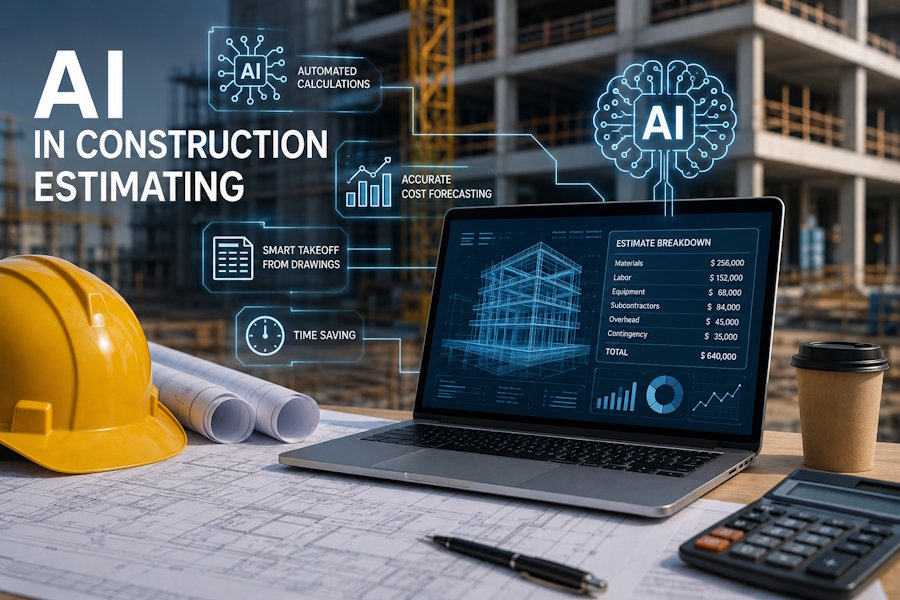
The construction industry has always depended on accurate planning, budgeting, and resource management. Before a project can move from an idea to a finished building, contractors and project managers need to understand how much material, labor, equipment, and time will be required. Takeoff Services can support this process by helping quantify materials and project requirements directly from construction drawings. Traditionally, much of this work has depended on spreadsheets, drawings, historical data, and manual calculations.
Today, artificial intelligence is changing that process.
AI-powered software can process large amounts of project information, identify patterns, automate repetitive calculations, and help construction professionals make better decisions. This does not mean that human estimators are becoming unnecessary. Instead, AI is becoming a powerful tool that can help professionals work faster and reduce avoidable errors.
Why estimating is important in construction
Every construction project starts with a financial plan. If the estimated cost is too low, a contractor may face budget problems during construction. If the estimate is too high, the project may become less competitive.
A construction estimate can include many different elements, such as:
- Building materials
- Labor costs
- Equipment and machinery
- Subcontractor costs
- Site preparation
- Project overhead
- Waste and material allowances
- Expected changes in market prices
Because of these variables, preparing an accurate estimate can take considerable time. This is one reason technology has become increasingly valuable in the construction sector.
How AI supports construction estimating
Artificial intelligence can help construction teams analyze project data much more efficiently. Instead of relying only on manual calculations, AI-based systems can examine drawings, specifications, historical project information, and cost databases.
For example, an AI system can be trained to recognize patterns from previous construction projects. When new project information is entered, the system can compare it with historical data and help identify potential cost ranges.
AI can also automate repetitive tasks. This lets estimators spend more time reviewing project requirements and less time doing manual calculations.
Many construction estimating service companies are now shifting tasks to AI for faster, better results.
AI and digital construction drawings
One of the most interesting applications of AI is its ability to work with digital construction documents.
Modern construction projects often contain architectural drawings, engineering plans, specifications, schedules, and other digital files. Manually reviewing these documents can take many hours, especially on large projects.
AI-powered software can assist with document analysis by identifying relevant information from digital files. When combined with construction takeoff software, AI can potentially help professionals identify quantities and organize project information more efficiently.
For example, a system could help identify doors, windows, walls, flooring areas, or other construction elements in digital drawings. The estimator can then review the results and make corrections where necessary.
This combination of automation and human review can make the overall process more efficient.
Better use of historical project data
Construction companies generate a large amount of valuable data from completed projects. Unfortunately, much of this information may remain inside spreadsheets, accounting systems, estimating software, and project management platforms.
AI can help turn this historical information into useful insights.
A construction estimating company can use historical project data to identify trends in material costs, labor requirements, project durations, and other factors. When estimating a new project, this information can provide additional context for making cost decisions.
For example, if similar projects repeatedly required more labor than originally estimated, historical data could help an estimator recognize this pattern before preparing a new bid.
However, the quality of the output depends heavily on the quality of the data used. Poor or incomplete historical data can lead to unreliable results.
Reducing repetitive work
Estimating involves many repetitive activities. Data entry, quantity calculations, cost comparisons, and document organization can consume much of an estimator's workday.
AI can help automate some of these tasks.
Instead of manually entering every piece of information, an AI-enabled workflow may extract relevant data from project documents and organize it into a structured format. This can reduce the routine work required of the estimating team.
The goal is not simply to make construction estimating faster. The larger objective is to let professionals focus on tasks where human judgment matters most.
AI does not replace human expertise
Despite the growing capabilities of artificial intelligence, construction estimating still requires human knowledge.
Construction projects are rarely identical. Site conditions, local requirements, design changes, subcontractor availability, material availability, and unexpected project conditions can all influence the final cost.
An AI system may identify a pattern from previous projects, but an experienced professional can determine whether that pattern actually applies to the current project.
This is why the most practical approach is often a combination of AI and human expertise.
AI can handle data-heavy and repetitive tasks, while experienced estimators can review assumptions, identify unusual conditions, communicate with project stakeholders, and make professional judgments.
Improving communication between construction teams
Another benefit of AI-driven estimating technology is improved access to project information.
Construction projects often involve architects, engineers, general contractors, subcontractors, suppliers, owners, and project managers. When everyone is working with different versions of information, misunderstandings can occur.
Modern software can centralize project information and make important data easier to access. AI can then help analyze that information and highlight potential inconsistencies or areas that require attention.
This can contribute to better communication and decision-making throughout the project lifecycle.
The future of AI in construction
AI is likely to become increasingly connected with other construction technologies.
Building Information Modeling (BIM), cloud platforms, project management software, computer vision, drones, and automated reporting systems can all generate valuable data. AI can help bring information from these different sources together.
In the future, construction professionals may use AI systems that continuously analyze project information and provide updates about potential cost changes, scheduling risks, material requirements, and other project factors.
However, successful adoption will require more than simply purchasing AI software. Companies will need reliable data, suitable workflows, trained employees, and clear processes for reviewing AI-generated results.
A technology-driven approach to estimating
The construction industry is moving toward a more digital working environment. Artificial intelligence is an important part of this transformation because it can process information quickly and support professionals with data-driven insights.
For construction businesses, the biggest advantage may not be complete automation. Instead, it may be the ability to combine advanced software with the experience of skilled professionals.
When AI is used correctly, construction teams can spend less time on repetitive tasks and more time analyzing project requirements, checking estimates, and planning for potential risks.
As construction projects become more complex, technologies that improve the way information is collected, analyzed, and used will become increasingly important. AI-powered estimating is one example of how the industry can use modern technology to make traditional processes more efficient while keeping human expertise at the center of important decisions.

