

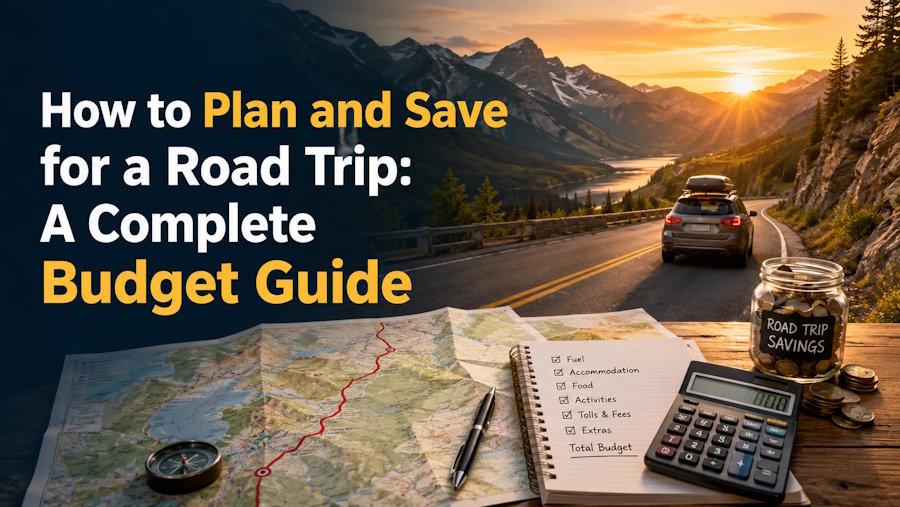
This July 4th, an estimated 61.4 million Americans will hit the road, making up 85% of all holiday travelers this year. That's a lot of people driving toward a destination without knowing what the trip will actually cost them.
Most road-trippers plan the route down to the last rest stop, but they leave the driveway without a real number in hand. This guide fixes that. You'll learn how to calculate your full trip cost, then build a savings plan that gets you there without leaning on a credit card.
Map the Route Before You Set a Budget
Every mile you drive costs something, so the route you map decides your budget before you write down a single number. Start by pulling your total round-trip mileage using a Google Maps trip planner, and don't assume the way home matches the way there. A return route differs from the outbound route in mileage and terrain, changing your total fuel cost, so check both legs on their own.
From there, count your overnight stops, since each one adds a hotel night to your final total. A toll-free detour lowers trip cost whenever the added drive time stays minimal, so compare the toll and no-toll routes before you commit. Charging-station gaps along a route force EV drivers into unplanned, unbudgeted detours, so scan the corridor for coverage before you leave.
Calculate the Full Cost of the Trip
Once you've mapped the route, every major cost on the trip becomes something you can actually estimate, because the miles you just counted feed straight into the math below.
Start with Fuel
Fuel is usually the first number people want, and it's the easiest to calculate once you know your mileage. To calculate fuel cost, divide total route miles by vehicle MPG, then multiply by the current fuel price:
Fuel cost = total route miles ÷ vehicle MPG × current fuel price
A 1,200-mile trip at 28 MPG and $4.00-per-gallon gas costs $171 in fuel. That $4.00 figure won't hold everywhere or every week, so check a current local price through AAA or the EIA's weekly gas price data before you lock in your own number.
Add Up the Remaining Costs
A complete road-trip budget includes fuel, lodging, food, tolls, parking, rental fees, activities, and vehicle prep costs. Round out the picture with everything else your trip pulls in:
- Lodging: nightly rate × number of nights (many hotels charge parking and resort fees separately from the room rate, so check before you book)
- Food: cost per person per day × group size × travel days
- Tolls and parking
- Rental fees, if you're renting a vehicle
- Activities and entrance fees
- A vehicle prep allowance for oil, tires, and fluids before you leave
A 10-15% buffer protects a road-trip budget from cost overruns like extra fuel stops or pricier meals. Run the numbers on our 1,200-mile trip and the subtotal lands at $1,791. Add a 10% buffer, and the real target becomes $1,970, the number we'll carry into the savings plan next.
Turn the Total Into a Monthly Savings Target
Once you know your trip total, the last step turns that number into something you can actually save toward, paycheck by paycheck. To find the monthly savings target, subtract the amount you've already saved from the trip total, then divide by the months remaining until departure:
Monthly target = (trip total - amount already saved) ÷ months until departure
A $1,970 trip, with $300 you've already saved and six months until departure, requires $278 in monthly savings. Biweekly earners should divide that $278 by 2.15 to get a per-paycheck number they can set aside automatically.
Automate the Road-Trip Fund
Once you know your number, the real work is making sure you don't have to think about it every week.
Qapital.com automates recurring contributions toward a savings goal like a road trip. Set up a recurring transfer from checking to savings, split part of your direct deposit into a separate account before it ever hits your main balance, or let qapital.com handle the transfers for you.
Whichever method you pick, the point is the same: move the money before you get the chance to spend it, and let the transfer do the remembering for you.
Lower the Cost Without Ruining the Route
Small choices during planning reduce what you spend without changing where you go. Traveling midweek or during shoulder season lowers lodging rates on a road trip.
- Pull up your route in Google Maps and compare the toll and no-toll options, then check whether the time you'd save actually justifies the extra cost.
- Travel midweek or during shoulder season, since lodging rates drop when demand does.
- Choose free or low-cost stops like state parks, scenic pullouts, and free landmarks over paid attractions whenever you can.
- Pack food for the hours you're driving, and save restaurant meals for the nights you're parked for good.
- If you're traveling with others, use a shared-expense app to split fuel, tolls, and lodging fairly as you go.
- Book accommodation with free cancellation so you can adjust the plan if something changes.
Protect the Plan When Costs Change
The buffer you already built into your subtotal does most of the heavy lifting here. If gas prices tick up or a meal runs more than planned, that 10-15% cushion absorbs it, so a small overrun doesn't send you reaching for a credit card.
Keep the trip fund out of your emergency account, though. A May 2026 Federal Reserve survey found only 63% of U.S. adults could cover a $400 surprise expense with cash or its equivalent, and mixing your travel savings into that pool puts both goals at risk. They're doing different jobs.
Before you leave:
- Verify current fuel prices and update your estimate
- Confirm the trip fund sits in its own account, separate from emergency savings
- Turn on your recurring transfer or savings automation

