

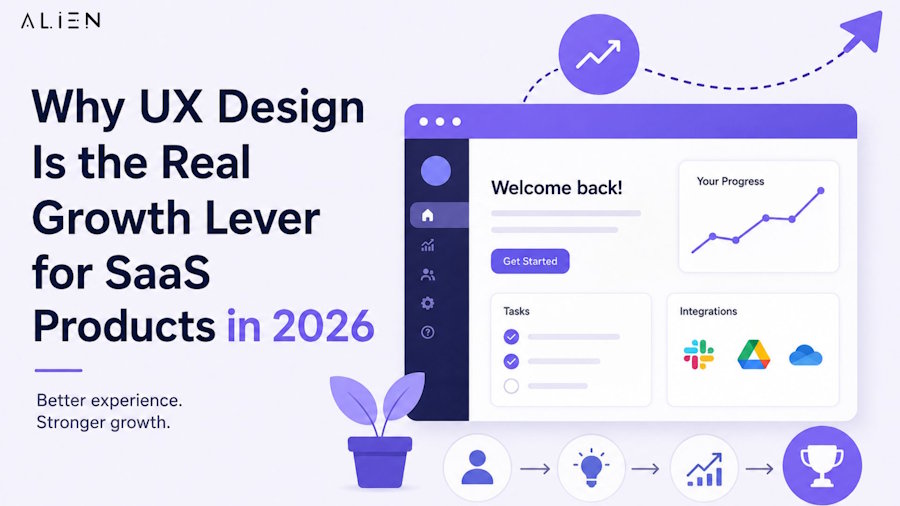
For years, SaaS companies chased growth through paid acquisition, feature velocity, and aggressive sales motions. Those levers still matter, but they are producing diminishing returns. Customer acquisition costs keep climbing, trial-to-paid conversion rates keep slipping, and churn quietly undoes whatever growth marketing manages to generate. In 2026, the companies pulling ahead are the ones that have stopped treating design as a finishing touch and started treating it as the product's core growth engine.
The Shift From Feature Wars to Experience Wars
Most SaaS categories are now crowded with products that do roughly the same thing. When feature parity becomes the norm, the deciding factor for buyers is no longer what a tool can do but how it feels to use it. A prospect evaluating three project management platforms with near identical feature sets will choose the one that felt intuitive during the free trial. That decision happens in minutes, often before a single feature is fully explored.
This is why experience has become the new differentiator. A product that is easy to understand, quick to configure, and pleasant to navigate earns trust faster than one that requires a demo call just to locate the settings page. Good UX shortens the distance between signup and the first meaningful outcome, and that distance is exactly what determines whether a free trial converts.
Onboarding Is a Revenue Function, Not a Design Afterthought
Nowhere is this more visible than in onboarding. SaaS teams that treat onboarding as a design problem rather than a documentation problem consistently see higher activation rates. Clear empty states, progressive disclosure of complexity, and contextual guidance reduce the cognitive load new users face in their first session. When users reach an "aha moment" quickly, they stick around long enough to become paying customers.
Poor onboarding, by contrast, is one of the most expensive silent killers in SaaS. Marketing spends money to bring users in, sales spends time qualifying them, and then a confusing interface loses them in the first ten minutes. No amount of top-of-funnel optimization can fix a leak that occurs the moment someone actually opens the product.
Retention Is Designed, Not Assumed
Growth is not only about acquiring users; it is about keeping them. Retention curves flatten when a product continues to feel effortless as usage deepens. This requires deliberate design decisions around information architecture, consistency across screens, and how new features are introduced without disrupting habits users have already formed. A well designed product scales in complexity without scaling in confusion.
Companies that invest early in a dedicated product design agency tend to build this discipline into their process from the start, rather than retrofitting it after churn numbers raise alarms. Design systems, usability testing, and iterative research create a feedback loop that keeps the product aligned with how real users actually think and work, not just how the engineering team assumes they do.
The Website Is Part of the Product Experience
UX does not stop at the application interface. For SaaS companies, the marketing website is often the very first product interaction a prospect has. A cluttered, slow, or confusing website undermines trust before a trial even begins, regardless of how polished the actual software is. Site structure, page speed, and clarity of messaging all influence whether a visitor believes the product inside will be equally well built.
This is why many SaaS teams are turning to a specialized Webflow design agency to rebuild their marketing sites with the same rigor applied to the product itself. Webflow's flexibility allows design and marketing teams to iterate on messaging and layout quickly, without waiting on engineering cycles, which matters when growth experiments depend on rapid testing.
Design as a Measurable Growth Input
The companies treating UX as a growth lever are not doing so on faith. They track activation rates, time to first value, feature adoption curves, and support ticket volume tied to confusing flows. Each of these metrics responds directly to design decisions. A redesigned dashboard that reduces support tickets by a meaningful margin is not just a design win; it is a cost reduction and a retention improvement at the same time.
This measurable connection between design quality and business outcomes is why UX has moved from a cost center conversation to a growth strategy conversation inside SaaS leadership teams.
Conclusion
SaaS growth in 2026 is being decided less by who can out-market competitors and more by who can out-design them. Acquisition channels are saturated, buyers are more discerning, and switching costs between tools are lower than ever. In this environment, a thoughtfully designed product and a well built marketing site are not aesthetic choices. They are the mechanisms through which trials convert, users activate, and customers stay long enough to become advocates. Treating UX as the growth lever, rather than a downstream deliverable, is quickly becoming the defining trait of SaaS companies that scale sustainably.

