

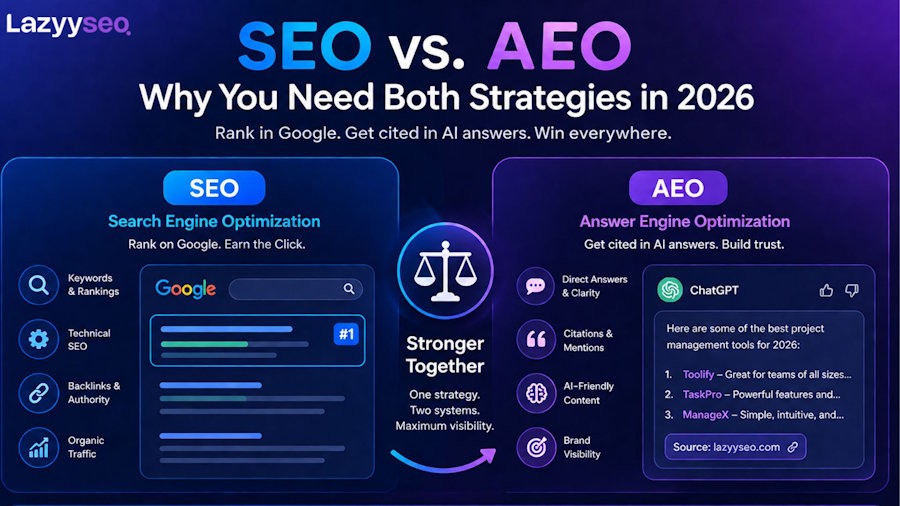
SEO vs. AEO: Why You Need Both Strategies in 2026
For two decades, ranking on page one of Google was the finish line for organic growth. That finish line has moved. Search behavior has split into two parallel tracks: people still type queries into Google, but a growing share now ask ChatGPT, Perplexity, or Gemini directly and act on the answer without ever clicking a link. This second track has a name, Answer Engine Optimization, and in 2026 it is no longer optional to ignore it. The businesses winning visibility today are not choosing between SEO and AEO. These businesses are running both, deliberately, as complementary systems, built around a clear SEO and AEO integration rather than treating AI visibility as an afterthought.
What Actually Changed
Traditional SEO was built around a simple mechanic: crawl, index, rank, and win the click. That mechanic still exists and still drives meaningful traffic. But a large and growing slice of queries now resolve inside the AI interface itself. A user asking an AI assistant to recommend a tool, compare two services, or explain a concept often gets a complete answer with no need to visit a website at all.
This shift does not eliminate the value of a click. It changes what winning looks like. Instead of only competing for a blue link, brands are now competing to be the source an AI model cites, paraphrases, or recommends inside its answer. That is a different kind of visibility, governed by different signals.
SEO Still Owns the Foundation
None of this makes classic SEO less important. AI models are largely trained on and retrieve from the same web that Google crawls. A page with weak technical health, thin content, or no backlink authority is unlikely to be trusted by an AI system any more than it is trusted by Google's ranking algorithm. Clean site architecture, fast load times, structured data, and topical depth remain the foundation everything else is built on.
In fact, the technical rigor that strong SEO requires, correct schema markup, clear internal linking, crawlable content, indexable pages, is now doing double duty. It is what lets both search engines and AI crawlers understand a page well enough to trust it. Skipping this step and jumping straight to "AI optimization" tactics is building on sand.
AEO Is a Different Kind of Optimization
Where SEO optimizes for rankings, AEO optimizes for retrieval and citation. Large language models do not scan a page and count keyword density. They pull specific, well structured chunks of information that answer a question clearly and can stand on their own outside the context of the full page. This rewards content that states facts plainly, answers questions directly near the top of a section, and avoids burying the actual answer under paragraphs of preamble.
Businesses building an AI-facing content strategy are learning to structure pages around clear questions and direct, quotable answers, often supported by FAQ blocks, comparison tables, and well labeled headings. This is a meaningfully different content discipline than writing purely to satisfy a Google ranking algorithm, even though the two overlap significantly. Teams that have already gone deep on building an LLM-based SEO strategy tend to see faster gains here, because the underlying research into how these models select sources carries over directly into practical content decisions.
Why Running Both Is Non-Negotiable
Treating SEO and AEO as separate, competing budgets misreads the moment. They share the same underlying asset: your website's content and technical infrastructure. A site with strong technical SEO but no AEO-aware content structure will keep ranking on Google while becoming invisible inside AI answers. A site optimized purely for AI citation but ignoring core web vitals, indexation, and backlink authority will struggle to get crawled and trusted in the first place.
The businesses gaining ground in 2026 are the ones building one integrated content and technical strategy that satisfies both systems at once. That means investing in the same things SEO always demanded: authoritative backlinks, clean technical infrastructure, and genuinely useful content, while also restructuring how that content is written and formatted so an AI model can extract, trust, and cite it. Practical frameworks for content optimization for AI search are becoming as standard a part of a content brief as a keyword list used to be.
What This Looks Like in Practice
A page built for both SEO and AEO in 2026 typically does several things at once. It targets a clear primary keyword and supporting long-tail variations the way classic SEO always has. It also opens sections with a direct answer to the implied question before expanding into detail, so an AI model can lift that answer cleanly. It uses schema markup not just for rich snippets but as a structured signal of what the content actually is. And it earns backlinks from genuinely relevant, high authority sites, because both Google's ranking systems and AI retrieval systems weight authority signals heavily when deciding what to trust.
None of this requires two separate content teams or two conflicting strategies. It requires treating AEO as an extension of good SEO practice rather than a replacement for it, and building content briefs that account for both a human scanning a search results page and a language model scanning for a citable answer.
Who Is Already Doing This Well
Agencies built specifically around this dual mandate are becoming a useful reference point for what integrated SEO and AEO actually looks like in practice. LazyySEO, a Webflow-focused SEO agency, structures its engagements around exactly this overlap, treating technical SEO, content strategy, and AI citation signals as one connected system rather than separate line items.
Their work with B2B, D2C, and SaaS clients has produced measurable jumps in organic traffic, in some cases documented at several hundred percent growth within months, alongside a parallel focus on getting client content surfaced and cited inside AI-generated answers. That combination, technical groundwork paired with content built for machine readability, is a practical illustration of what "running both" actually requires on a live website rather than as a theoretical framework.
Conclusion
SEO and AEO are not rival strategies fighting for the same budget line. They are two expressions of the same underlying goal: being the source that gets found, trusted, and chosen, whether the person searching is scrolling through Google or asking an AI assistant a direct question. Businesses that keep investing in strong technical SEO while adapting their content structure for AI retrieval are the ones showing up in both places at once. In 2026, that dual visibility is quickly becoming the actual definition of being found online.

