

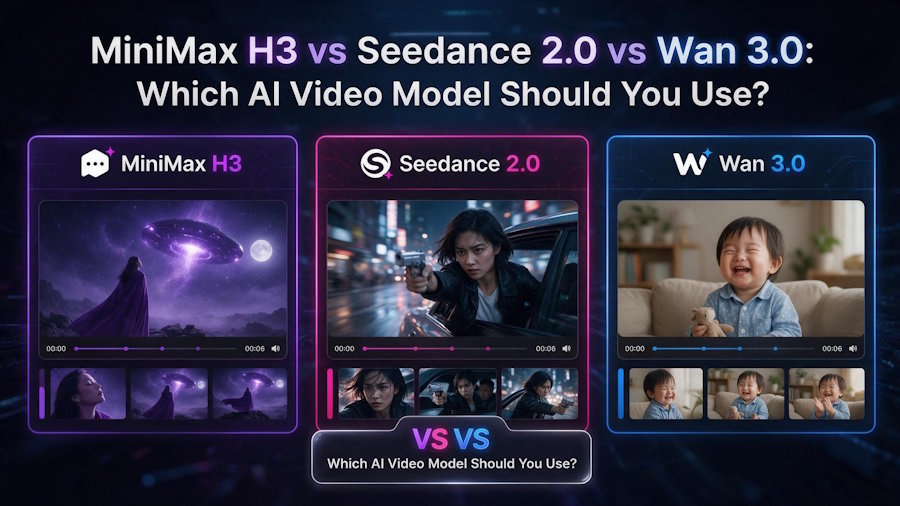
One prompt, three renders, real per-second prices, from $0.64 clips to $28 finals. Here's which model actually earns your credits.
3 models. 9 test clips. One identical prompt.
That's what it takes to get a straight answer in the MiniMax H3 vs Seedance 2.0 vs Wan 3.0 debate. Most reviews you'll read this month are written off launch-day demo reels, not side-by-side output. So we compared all three on Dream Smith AI, where they sit in one model list.
All three are 2026 releases. All three handle text, image, and reference inputs. And all three claim "cinematic" quality, whatever that's worth.
The differences only show up when you run the same work through each one: same prompts, same references. Specs, real per-second prices, and which model earns your credits for which job: here's the honest version.
The 10-Second Comparison
| MiniMax H3 | Seedance 2.0 | Wan 3.0 | |
|---|---|---|---|
| Clip length | 4–15s | 5–15s | Up to 30s |
| Max resolution | 2K native | 4K native | 1080p native |
| Reference inputs | Up to 12 (image, video, audio) | 4 images + 2 videos + 2 audio | Images + video |
| Native audio | Yes (stereo, 11 languages) | Yes | Yes |
| Open weights | Yes | No | No |
MiniMax H3: The Audio + 2K Specialist
H3 is the newest of the three and the only one with open weights. Released July 31, 2026, it spent the last month flooding r/StableDiffusion, mostly because of one feature: native stereo audio generated in the same pass as the video.
Dialogue in 11 languages, sound effects timed to what's on screen, music that fits the scene. No separate audio tool, no post-sync. If your clip needs sound, H3 is the default pick.
It's also the reference king: up to 12 mixed inputs in a single generation. Character identity from a photo, motion from a clip, voice from an audio file. One pass, no compositing.
Where it falls short: 15 seconds is the hard ceiling. And the open-weight hype hides a hardware tax: running it locally wants 24GB+ of VRAM and a 42GB download. (We wrote a full guide on using MiniMax H3 online without a GPU if that's you.)
Seedance 2.0: The 4K Heavyweight
ByteDance's Seedance built its reputation on one thing: multi-shot consistency. A character or product stays identical across cuts: face, clothing, lighting. For e-commerce and brand work where drift is a dealbreaker, it's still the safest pair of hands.
It's also the only one of the three with native 4K output, and it shows. Frame for frame, Seedance produced the most polished lighting and skin texture in our tests.
Where it falls short: the same 15-second ceiling as H3, no open weights, and the tightest reference budget of the three: 4 images, 2 videos, and 2 audio clips against H3's 12 mixed inputs.
Wan 3.0: The 30-Second Marathon Runner
Alibaba's Wan 3.0 is the endurance pick. Thirty-second continuous single takes, no stitching, no cuts. It's the longest native generation of the three by double.
That makes it the default for continuous camera moves, walkthroughs, and scene-long tracking shots. It also parses multi-page scripts and documents as context, which is quietly useful for structured, storyboarded content.
Where it falls short: 1080p is the native ceiling, and its 4K is an upscale, not a render. And 30 seconds is a lot of frames to keep coherent; the longer the take, the more chances for drift.
The Same-Prompt Test
Specs are one thing. We ran one identical prompt through all three (a barista scene with a line of dialogue, a slow camera push-in, and café background noise) to see where each model's personality shows up.
H3 was the only one that nailed the audio brief: the cup clink timed to the set-down, intelligible dialogue, room tone that matched the space. That's the joint audio-video pass doing its job.
Seedance produced the best-looking frame, with lighting and texture a clear notch above, though it capped at the same 15 seconds as H3.
Wan 3.0 gave the smoothest camera move and held the scene longest without drift. It just ran out of resolution headroom at 1080p.
You can run this exact test yourself on Dream Smith: the same prompt and references go to each model without re-uploading anything. Honestly, that side-by-side check is the fastest way to pick.
The $50 Budget Test
Now the money question. $50 gets you 5,000 credits on Dream Smith. Here's how many 8-second clips that buys on each model, at every resolution tier:
| Model | Clips per $50 (8s each) |
|---|---|
| MiniMax H3 | 78 at 768p · 52 at 2K |
| Seedance 2.0 | 34 at 480p · 16 at 720p · 7 at 1080p · 3 at 4K |
| Wan 3.0 | 78 at 480p · 41 at 720p · 20 at 1080p |
Or, for Wan 3.0's party trick: 5 full 30-second takes at 1080p per $50.
The gap is the story. H3 and Wan's draft tiers give you up to 78 attempts at an idea; Seedance 4K gives you three. That's not an argument against Seedance. It's a workflow. Draft cheap, ship expensive: iterate at 768p or 480p until the take is right, then spend the last few dollars on the final render at the highest tier your delivery needs.
Which Model for Which Job
| Job | Pick | Why |
|---|---|---|
| Social clips with sound | MiniMax H3 | Native audio, cheapest per clip |
| Product & brand ads | Seedance 2.0 | 4K + identity lock across shots |
| Long single takes | Wan 3.0 | 30s continuous, stable tracking |
| Character-driven series | H3 or Seedance | 12 references vs. tighter identity hold |
| Drafts & iteration | MiniMax H3 at 768p | Fast renders, audio included even on drafts |
| Final 4K delivery | Seedance 2.0 | Only native 4K of the three |
The pattern: nobody wins everything. The creators getting the most out of 2026's models draft cheap on H3, go long on Wan when the shot needs it, and reserve Seedance's 4K for finals.
Quick Answers
Is MiniMax H3 better than Seedance?
For audio and price, yes. For 4K output and multi-shot brand consistency, Seedance still leads. Different jobs, different winners. That's the whole point of testing side by side.
How much does an AI video clip actually cost?
Anywhere from $0.64 (8s at 768p on H3) to about $28 (15s at 4K on Seedance). The $50 budget table above breaks it down per model. The short version: resolution and length move the bill far more than the model choice does.
Can I use the same references across all three models?
Yes, and that's the practical way to compare. Upload once, send the same prompt and references to each model, keep the output that fits the job.
What about Seedance 2.5?
ByteDance's newer 2.5 extends clip length to 30s and reference inputs to 50. It's rolling out through enterprise channels first. For now, 2.0 is the version you can actually test alongside the others.
Test All Three Yourself
No subscriptions, and credits never expire. Load once, spend them across whichever model wins your test.

