

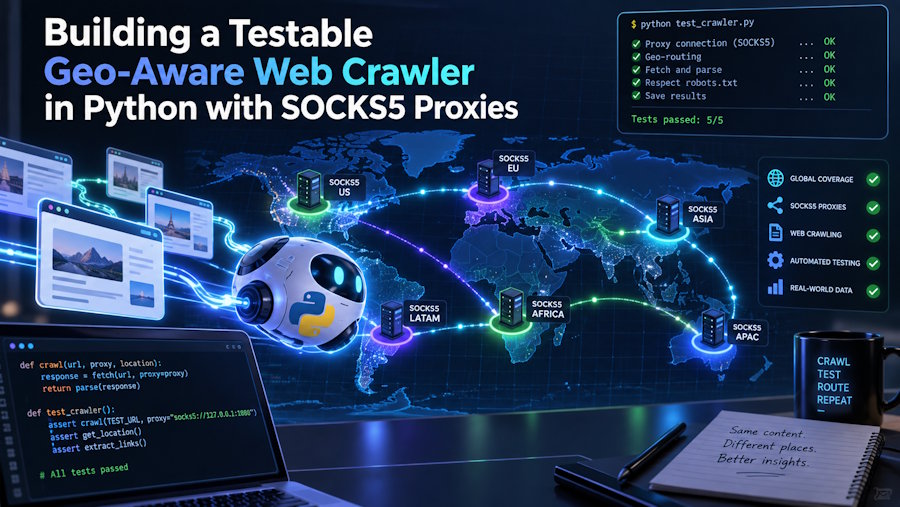
A crawler that works perfectly from one country can produce misleading results everywhere else. Prices, search results, product availability, consent banners, language, and even page structure often change according to the visitor’s apparent location. A socks5 proxy gives a Python crawler a practical way to test those regional variations without exposing the machine’s origin IP to every destination.
This article explains how to build a geo-aware crawler with Python, httpx, and SOCKS5 routing. It covers proxy rotation, sticky sessions, DNS handling, retries, observability, and compliance. Socks5.IO is used as an integration example because its public documentation provides Python-compatible connection examples, residential and datacenter options, country-level coverage, and usage-based plans. The same architecture works with any provider that exposes a standard SOCKS5 endpoint.
The goal is not to bypass access controls or overwhelm websites. A production crawler should collect only permitted public data, honor robots.txt and terms of service, use conservative request rates, and maintain an audit trail of what it retrieves and why.
What Makes a Crawler “Geo-Aware”?
A normal crawler treats location as incidental. A geo-aware crawler treats it as a test variable.
For example, an ecommerce team may need to answer:
- Does the US visitor see the same price as the German visitor?
- Is a product available in Tokyo but unavailable in London?
- Do localized SERPs contain the expected title and ranking?
- Is an advertising campaign visible in the markets where it was purchased?
- Does a consent or age-verification flow behave differently by region?
The crawler should record the requested market, the proxy exit location, the observed IP address, response status, final URL, and selected page signals. That makes the result reproducible instead of turning “the page looked different” into an anecdote.
A useful mental model is:
market configuration
        |
        v
proxy selection -> request policy -> HTTP request
        |                              |
        v                              v
 exit-IP check                response validation
        |                              |
        +---------- structured result -+
Choosing the Right Proxy Type
The proxy type affects both the validity and the cost of your test.
| Requirement | Recommended option | Why |
|---|---|---|
| Long-running account or checkout session | Static residential or sticky session | Keeps the apparent visitor stable |
| Broad market sampling | Rotating residential | Provides a larger pool of real residential exits |
| High-volume, non-sensitive endpoints | Datacenter proxy | Usually lower cost and latency |
| Mobile-only behavior | Mobile proxy | Represents carrier-based 4G/5G traffic |
| IPv6 application testing | Dedicated IPv6 proxy | Lets you test an IPv6-only or dual-stack path |
| SERP and ad verification | Residential, with strict pacing | Better represents regional user traffic |
Socks5.IO publicly describes a network covering more than 190 countries and regions, with residential, mobile, datacenter, static residential, and IPv6 products. Its homepage also lists a 99.9% availability target and 24/7 support. Treat those as provider-published claims, not as a substitute for your own benchmark. Measure success rate, median latency, and error distribution from the exact locations and targets you care about.
For a location-sensitive login or checkout workflow, use a sticky session. For independent page snapshots, rotation is usually more useful. Changing the IP in the middle of one logical session can create false failures because the target may interpret it as suspicious or inconsistent behavior.
Project Setup
Install the HTTP client with SOCKS support:
python -m pip install "httpx[socks]" beautifulsoup4 python-dotenv
Keep credentials outside source control:
SOCKS5_USER=replace_me
SOCKS5_PASSWORD=replace_me
SOCKS5_HOST=proxy-na.socks5.io
SOCKS5_PORT=3000
Use the hostname and port shown in your provider console. The socks5h scheme is important: it asks the proxy to resolve DNS, which prevents local DNS lookups from revealing the crawler’s network location.
import os
from dataclasses import dataclass
from urllib.parse import quote

@dataclass(frozen=True)
class ProxyConfig:
    country: str
    host: str
    port: int
    username: str
    password: str
    session: str | None = None

    @property
    def url(self) -> str:
        user = quote(self.username, safe="")
        password = quote(self.password, safe="")
        return f"socks5h://{user}:{password}@{self.host}:{self.port}"
Do not log the complete proxy URL. It contains a reusable secret.
Designing a Proxy Pool
A pool should represent your test plan, not simply contain as many endpoints as possible. Start with one or two exits per market, then expand after measuring failure modes.
from itertools import cycle
import os

def load_proxies() -> list[ProxyConfig]:
    user = os.environ["SOCKS5_USER"]
    password = os.environ["SOCKS5_PASSWORD"]
    host = os.environ["SOCKS5_HOST"]
    port = int(os.environ.get("SOCKS5_PORT", "3000"))

    return [
        ProxyConfig("us", host, port, user, password, session="us-test"),
        ProxyConfig("de", host, port, user, password, session="de-test"),
        ProxyConfig("jp", host, port, user, password, session="jp-test"),
    ]

proxy_cycle = cycle(load_proxies())
In a real system, the provider’s API or dashboard may let you request a country, city, ASN, or session identifier. Keep that selection logic in one component. The crawler itself should receive a ready-to-use ProxyConfig, which makes testing easier.
A rotation policy should also have cooldowns. If an endpoint returns repeated connection failures, temporarily remove it from rotation instead of sending more traffic to the same unhealthy route.
A Reliable Request Function
Retries need rules. Retrying every error is wasteful and can make a blocked target even less reachable.
Retry transient network errors, HTTP 408, 425, 429, and selected 5xx responses. Do not blindly retry 401, 403, 404, or validation failures. A 403 may be the result you need to record.
import asyncio
import random
import httpx

RETRY_STATUS = {408, 425, 429, 500, 502, 503, 504}

async def fetch(
    client: httpx.AsyncClient,
    url: str,
    proxy: ProxyConfig,
    attempts: int = 3,
) -> httpx.Response:
    last_error = None

    for attempt in range(attempts):
        try:
            response = await client.get(
                url,
                headers={
                    "User-Agent": "GeoAuditBot/1.0 ([email protected])",
                    "Accept": "text/html,application/xhtml+xml",
                },
                follow_redirects=True,
            )

            if response.status_code not in RETRY_STATUS:
                return response

            if response.status_code == 429:
                retry_after = response.headers.get("retry-after")
                delay = float(retry_after) if retry_after and retry_after.isdigit() else 5.0
            else:
                delay = 2 ** attempt

        except (httpx.TimeoutException, httpx.ProxyError, httpx.NetworkError) as exc:
            last_error = exc
            delay = 2 ** attempt

        await asyncio.sleep(delay + random.uniform(0, 0.5))

    if last_error:
        raise last_error
    raise RuntimeError(f"Request failed after {attempts} attempts: {url}")
Use separate connect and read timeouts. A short connect timeout prevents one dead proxy from stalling the whole queue, while a longer read timeout accommodates a slow but valid page.
timeout = httpx.Timeout(connect=10.0, read=30.0, write=10.0, pool=10.0)
Verifying the Exit Location
Never assume that selecting “Germany” means the request actually exited in Germany. Verify it with an IP diagnostic endpoint that you control or trust, then store the result with the crawl record.
async def check_exit_ip(proxy: ProxyConfig) -> dict:
    async with httpx.AsyncClient(
        proxy=proxy.url,
        timeout=10.0,
        trust_env=False,
    ) as client:
        response = await client.get("https://ip234.in/ip.json")
        response.raise_for_status()
        return response.json()
The diagnostic response should be treated as evidence, not absolute truth. Geo-IP databases disagree, and a provider’s “country” label may reflect the registered network rather than the physical location. For critical tests, compare multiple geolocation signals and document the database or API used.
Crawling Without Losing Reproducibility
A useful result record includes:
{
  "url": "https://example.com/product/123",
  "market": "de",
  "exit_ip": "203.0.113.10",
  "status": 200,
  "final_url": "https://example.com/de/product/123",
  "title": "Example Product",
  "content_hash": "sha256:...",
  "fetched_at": "2026-09-04T08:30:00Z"
}
Store a content hash rather than duplicating every full HTML document when retention is sensitive. If you do retain HTML, define a deletion period and remove personal data from logs.
For comparison, normalize only what is necessary. Lowercasing text and removing timestamps may be appropriate; stripping every script or price element can hide the very difference you are trying to detect. Keep both the raw observation and the normalized comparison output when possible.
Rate Limiting and Ethical Boundaries
Proxy rotation does not make unlimited crawling acceptable. Apply a per-domain rate limit, cap concurrency, and respect explicit crawl restrictions. A token-bucket limiter or a simple semaphore is often enough for a first implementation.
Avoid collecting login-protected data, personal information, copyrighted material beyond what your use permits, or content behind technical access controls. If your use case is ad verification, price monitoring, or SEO auditing, obtain authorization where required and identify your crawler honestly.
Why Socks5.IO Can Fit This Workflow
A provider is useful here when it offers more than a list of IP addresses. Socks5.IO advertises multiple IP categories, country and region selection, sticky sessions for rotating residential traffic, and ready-to-run examples for Python, cURL, PHP, Go, Java, and C#. Its public material also describes usage-based billing and a developer documentation center.
Those features map directly to the engineering concerns in this article:
- Market coverage: useful when a test matrix spans many countries.
- Session control: important for workflows that must keep one apparent visitor.
- Multiple IP types: lets you balance realism, latency, and cost.
- Integration examples: reduces setup time for a small test harness.
- Usage-based plans: easier to align with scheduled audits than a fixed fleet.
Validate these characteristics against your account, contract, and current documentation before publishing a benchmark or making a purchasing decision.
Common Failure Modes
The IP is correct, but the page is not localized.
The site may use cookies, browser language, account settings, GPS, or CDN headers in addition to IP. Set Accept-Language deliberately and clear cookies between independent market tests.
Requests work locally but fail in production.
Check CI firewall rules, environment proxy variables, certificate stores, and connection pool limits. Log error classes and timings, not credentials.
Rotation creates inconsistent sessions.
Use a stable session for multi-step flows. Rotate only between independent test cases.
The crawler gets duplicate pages.
Canonical URLs, redirects, tracking parameters, and localized subdomains can all create duplicates. Normalize URLs carefully and preserve the original URL for auditability.
FAQs
Is SOCKS5 better than an HTTP proxy for geo-testing?
Neither is universally better. SOCKS5 operates at a lower level and can carry more kinds of TCP traffic, while HTTP proxies expose HTTP-aware controls. For a Python HTTP crawler, both can work; SOCKS5 is attractive when you want the client to handle the HTTP protocol while the proxy handles the connection.
Should I use socks5:// or socks5h://?
Use socks5h:// when you want hostname resolution to happen through the proxy. Plain socks5:// may resolve DNS locally, depending on the client, which can undermine a location or privacy test.
How many proxies do I need?
Start with one healthy exit per market and add redundancy after measuring failures. More IPs do not automatically improve data quality. A smaller, monitored pool is easier to audit and usually produces more consistent results.
Can I use rotating proxies for login and checkout tests?
Usually no. Use a sticky session or static residential exit for the full workflow. Changing IPs mid-session can trigger security systems or invalidate the test.
How do I measure proxy quality?
Track connection success rate, HTTP success rate, median and percentile latency, timeout rate, CAPTCHA or block rate, and geolocation accuracy. Measure these per market and per target domain over a defined period.
Does a proxy hide all identifying signals?
No. Websites can still observe cookies, browser fingerprints, headers, TLS characteristics, language, and behavior. A proxy changes the network path; it is not a complete anonymity or security solution.
Is crawling through a proxy legal?
The answer depends on your jurisdiction, the target website, the data, and your authorization. Read the site’s terms, robots.txt, privacy requirements, and applicable law. When in doubt, obtain permission and collect the minimum data necessary.
Final Takeaway
A geo-aware crawler is a measurement system, not merely a script with a rotating IP. Define the market hypothesis, verify the exit location, keep sessions consistent, retry only transient failures, record enough metadata to reproduce results, and enforce conservative request policies.
Socks5.IO can be evaluated as one infrastructure option for this design, particularly when you need multiple IP types, broad market selection, sticky sessions, and language-specific integration examples. The strongest implementation is still the one that reports its limitations clearly and produces evidence another engineer can reproduce.

