

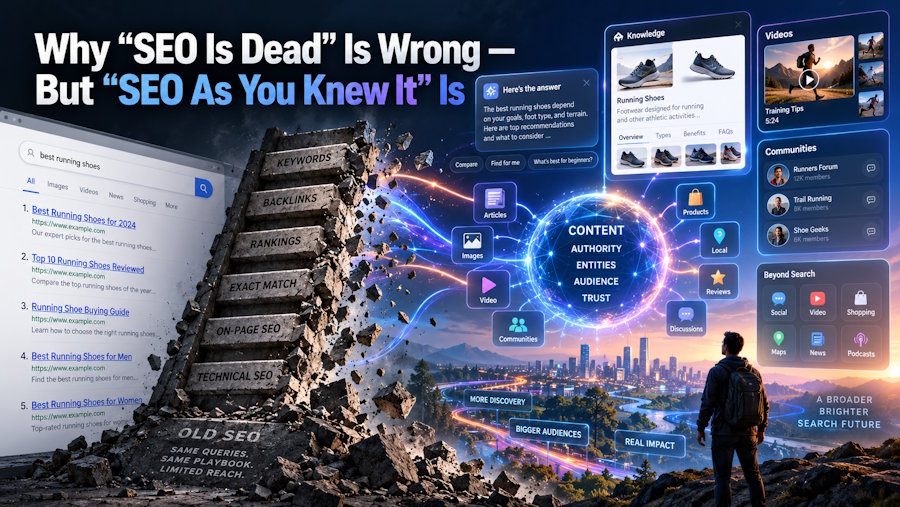
The same argument keeps breaking out across marketing and business circles lately: one camp insists SEO is finished, killed off by ChatGPT and AI Overviews; the other insists nothing has really changed and people are just panicking. After looking closely at how roughly 200 small and mid-sized businesses are actually performing in AI search using UpliftAI SEO Automation Software to track it, neither camp turns out to be quite right.
SEO isn't dead. But the version most people learned—rank on page one, win the click, done—genuinely is. And the distinction matters more than it sounds like it should.
What actually changed
For most of the last two decades, "search" meant one thing: type a query, get a ranked list of ten blue links, click one. Every SEO tactic that mattered was built around that single mechanic.
That mechanic is no longer the whole story. A large and growing share of queries now get answered directly inside Google's AI Overviews, inside a ChatGPT or Perplexity conversation, inside Gemini's responses with no click and often no visit to any website at all. This isn't a fringe behavior anymore; it's becoming a default one, especially for the kind of informational and comparison questions that used to reliably send traffic to business websites.
That's the part the "SEO is dead" crowd gets right. The part they get wrong is assuming that because the mechanism changed, the underlying goal—being the source an audience trusts and finds—disappeared too. It didn't. It just moved to a different layer.
Three terms worth actually understanding
Operating in this new layer means getting precise about the vocabulary, because these three terms get used almost interchangeably, and they're not quite the same thing:
AIO (AI Overviews) is Google's specific AI-generated answer box that now appears above traditional results for a large share of searches. It's a single, named feature but functionally, it behaves like the new "position zero," and it's already absorbing a meaningful share of clicks that used to go to normal listings.
GEO (Generative Engine Optimization) is the broader discipline of optimizing content so that any generative AI system—not just Google's—is more likely to reference, quote, or cite it when generating an answer. Think of it as SEO's successor discipline: same underlying goal of being found, adapted for an interface that summarizes rather than lists.
AEO (Answer Engine Optimization) is closely related but more tactical: structuring a specific piece of content, a page, a paragraph, an FAQ block so it directly and clearly answers one question, in a way models can lift cleanly. AEO is largely how good GEO gets executed at the page level.
None of these replace SEO outright. They sit on top of it. A page still needs to be crawlable, fast, and well-structured for a search engine to find it in the first place—that groundwork hasn't gone anywhere. What's changed is what happens after it's found.
What the data actually shows
Looking across real businesses—renovation contractors, insurance brokers, healthcare providers, e-commerce shops—one pattern kept repeating: ranking well on Google and getting cited by an AI model turned out to be two different outcomes, and a business could easily have one without the other.
The businesses that started showing up inside AI answers weren't the ones publishing the most content. They were the ones publishing the most specific content—real, detailed answers to real questions, written the way an expert would actually explain something to a person, not padded out to hit a word count. That's a striking overlap with what Google's own helpful content guidance has said since 2022: reward content written for people, by people with genuine experience, rather than content engineered purely to rank. Optimizing for AI citation and satisfying "helpful content" turn out to be much closer to the same job than either camp in this argument seems to assume.
Anyone rebuilding a content process around this shift tends to end up checking the same handful of things before publishing—they're collected here: AI SEO Checklist.
The measurement problem nobody's solved yet
Here's where "SEO as you knew it" breaks down most obviously: rank tracking, the bedrock metric of traditional SEO, doesn't tell you anything about whether ChatGPT or Perplexity ever mentions you. There's no equivalent of a rank-tracking API for AI citation yet—the current approach is largely to probe these systems with representative questions and check whether a brand or domain shows up in the answer, then repeat that on a schedule.
It's a real, still-evolving measurement problem. The mechanics of it, along with the common failure modes, are broken down here: How to get cited by ChatGPT and Perplexity.
So is SEO dead or not
Wrong question, honestly. The right one is whether a business is still optimizing purely for a search results page that a shrinking share of its audience actually scrolls through. If the answer is yes, that's the part of "SEO as you knew it" that's genuinely over—not because search died, but because the destination moved.
The organizations adapting fastest aren't abandoning SEO fundamentals; they're extending them into GEO and AEO practice on top of the same base clear structure, real expertise, genuine specificity. The goal was never "rank." It was always "be found." That part hasn't died at all.
FAQ
Is SEO actually dead because of ChatGPT and AI Overviews? No. The goal of being found by your audience hasn't gone away; the mechanism has expanded beyond a single ranked list of links to include AI-generated answers. Traditional ranking still matters; it's just no longer the whole game.
What's the difference between GEO and AEO? GEO is the overall discipline of getting cited across generative AI systems. AEO is the more tactical practice of structuring individual pieces of content to directly and clearly answer one specific question, which is one of the main ways good GEO gets executed at the page level.
Does optimizing for AI citation conflict with traditional SEO best practices? Generally not. Both reward the same underlying qualities—clear, specific, genuinely expert content—which is why Google's helpful content guidance and AI-citation performance tend to move together rather than in opposite directions.

