

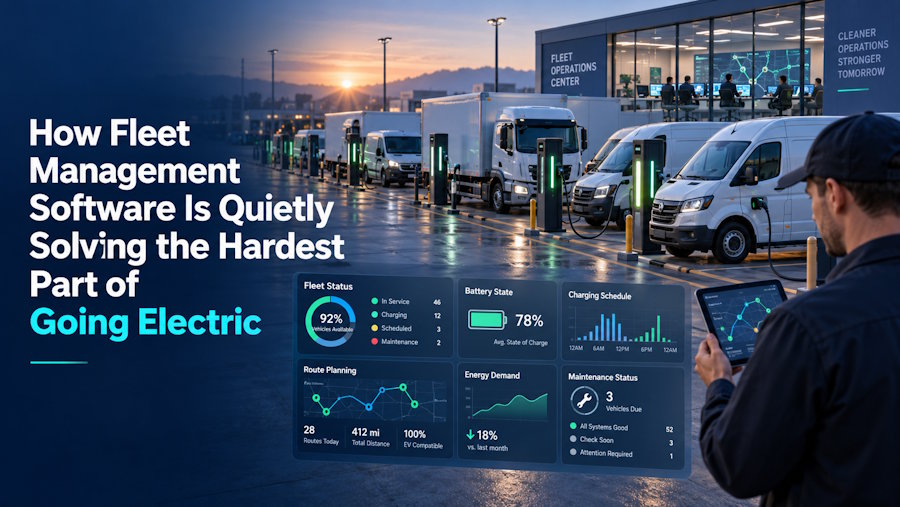
Most conversations about electric vehicles focus on the hardware — battery chemistry, range figures, charging speeds. That makes sense; those are the specs that show up on a spec sheet. But talk to anyone who's actually run a fleet through an electrification project, and you'll hear a different story. The hardware wasn't the hard part. The software was.
Managing a fleet of combustion vehicles is, from a data standpoint, relatively simple: track mileage, schedule oil changes, watch fuel cards. Managing an electric fleet introduces an entirely new layer of variables — state of charge across dozens of vehicles, charger availability and utilization, energy pricing that shifts by time of day, and route planning that now has to account for range instead of just distance. None of that is solvable with a spreadsheet at any meaningful scale, and it's exactly why fleet management software has quietly become the backbone of every serious EV transition.
The Data Problem Nobody Talks About
When a company decides to electrify part of its fleet, the pitch usually centers on emissions and fuel savings. What doesn't get discussed enough beforehand is that the vehicles themselves generate a firehose of telemetry that didn't exist in the same form before. Battery state of charge, charging session duration, energy consumption per mile, thermal management data, regenerative braking efficiency — all of it streams continuously from every vehicle in the fleet.
That data is useless without a system built to ingest, normalize, and act on it. This is where telematics platforms and fleet management APIs have had to evolve fast. A combustion fleet's telematics stack was mostly built around GPS tracking and basic diagnostics. An EV fleet's stack needs to answer questions those systems were never designed for: Which vehicles need to charge tonight, and in what order, given a shared power constraint at the depot? Which routes are burning more energy than expected, and why? Is a charger reporting a fault, or is it actually a vehicle-side charging circuit issue?
Answering those questions in real time is a genuinely interesting software problem — closer to a scheduling and constraint-optimization challenge than a simple dashboard. Depots running a dozen or more vehicles overnight, with a fixed amount of available power, effectively need a load-balancing algorithm deciding which vehicle charges when, at what rate, to make sure every vehicle is ready for its route by morning without tripping a demand charge or overloading circuits. That's not a hypothetical — it's the exact kind of problem depot operators run into within weeks of their first EVs arriving.
Why Charging Infrastructure Needs Its Own API Layer
Anyone who's worked with IoT devices at scale will recognize the shape of this problem immediately. A charger is, functionally, a networked device that needs to report status, accept commands, and integrate with whatever backend is orchestrating the fleet. Multiply that by dozens of chargers across multiple depots, each potentially from different hardware vendors, and you get the same interoperability headache that shows up in any large IoT deployment — except here, a bug in the integration means a delivery van doesn't have enough charge to finish its route the next day.
This is a big part of why fleets increasingly rely on platforms that treat charging infrastructure as a managed, API-connected system rather than a collection of standalone boxes plugged into the wall. Providers offering integrated EV fleet solutions build the charger network, the vehicle telemetry ingestion, and the scheduling logic as one connected system, which matters more than it sounds like it should — a charger that reports status correctly but isn't actually coordinated with the fleet's routing and scheduling software just becomes another disconnected data source instead of a piece of the automation.
For developers who've worked on IoT fleets before — sensor networks, smart building systems, anything with dozens of physical endpoints reporting into a central system — this will feel familiar. The difference with EV charging is the stakes: a missed sync on a smart thermostat is an inconvenience, a missed sync on a fleet charger means a vehicle doesn't make its first stop the next morning.
Route Optimization Gets a Lot More Interesting With Range as a Constraint
Route optimization for combustion vehicles is largely a distance and time-window problem — classic traveling salesman territory with some real-world constraints layered on. Electric vehicles add a hard constraint that didn't really exist before at the same scale: the vehicle has a battery that depletes based on route, load, terrain, weather, and driving behavior, and it needs to either finish the route or reach a charger before running out.
This turns route planning into something closer to a constrained optimization problem with a stateful resource — battery charge — that depends on decisions made earlier in the route. Cold weather alone can meaningfully reduce range, which means a route that works fine in summer might need a mid-route charging stop in winter. Fleets running EVs seriously have had to build or adopt routing systems that model energy consumption per segment rather than just distance, factoring in elevation change, average speed, cargo weight, and ambient temperature.
The interesting part, from a software perspective, is that this data compounds. Every completed route adds a data point about actual energy consumption versus predicted consumption, which feeds back into better range predictions for future routes. Fleets that have been running EVs longest tend to have noticeably more accurate range estimates than fleets in month one, simply because their models have more real-world data to learn from.
What This Means for Anyone Building or Evaluating Fleet Software
For developers or technical decision-makers evaluating fleet management platforms — whether building custom tooling internally or evaluating third-party systems — a few things stand out once you've looked at a few EV-specific implementations.
API access matters more than it does for combustion fleet software. Because charging infrastructure, energy pricing, and vehicle telemetry are all separate data sources that need to be unified, a platform with a well-documented API is going to be far easier to extend or integrate with existing dispatch and ERP systems than one that only offers a closed dashboard. If a fleet is running any kind of custom logistics software already, the EV layer needs to talk to it, not replace it.
Real-time versus polled data matters too. Charging status and vehicle state of charge change quickly enough that a system polling every few minutes will consistently show stale information at exactly the moments it matters most — right before a shift starts, or when a charger fault needs immediate attention. Systems built around webhooks or streaming updates handle this meaningfully better than ones built around periodic polling.
And it's worth evaluating how a platform handles multi-vendor hardware. Fleets rarely stay locked into a single charger manufacturer forever, especially as they scale, so a platform that assumes a single proprietary hardware ecosystem tends to become a limiting factor within a couple of years.
The Bigger Pattern: Hardware Problems Are Becoming Software Problems
There's a broader trend here that goes beyond fleets specifically. A lot of what used to be pure hardware and logistics problems — inventory management, warehouse routing, now vehicle fleets — are increasingly being solved by treating the physical assets as data sources feeding into optimization software, rather than as things you just track and maintain. EV fleets are a particularly clean example of this shift because the vehicles themselves are, functionally, rolling IoT devices generating continuous telemetry that didn't exist in the combustion-vehicle era.
For anyone working in logistics tech, telematics, or IoT integration, fleet electrification isn't just a sustainability story — it's a genuinely interesting systems problem involving real-time data ingestion, constraint-based scheduling, multi-vendor hardware integration, and predictive modeling that gets better with more data. It's the kind of problem that looks simple from the outside ("just charge the trucks overnight") and turns out to be a fairly deep optimization challenge once you're actually building the system that has to make it work reliably, every night, across dozens of vehicles and chargers, without anyone noticing the software running underneath it at all.

