

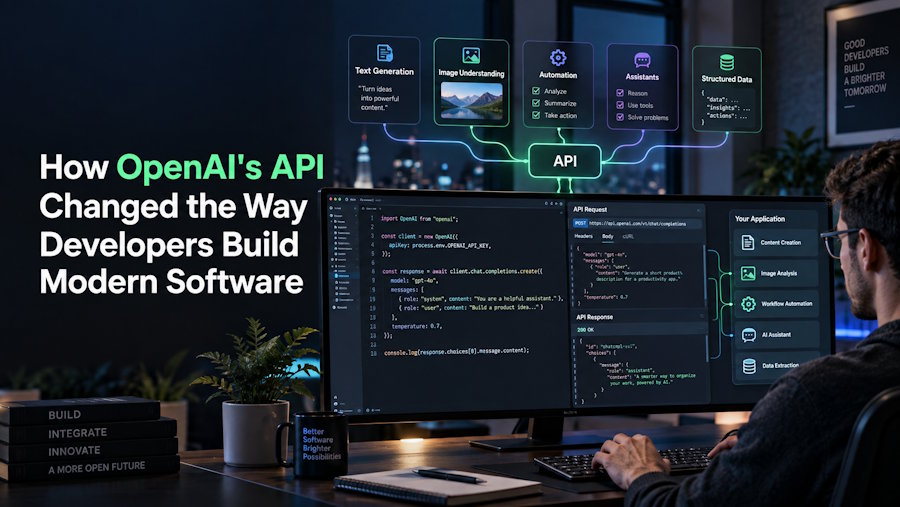
The OpenAI API for developers has done something rare in software engineering: it changed the default architecture of a whole class of applications in under three years. Features that used to require dedicated ML teams and months of infrastructure work can now ship in an afternoon. But the shift runs deeper than convenience. It has rewired how developers approach problem decomposition, feature design, and even API contract thinking.
What the OpenAI API Actually Provides
The OpenAI API is a REST-based interface that gives developers programmatic access to OpenAI's models. It handles authentication with bearer tokens, returns JSON responses, and works with any language that can make HTTP requests.
The Core Endpoints Developers Use Most
The API is not a single endpoint. It is a set of purpose-built interfaces:
- Chat Completions for conversational and generation tasks
- Embeddings for semantic search, clustering, and retrieval systems
- Whisper for speech-to-text transcription
- TTS for generating natural-sounding audio from text
- Vision for analyzing images and extracting structured data
- Realtime API for low-latency voice and streaming interactions
- Batch API for high-volume asynchronous jobs at reduced cost
Each endpoint follows consistent authentication and response patterns. Once developers understand one, the rest feel familiar.
Why REST-First Design Matters
OpenAI made an intentional choice to keep the API simple. No proprietary protocols. No mandatory SDKs. This means Python developers, Node.js developers, Go developers, and even Bash scripts can integrate with the same underlying interface. Official SDKs exist for Python and JavaScript, with high-quality community libraries for most other languages.
How Software Development Workflows Have Changed
The change is not just what developers can build. It is how they think about building.
From Feature Engineering to Prompt Engineering
Building a text classifier used to mean collecting training data, engineering features, training a model, and deploying it. That entire pipeline can now be replaced with a well-crafted prompt sent to a Chat Completions endpoint. The tradeoffs are different, and both approaches still have valid use cases, but the default has shifted.
Prompt engineering has become a legitimate skill. It sits somewhere between writing SQL queries and writing documentation. Precise, intentional, and surprisingly hard to do well.
Natural Language as a New Interface Layer
For decades, the interface between users and software was structured. Buttons, forms, dropdowns, and typed commands. The OpenAI API introduced a new layer where users can describe what they want in natural language and have the software translate that into actions.
This has changed product design fundamentally. Search boxes are becoming conversational. Command palettes are being replaced by AI agents. Even traditional CRUD applications now include natural-language interfaces for filtering, summarizing, and querying data. As covered in a recent piece on AI video APIs at scale, similar patterns are emerging across creative tooling, where natural-language input has replaced complex parameter tuning.
The Rise of AI-Native Application Architecture
New architectural patterns have emerged specifically for AI-integrated software:
- RAG (Retrieval-Augmented Generation) pipelines that combine embeddings with generation
- Function calling patterns where the model decides which tools to invoke
- Multi-agent systems where different model calls handle different sub-tasks
- Structured output validation using JSON schemas the API can enforce
None of these existed as common patterns three years ago. All of them are now standard building blocks in modern applications.
The OpenAI API for Developers Building Production Software
Getting a demo working with the OpenAI API takes minutes. Getting it production-ready is a different problem.
Streaming, Latency, and User Experience
The API supports Server-Sent Events for streaming responses. This is essential for chat interfaces where waiting for a full response feels unresponsive. Streaming lets users see output as it generates, which changes the perceived speed of the application dramatically.
Latency matters for other reasons too. Every API call adds network overhead, model processing time, and token generation time. Developers who care about performance quickly learn to batch requests, cache responses, and use smaller models for tasks that do not need the largest one.
Cost Management and Model Selection
Token-based pricing means every request has a variable cost. Developers accustomed to fixed infrastructure billing have had to learn a new discipline. Common cost-control patterns include:
| Pattern | What It Solves |
|---|---|
| Model tiering | Route simple tasks to cheaper models, reserve expensive models for hard tasks |
| Response caching | Store common responses to avoid duplicate API calls |
| Prompt compression | Reduce token counts without losing intent |
| Batch processing | Use the Batch API for non-urgent, high-volume workloads |
| Structured outputs | Reduce output tokens by constraining formats |
Structured Outputs and Reliable Integration
The introduction of guaranteed JSON mode and structured outputs was a turning point for production reliability. Before this, developers spent significant effort parsing and validating model responses. Now the model can be constrained to return responses that match a defined schema, which makes downstream integration far more predictable.
Where OpenAI Sits in the Broader Developer Ecosystem
OpenAI is not the only AI API provider, and any thoughtful developer evaluates alternatives.
Comparison with Other AI API Providers
Anthropic's Claude API, Google's Gemini API, and open-source models running on infrastructure like Groq or Together AI all compete for developer attention. For teams already using Google Cloud, a piece on getting started with Gemini's API covers a parallel integration path.
Developers typically evaluate providers on model quality, pricing, latency, rate limits, feature availability, and ecosystem maturity. OpenAI has historically led on ecosystem maturity, which matters for teams that need reliable documentation, community support, and a broad SDK footprint.
The Business Context Developers Should Understand
The commercial trajectory of the platforms developers build on matters for long-term architectural decisions. Growing investor attention on the openai ipo reflects how the company has evolved from a research lab into a serious commercial infrastructure provider. For developers, the practical implication is that OpenAI is likely to remain a stable, well-resourced platform to build on. Pricing may shift, features will change, but the platform is not going away.
This matters when choosing between building on a single provider or designing for provider flexibility. Both are valid strategies. The right choice depends on the specific application.
Practical Patterns for Building on the OpenAI API
Some patterns have emerged as reliable defaults across production systems.
Common Integration Architectures
Most production integrations follow one of these shapes:
- Backend proxy pattern: The client sends requests to your server, which then calls OpenAI. This keeps API keys secure and lets you add caching, rate limiting, and monitoring.
- Streaming middleware: A backend service that streams responses back to the client with minimal buffering, essential for chat and interactive applications.
- Async job queue: For long-running or batch tasks, requests go into a queue and workers process them, storing results for retrieval.
- Function-calling orchestration: The model decides which internal tools to invoke, and your code executes those tool calls and returns results to the model.
What to Watch as the Platform Evolves
Several developments are worth tracking. Model context windows continue to expand, changing what is possible with large document analysis. Multimodal capabilities are expanding rapidly. Latency continues to drop. And OpenAI's Realtime API is opening new use cases for voice-native applications that were impractical before.
What This Shift Means for Developers
The OpenAI API for developers is not just another SaaS integration. It represents a category shift in how certain problems get solved in software. Tasks that used to require specialized ML infrastructure are now available as HTTP requests. Tasks that used to require complex UIs can now be handled through natural language.
The developers who adapt fastest are not the ones with the deepest AI backgrounds. They are the ones who understand how to compose these new primitives with the software engineering fundamentals they already know. Solid API design, careful error handling, thoughtful cost management, and a clear understanding of when to use AI and when not to.
That combination is where the real leverage lives.

