

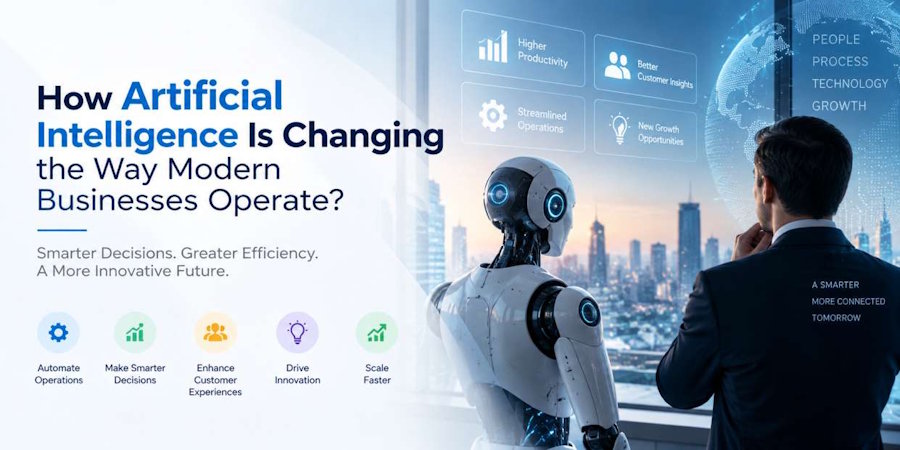
Artificial intelligence is going even deeper into everyday business operations. It is no longer only about experimental chatbot tools or isolated analytics bits. Firms are using AI to enhance customer service, support employees, streamline routine workflows, sift through information, and make faster choices, sometimes all in the same week.
The real change isn’t just more adoption. It’s how businesses are redoing the whole method of work getting done, end to end, with AI acting as part of the process rather than a side project.
AI Is Moving From Tools to Business Processes
Many companies first dipped into AI using separate tools. For instance, a marketing team might use generative AI to craft content, while a developer uses it to help out with code at the same time. The next stage is more connected.
With AI business automation, organizations can tie together AI capabilities with their existing software, databases, workflows, and approval systems. So instead of AI doing one isolated task, it can help across an entire process, end to end.
Enterprise AI Solutions Are Starting to Get More Specialized
One big problem with generic AI tools is that they often do not truly understand a company’s own processes, data, policies, or customers.
This is where enterprise AI solutions start to matter. An enterprise might need an AI setup that works with its internal knowledge base, follows industry regulations, integrates with ERP or CRM systems, and respects role-based access controls. A financial services company, for example, usually has requirements that are much more strict and different than what a retail business would face.
This has increased demand for custom AI development. Instead of asking employees to shape their day-to-day work around a general-purpose tool, companies can build AI systems that fit existing business requirements, like they were planned from the start.
The custom options might involve intelligent document processing, recommendation engines, predictive models, AI assistants, fraud detection systems, knowledge management platforms, and AI-powered customer support.
AI Software Development Is Changing Too
AI is also shifting the way software itself is made. Developers can bring in AI for code generation, testing, documentation, debugging, code review, and ongoing software care and maintenance. In practice, it feels like a real partner, more than just a tool. McKinsey identifies software engineering as one of the business functions where generative AI is being widely deployed. This does not remove the need for skilled developers. Instead, it changes where their time ends up.
Developers can spend less time on repetitive coding tasks and more time on architecture, security, integration, testing, and product decisions that matter. For businesses investing in AI software development, this can help shrink development cycles while opening up more chances for ongoing refinement and continuous improvement.
But just going fast is not the main aim. AI-generated code still needs human review, testing, security checks, and proper governance.
AI Is Creating a New Human-Machine Workflow
The most useful business applications of AI do not necessarily replace people. They distribute work differently.
Employees provide context, make decisions, handle exceptions, and take responsibility for outcomes. Meanwhile, AI can process huge amounts of information, recognize patterns, sketch recommendations, and complete repetitive steps.
This model becomes particularly important as businesses explore AI agents. There is a real chance to figure out which tasks should stay human-led, and which can be nudged along or run by AI, though that line can be blurry initially.
AI Adoption Requires More Than Just Technology
The main mistake companies can make is treating AI implementation like a simple software purchase—buy it, install it, and it's done.
Reliable AI development services must address more than the model itself. They consider data quality, systems integration, security, governance, user adoption, and outcomes measurable for the business, not just technical metrics.
Governance becomes a business issue, not something that sits only inside IT, no matter how tempting it is to hand it off. Companies need clear, usable rules: what data AI systems can access, how outputs are checked, when human approval is required, and how performance is tracked over time, even as things change.
The Business Case Is Moving From Experimentation to Value
The strongest AI strategies focus on specific business problems. Instead of asking, “Where can we use AI?” leaders can ask:
- Which processes consume significant employee time?
- Where do delays affect customers?
- Which decisions require large amounts of data?
- Where do errors create measurable costs?
- Which workflows can be improved without increasing operational complexity?
These questions help organizations select practical AI use cases. AI investment becomes more meaningful when tied to measurable operational outcomes.
Building the Next Generation of Business Operations
Artificial intelligence is becoming an operating layer inside modern businesses. It influences how companies build software, serve customers, handle knowledge, interpret information, and automate internal workflows end to end.
Organizations that keep durable value won’t always be the ones grabbing the highest number of AI tools. More often, it will be those that tie AI into good, dependable processes, reliable data, human insight, and clear business intentions. Not just using AI, but actually making it work.
That’s why custom AI development, AI-driven business automation, and properly designed enterprise AI solutions are starting to look less like short-term novelties and more like strategic capabilities.
For companies looking at AI Software Development Services, the goal should be clear: create AI that solves genuine business problems, matches how people already work, and delivers measurable results.
With experience across custom software and technology solutions, WeblineIndia supports businesses in exploring and implementing practical AI-led digital solutions aligned with their operational needs.

