

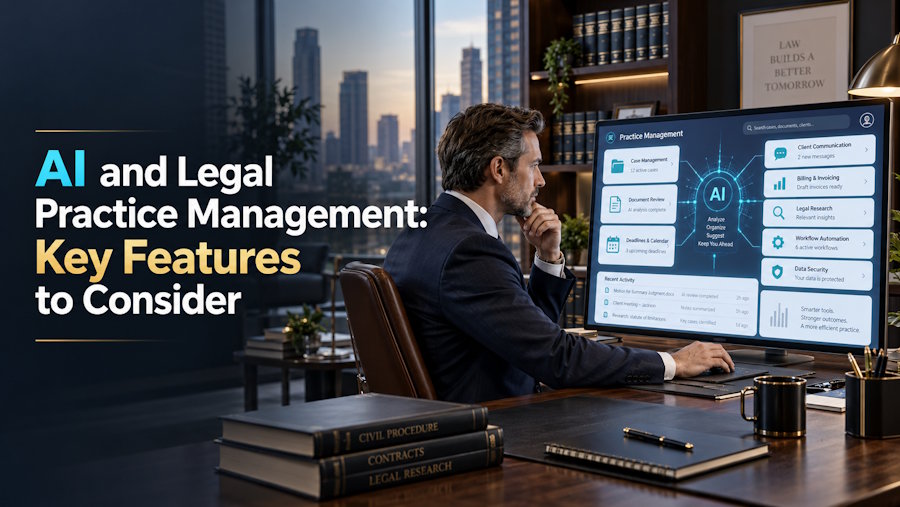
Artificial intelligence has moved from being a futuristic idea to something law firms can realistically use in their day-to-day operations. While legal professionals still need to make the important decisions, AI can take on many of the repetitive tasks that consume valuable time. That includes organizing case information, reviewing documents, tracking deadlines, preparing summaries, and even helping with billing and administrative work.
This shift is particularly interesting for law firms because legal practice management has traditionally depended on a mix of people, spreadsheets, email, shared drives, calendars, and specialized software. As the number of matters grows, keeping all of those moving parts organized becomes increasingly difficult.
AI-powered practice management software aims to bring these activities together while adding another layer of intelligence. Instead of simply storing information, newer platforms can analyze it, identify useful information, and help lawyers decide what needs attention.
But not every platform offering an "AI" feature provides the same value. If a firm is considering adopting AI for practice management, there are several features worth looking at before making a decision.
1. Centralized Matter Management
At its most basic level, legal practice management software should make it easier to understand what is happening across every matter.
A good system provides a central location for case information, contacts, documents, tasks, communications, deadlines, and financial details. This can be especially valuable when attorneys are handling numerous matters simultaneously.
AI can make centralized matter management more useful by turning large amounts of information into something easier to understand. Rather than manually searching through a collection of documents to remind yourself what happened in a case, an AI-enabled system may be able to provide a concise summary of important developments.
The key is that AI should work with the information already contained within the matter rather than existing as a completely separate tool.
2. Intelligent Document Analysis
Lawyers spend a considerable amount of time reading and reviewing documents. Depending on the type of practice, a single matter can involve pleadings, contracts, correspondence, transcripts, medical records, discovery materials, invoices, and other supporting documents.
AI can help make this process more manageable.
Useful document intelligence features might include summarization, information extraction, question answering, document comparison, and the ability to identify relevant passages. Instead of treating every document as something that must be manually searched from beginning to end, AI can help users locate the information that matters.
That does not mean lawyers should blindly rely on automatically generated summaries. Legal documents often contain nuances where a seemingly minor detail can change the interpretation of an issue. AI should therefore be viewed as an assistant for navigating information, not a replacement for professional judgment.
3. Automated Workflows and Tasks
Another feature worth considering is workflow automation.
Many law firm processes follow predictable patterns. A new matter comes in, someone performs a conflict check, documents are collected, tasks are assigned, deadlines are entered, and updates are sent to the appropriate people.
When these steps are handled manually, things can fall through the cracks.
A modern practice management platform can automate portions of these workflows. AI can take this further by recognizing information within documents or communications and helping determine what action should happen next.
For example, software might identify a deadline in a document and prompt the appropriate team member to review it. The goal is not to have software make every decision independently. Rather, it is to reduce the amount of routine coordination that lawyers and legal staff have to perform themselves.
4. Better Time Tracking
Time is one of the most important resources in a law firm, yet it is surprisingly easy to lose track of it.
An attorney may spend twenty minutes reviewing an email, another fifteen minutes discussing a matter with a colleague, and additional time looking through documents. If those activities are not recorded promptly, some billable work may never make it onto the timesheet.
AI can potentially help identify these gaps.
Some legal technology platforms can analyze activity associated with a matter and suggest time entries based on work that appears to have been completed. This can reduce the burden of reconstructing an entire day's activities at the end of the week.
For firms that bill clients based on time, this functionality can have a direct financial impact. It is not simply about convenience. Accurate time capture can help firms understand how much work is actually being performed and where resources are being spent.
5. Billing and Compliance
Billing is another area where automation can make a noticeable difference.
Different clients may have different billing requirements. There can be specific rules regarding billing codes, descriptions, time increments, expenses, or activities that are considered non-billable.
A useful practice management system should make these requirements easier to manage.
AI can assist by identifying potentially problematic entries before an invoice goes out. It can also help review large amounts of billing data more quickly than a person working through every entry manually.
For firms working with insurance carriers, for example, AI-powered insurance defense matter management can connect case activity with timekeeping and billing workflows, helping firms manage both legal work and the administrative requirements surrounding it.
The important point is that billing intelligence should be integrated into the broader practice management system. A standalone billing tool may solve one problem, but a connected platform can provide a more complete picture of the matter.
6. Useful Summaries and Reporting
Partners and firm managers often need to know what is happening across a large collection of matters without reading every case file.
This is where AI-generated summaries and reporting can become particularly useful.
Instead of manually compiling updates, a system could summarize recent developments, outstanding tasks, important dates, financial activity, and other relevant information. That information can then be used to prepare internal reports or communicate updates to clients.
Good reporting should also go beyond attractive dashboards. The real value comes from being able to answer practical questions.
Which matters are taking longer than expected? Where is the firm spending the most time? Which cases have upcoming deadlines? Are certain types of matters consistently exceeding their budgets?
The more effectively software can answer these questions, the more useful it becomes as a management tool.
7. Integrations With Existing Tools
Even the most sophisticated legal software will struggle if it forces a firm to abandon every tool it already uses.
Lawyers commonly rely on email, calendars, document management systems, accounting software, communication platforms, and other applications. Integration should therefore be an important consideration when evaluating a new practice management platform.
A system that works with existing tools can reduce duplicate data entry and make adoption easier.
For example, if emails and calendar activities can be associated with the appropriate matter automatically, attorneys may spend less time manually updating records. Similarly, connecting document storage and billing systems can reduce the need to move information between multiple applications.
8. Security and Access Controls
AI introduces another important consideration: security.
Legal matters can contain highly sensitive information, so firms need to understand how their data is stored, accessed, processed, and protected.
Before adopting an AI-enabled platform, firms should ask practical questions about user permissions, data encryption, access controls, retention policies, audit logs, and how AI systems handle submitted information.
It is also worth considering whether different users should have different levels of access. A partner, associate, paralegal, billing specialist, and external collaborator may not need access to exactly the same information.
Convenience should never come at the expense of appropriate security.
9. Human Oversight
Perhaps the most important feature of AI legal software is not actually a software feature. It is the ability for people to remain in control.
AI can summarize documents, organize information, suggest tasks, and identify patterns. It can make mistakes, however, particularly when dealing with ambiguous language or incomplete information.
Legal professionals should have the ability to review AI-generated outputs, verify important information, and make the final decision.
The best systems are designed around this relationship. AI handles repetitive or information-heavy work while attorneys retain responsibility for legal strategy and judgment.
Finding the Right Balance
AI is unlikely to eliminate the need for traditional legal practice management. Instead, it is changing what these systems can do.
The first generation of practice management software primarily focused on storing information and helping firms keep track of matters. AI adds the possibility of turning that information into useful insights and automated actions.
For law firms considering this technology, the best approach is not necessarily to choose the platform with the longest list of AI features. It is to look at the problems the firm actually faces.
If attorneys lose time searching through documents, document intelligence may be particularly valuable. If deadlines and administrative tasks are difficult to track, workflow automation may offer the biggest benefit. If the firm struggles with missed time or billing requirements, intelligent timekeeping and billing features may deserve greater attention.
Ultimately, effective AI in legal practice management should make the work around practicing law simpler, not more complicated. The technology should reduce administrative friction, make information easier to access, and give legal professionals a clearer view of their matters.
That is where AI has the most practical potential: not replacing lawyers, but giving them better tools to spend less time managing information and more time using their expertise.

