

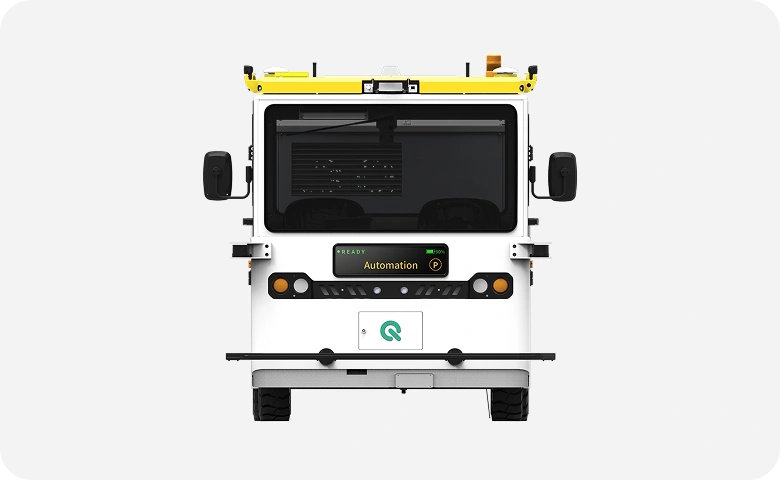
Autonomous vehicles are becoming increasingly common in ports, airports, logistics parks, and industrial facilities. Yet deploying an autonomous cargo tractor is very different from testing one vehicle on a controlled route.
A pilot can demonstrate that a vehicle can navigate, transport cargo, and complete predefined tasks without a driver. Scaling that technology across a busy cargo environment is a much larger challenge. Roads, digital infrastructure, fleet coordination, charging systems, safety procedures, and human workflows all have to work together.
This is why successful autonomous transportation is not simply a vehicle technology problem. It is an infrastructure and operational challenge.
Key Takeaways
- Scaling autonomous cargo tractors requires both physical and digital infrastructure.
- Mixed traffic and dynamic cargo flows make fleet coordination critical.
- A successful pilot proves technical feasibility, while large-scale deployment requires operational readiness.
Why Scaling Autonomous Cargo Tractors Is Different From Running a Pilot
An autonomous cargo tractor may perform extremely well when operating on a fixed route with predictable traffic. But real cargo hubs rarely remain predictable for long.
As fleet size increases, vehicles must share roads, loading areas, intersections, and transfer points. At the same time, human-driven trucks, workers, cargo-handling equipment, and unexpected obstacles may occupy the same operating environment.
A single autonomous vehicle can often be managed with relatively simple rules. A fleet requires something more sophisticated.
The system needs to determine which vehicle should handle each task, which route is most efficient, how vehicles should respond to congestion, and how priorities should change when cargo schedules shift.
This creates an important distinction:
A successful pilot proves that autonomy works. A successful deployment proves that autonomy can scale.
What Infrastructure Does an Autonomous Cargo Tractor Need?
The vehicle itself is only one part of the deployment.
Physical infrastructure is the first consideration. Roads and operating areas need to be suitable for autonomous movement, with clearly defined routes, traffic zones, loading areas, and safety boundaries. The more complex the environment, the more important predictable traffic patterns become.
Digital infrastructure is equally important. Autonomous cargo tractors depend on accurate positioning, mapping, communication, route planning, and fleet management. Without reliable operational data, even a capable autonomous vehicle may make inefficient decisions.
This becomes especially important when multiple vehicles are operating simultaneously. The system needs to understand not only where each vehicle is, but also what each vehicle is doing and what is happening around it.
That is why large-scale autonomy increasingly depends on an integrated fleet management and orchestration layer rather than treating each vehicle as an independent machine.
Can Autonomous Cargo Tractors Operate in Mixed Traffic?

One of the biggest misconceptions about autonomous transportation is that vehicles need a completely autonomous environment to operate successfully.
In reality, many commercial cargo facilities are mixed environments.
Autonomous vehicles may operate alongside conventional trucks, forklifts, workers, and other equipment. Completely separating these activities may not always be practical, particularly during the transition from manual operations to automation.
The challenge is therefore to make autonomous vehicles predictable and responsive within a shared environment.
An autonomous cargo tractor needs to recognize changing traffic conditions, respect operational boundaries, and respond appropriately when its planned route is disrupted.
This makes infrastructure design and traffic management just as important as the autonomous driving technology itself.
The real test of autonomy is not whether a vehicle can operate alone. It is whether it can operate reliably around everything else.
Charging and Uptime Become More Important at Scale
Energy management is another issue that becomes significantly more complicated as fleet size grows.
Charging one electric autonomous vehicle is relatively straightforward. Managing the energy requirements of dozens of vehicles operating continuously is a different problem.
If several vehicles need charging at the same time, charging capacity can become a bottleneck. Vehicles may need to leave service during peak operating periods, reducing fleet availability and potentially creating additional scheduling pressure.
For this reason, some autonomous cargo operations are exploring automated battery-swapping systems as an alternative or complement to conventional charging.
Commercial deployments such as Westwell's Q-Truck demonstrate how autonomous transportation can be combined with automated energy management and fleet coordination. The company has deployed autonomous terminal tractors in multiple cargo environments, including port operations where large fleets must operate continuously and alongside existing transportation equipment.
The broader lesson is that energy infrastructure should be considered as part of the automation strategy from the beginning rather than added after the vehicle fleet has already been selected.
Safety Is an Infrastructure Issue
Safety is often discussed as a feature of autonomous vehicles, but large-scale deployment requires a much broader approach.
Sensors and perception systems are essential, but they are only part of the safety equation. The surrounding environment also needs clearly defined operating rules.
A cargo terminal may require designated autonomous zones, speed restrictions, pedestrian management, emergency procedures, remote intervention capabilities, and clearly defined responses to unexpected events.
This becomes increasingly important as autonomous and manually operated vehicles share the same space.
Safety should therefore be designed at three levels: the vehicle, the operating environment, and the overall fleet.
A technically capable vehicle cannot compensate for an unstructured operating environment.
What Changes When the Fleet Grows?
The difference between a small pilot and a large deployment can be summarized simply:
| Pilot Deployment | Scaled Deployment |
|---|---|
| Few vehicles | Large autonomous fleet |
| Fixed routes | Dynamic routing |
| Limited traffic | Mixed traffic |
| Manual supervision | Fleet orchestration |
| Simple charging needs | Coordinated energy management |
| Few exceptions | Continuous exception handling |
At scale, coordination becomes the central issue.
When five vehicles operate in a controlled area, an operator may be able to resolve problems manually. When dozens of autonomous cargo tractors are moving continuously, manual intervention becomes increasingly difficult and expensive.
The system must be able to coordinate movements automatically while giving human operators visibility and control when exceptions occur.
This is where intelligent automation begins to differ from simple vehicle automation.
What Real-World Deployments Reveal
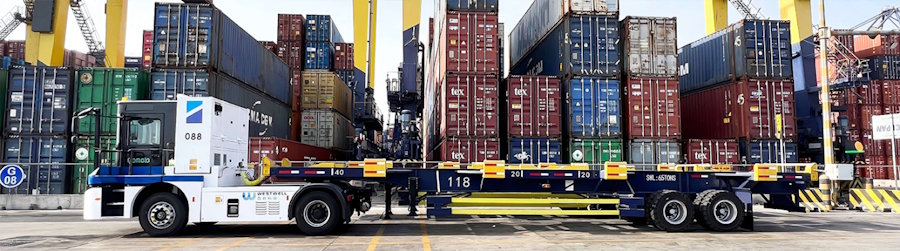
Commercial deployments provide an important lesson: autonomous cargo transportation is becoming a system-level challenge.
Westwell's Q-Truck autonomous terminal tractor has been deployed in several international cargo environments, including projects associated with Felixstowe and Laem Chabang. The company's published materials describe a Felixstowe deployment involving a planned fleet of 100 battery-powered autonomous vehicles.
Projects at this scale demonstrate that autonomous transportation cannot be treated as a simple vehicle replacement program. Fleet management, infrastructure, energy availability, traffic coordination, and operational processes all become interconnected.
The more vehicles an operation adds, the more important that coordination becomes.
How Should Companies Prepare for Autonomous Cargo Tractor Deployment?
Companies considering autonomous cargo tractors should start with the operating environment rather than the vehicle.
The first step is to understand how cargo currently moves through the facility. Where does congestion occur? Where do vehicles wait? Which routes are shared with human-driven equipment? Where are the most frequent handoffs?
Once these constraints are understood, operators can determine whether their physical infrastructure, digital systems, and operational processes are ready for autonomous transportation.
The goal should not be to automate every movement immediately.
A better approach is to identify the routes and processes where autonomous transportation can deliver measurable improvements, establish a controlled operating environment, and then expand the fleet as the supporting infrastructure matures.
This reduces the risk of treating autonomy as a standalone technology purchase.
The Future of Autonomous Cargo Transportation Is System-Level
The future of autonomous cargo transportation will not be determined simply by how capable an autonomous cargo tractor becomes.
The bigger question is whether the infrastructure around that vehicle can support continuous, coordinated operation.
Physical roads, digital maps, fleet management, energy systems, safety procedures, and human workflows all contribute to the final result.
That is why autonomy should be viewed as an operational architecture rather than a vehicle feature.
A single autonomous cargo tractor can demonstrate what the technology can do. A coordinated fleet demonstrates what the entire logistics system can achieve.
Frequently Asked Questions
What is an autonomous cargo tractor?
An autonomous cargo tractor is a specialized vehicle designed to transport trailers, containers, or other cargo within controlled or semi-controlled environments with limited or no direct human driving.
Where are autonomous cargo tractors commonly used?
They are commonly used in ports, container terminals, airports, logistics parks, warehouses, and industrial facilities where cargo needs to be transported repeatedly between defined operational areas.
What infrastructure is required for autonomous cargo tractors?
Deployment typically requires suitable roadways, digital mapping and positioning, reliable communications, fleet management, defined operating zones, safety procedures, and appropriate charging or battery-management infrastructure.
Can autonomous cargo tractors operate alongside human-driven vehicles?
Yes. Many commercial environments use mixed traffic. However, successful deployment requires effective traffic coordination, clearly defined operating rules, and autonomous systems capable of responding to changing conditions.
What is the biggest challenge when deploying autonomous cargo tractors at scale?
The biggest challenge is usually not the vehicle itself but coordinating the entire operating environment. As fleet size increases, traffic, scheduling, energy management, safety, and system integration become increasingly interconnected.
Conclusion
Deploying autonomous cargo tractors at scale requires more than proving that a vehicle can drive without a human operator. It requires an environment where vehicles, infrastructure, software, energy systems, and people can work together reliably.
For cargo operators, the most important question is therefore not simply whether an autonomous cargo tractor is technically capable. It is whether the surrounding operation is ready to support autonomy.
As the industry moves from small pilots toward larger commercial fleets, the organizations that treat autonomy as a system-wide transformation—not simply a vehicle upgrade—will be better positioned to achieve consistent efficiency, scalability, and long-term value.
Website: www.en.westwell-lab.com
Westwell: https://en.westwell-lab.com/about
Email: [email protected]

