

Online stores have become very good at recommending products. Search for a laptop, camera, or exercise bike and algorithms quickly produce ranked lists, sponsored options, and “customers also bought” suggestions.
These systems help people discover products, but discovery is only the beginning. A shopper still has to decide whether an item fits a particular space, works with existing devices, suits a daily routine, and justifies its long-term cost. That creates a gap between product discovery and product understanding, one that recommendation systems alone do not solve.
The next generation of AI shopping tools should do more than recommend. It should explain.
A ranking cannot understand every situation
Recommendation systems often rely on popularity, purchase history, similarity, price, and engagement. These signals can identify products that many people considered attractive. They do not prove that a product suits one person's needs.
A popular robot vacuum may struggle with the buyer's floor type. A highly rated monitor may lack the port required by an older laptop. A compact exercise bike may still be too large for the intended storage space.
Rankings answer, “What do people often choose?” Shoppers also need an answer to, “What will this product mean for me?”
Specifications need interpretation
Product pages provide measurements, materials, power ratings, compatibility lists, and performance claims. These facts become useful only when connected to everyday consequences.
A battery capacity should lead to questions about expected runtime and charging frequency. Dimensions should be compared with the available space. A noise rating matters differently in a shared apartment and a private workshop. A return policy matters more when comfort or fit cannot be tested before delivery.
The explanation does not need to be long. It needs to connect the documented detail with a relevant concern.
Personalization should prioritize facts, not alter them
AI can make product research more relevant by asking for a small amount of context: intended use, available space, existing equipment, frequency of use, or maintenance tolerance.
That context should change which facts receive attention. It must not change the facts themselves.
For example, storage dimensions may be central for an apartment resident and minor for someone with a garage. The dimensions remain identical. Only their importance changes.
This distinction keeps personalization useful without turning it into persuasion. The system adapts the explanation, not the evidence.
Show the basis for each takeaway
AI-generated advice often sounds confident, even when the supporting information is incomplete. A trustworthy shopping tool should keep conclusions tied to the source material.
If a product page documents a measurement, the tool may translate it into a familiar size comparison. It should still show the original measurement. If a page states compatibility with one operating system but says nothing about another, the tool should not silently expand the claim.
This approach lets users separate three things:
- what the seller explicitly states;
- what can reasonably be concluded;
- what still needs verification.
Clear evidence is more valuable than confident wording.
Missing information can be a useful result
A product page may advertise app control without explaining whether the device works offline. It may list battery capacity without realistic runtime. It may mention returns without stating restocking fees or return-shipping costs.
In an AI system, an unanswered field should be treated differently from a negative answer. It should identify them and turn them into practical questions.
This protects shoppers from assuming that a common feature is present when the seller has not documented it. It also makes research faster: the user knows exactly what to check in a manual, policy page, or support conversation.
Product categories need different forms of guidance
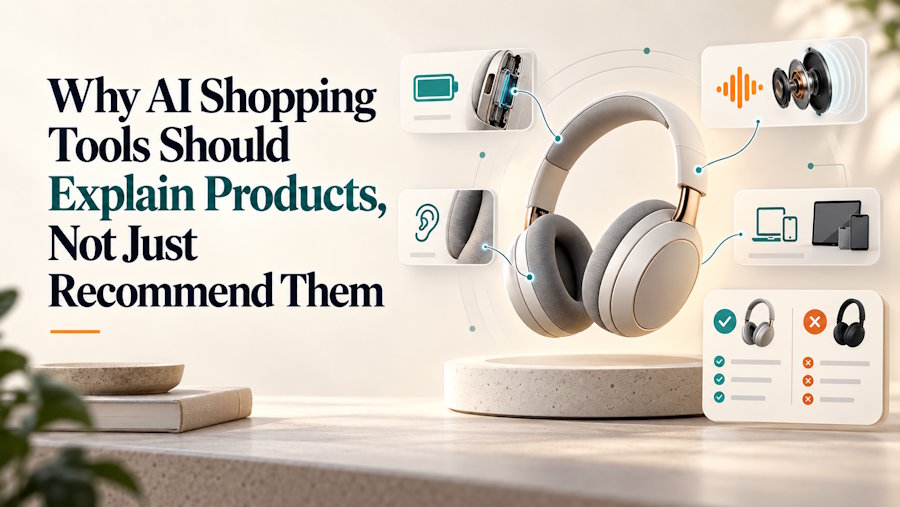
Every category has its own decision points. Headphones raise questions about comfort, microphone quality, battery life, and device switching. Air purifiers involve room coverage, filter cost, noise, and maintenance. Furniture requires attention to dimensions, assembly, materials, and return logistics.
A generic summary may repeat the most visible features. AI shopping tools can instead organize page evidence around the concerns most likely to affect real use.
That difference is important. A shorter product description saves reading time; a relevant explanation improves the decision.
Good explanations preserve trade-offs
Products rarely improve in every dimension at once. A larger battery may provide longer runtime but add weight. More powerful hardware may be faster but produce more heat or noise. A compact design may save space while limiting capacity.
Recommendation systems often compress these tensions into a score. Explanations should preserve them. The right product depends on which benefit the shopper values and which compromise they can accept.
AI should not pretend to find a universal winner. It should make the trade-offs easier to compare.
A practical way to research any product
Shoppers can apply the same method with or without an AI tool:
- Describe the intended use in one sentence.
- List the main concerns that could affect daily experience.
- Find product-page evidence for each concern.
- Translate every important detail into a practical consequence.
- Record missing information as questions to verify.
- Compare products using the same concerns.
This workflow reduces the influence of impressive but irrelevant features. It also gives the buyer a clear reason for choosing one option over another.
Better decisions, not more persuasion
Ecommerce already has enough systems designed to increase clicks. Shopping AI can serve a more valuable role by helping people understand what they are considering.
Recommendations are useful for narrowing the market. Explanations help shoppers make the final judgment. The strongest tools combine both while keeping evidence visible, uncertainty honest, and the buyer's real situation at the center.
The goal is not to tell everyone what to buy. It is to help each person understand why a product may—or may not—fit their life.

