


Your website works every hour of every day. It answers questions, builds trust, and shapes first impressions. It also decides whether a new visitor stays or leaves within seconds. Still, many owners only look closely at their site when something breaks.
That habit quietly costs money. A slow page, a broken form, or a confusing menu sends buyers straight to a competitor. Because of that risk, businesses across Alberta now treat their website as core infrastructure rather than a simple online brochure.
So how do you know when small fixes are no longer enough? Fortunately, the warning signs are easy to spot once you know where to look. Below you will find five clear signals that point toward hiring a professional Calgary web development service. Each sign explains what to check, why it matters, and how an experienced team usually solves it.
Use this guide as a checklist. Read each section, test your own site, and note what you find. By the end, you will know whether you need a small repair or a proper rebuild.
Why Your Website Deserves Real Attention
Buying habits have changed. People research online first, compare three or four options, and then contact only the businesses that feel credible. In many local industries, the website carries that entire first impression alone.
Search engines reward the same qualities that customers value. Speed, clarity, mobile comfort, and secure connections all influence rankings. Therefore, technical quality and marketing results are now tied together. A qualified Calgary web development service understands that overlap and plans for it from the start.
A skilled Calgary web development service looks at both sides. First, they measure how the site performs. Next, they connect those numbers to real business outcomes such as calls, form fills, bookings, and orders. That combined view separates guesswork from strategy.
Sign 1: Your Pages Load Too Slowly
Speed is the easiest problem to measure and the most expensive one to ignore. Research across the industry consistently shows that visitors abandon pages that take longer than three seconds. Mobile users leave even faster.
Run a simple test. Open your homepage on a phone using mobile data instead of Wi-Fi. Then count the seconds until you can read the headline and tap a button. If that takes more than a few seconds, you already have a measurable leak.
Common causes appear again and again. Oversized images slow everything down. Bloated themes load code that your site never uses. Too many plugins fight for the same resources. Cheap shared hosting adds delay on top of all that.
A professional Calgary web development service treats speed as an engineering task, not a plugin purchase. Developers compress and resize images, remove unused scripts, enable proper caching, and move heavy files to a content delivery network. In addition, they retest each change so that improvements stay visible in real numbers.
The payoff shows up quickly. Faster pages keep more visitors, lift conversion rates, and support better search visibility. Above all, speed improves how your brand feels to a stranger.
Sign 2: Your Site Struggles on Mobile Devices
Most local searches now happen on phones. Someone standing in a parking lot may look for your hours, your prices, or your phone number. If your layout fights them, they simply leave.
Check the basics yourself. Are buttons large enough for a thumb? Does text stay readable without zooming? Do menus open smoothly? Does a form fit the screen? Meanwhile, watch for elements that overlap or scroll sideways, because both signal deeper layout problems.
Many older sites were built for desktop screens first. A responsive layer was then added later as a patch. As a result, the mobile version often looks squeezed rather than designed.
Professional responsive web design solves this differently. Developers plan the smallest screen first and then expand outward. Consequently, navigation stays simple, tap targets stay generous, and images adapt to each device.
Accessibility improves at the same time. Clear contrast, sensible heading order, and keyboard-friendly menus help every visitor, including people using screen readers. A dependable Calgary web development service builds these standards into the code instead of bolting them on afterwards.
Local search results depend on the same work. Google now judges pages largely through mobile performance data. Therefore, a weak phone experience limits visibility even when your content is genuinely useful.
Sign 3: Traffic Arrives, but Enquiries Stay Flat
This sign frustrates owners the most. Analytics show steady visits, yet the phone stays quiet. Usually, the problem sits in structure rather than volume.
Look for friction. Does each page state one clear next step? Can a visitor find pricing guidance, service areas, or proof of past work in a single click? Do your contact forms actually deliver messages to the right inbox? Broken forms are surprisingly common, and they hide in plain sight for months.
Trust signals matter just as much. Real photos, named testimonials, service details, and honest timelines all reduce hesitation. Meanwhile, stock images and vague claims raise doubt.
An experienced web development company in Calgary approaches this as a conversion problem. First, the team maps the journey from search query to enquiry. Then it tests headlines, page order, form length, and calls to action. Finally, it tracks each result so that decisions rest on evidence instead of opinion.
Custom website development helps here because templates rarely match a real sales process. When the structure follows how your customers actually decide, the same traffic starts producing better leads. For that reason, a good Calgary web development service starts with your sales process rather than a design gallery.
Sign 4: You Cannot Update Your Own Content
Content should never depend on a developer's schedule. Yet many owners wait days to change a price, publish a job opening, or post a seasonal notice. That delay makes the whole website feel stale.
Ask a practical question. Could a member of your team add a blog post, swap a photo, or edit a service page this afternoon without help? If the honest answer is no, your content management setup is holding the business back.
Sometimes the platform is fine but the training never happens. Other times the site was built with hard-coded pages that only a coder can touch. Either way, the fix belongs to a professional.
A capable Calgary web development service builds a clean editing experience. Developers create clear content blocks, sensible field labels, and safe permissions for each user. Furthermore, they document the process and train your staff, so ownership stays inside your company.
Independence pays off over time. Teams that publish freely keep their pages fresh, answer customer questions faster, and build search authority month after month. In short, a well-built Calgary web development service handover turns your website into a tool your staff can actually use.
Sign 5: Security Warnings and Ageing Technology
Security problems rarely announce themselves politely. Instead, browsers show a "not secure" label, forms stop working, or a plugin update quietly breaks a page. Sometimes a spam script appears in your footer before anyone notices.
Watch for these red flags. Missing or expired SSL certificates. Software versions that no longer receive updates. No visible backup routine. No staging site, which forces every change to happen live in front of customers.
Older platforms create another hidden cost. As technology moves forward, unsupported code blocks new integrations such as online booking, payments, or ecommerce web development. Growth then stalls for technical reasons rather than commercial ones.
Professional teams manage risk in layers. They install valid certificates, apply updates on a schedule, run automated backups, and use a staging environment for testing. In addition, they monitor uptime and review error logs, which catches small faults before customers ever see them.
Recovery planning matters too. Ask any prospective Calgary web development service how quickly it can restore your site after a failure. A clear answer, measured in hours rather than days, signals genuine experience.
The Real Cost of Waiting
Delay feels cheap because nothing appears to break. However, the losses accumulate quietly. Every slow page turns away a share of visitors. Every broken form loses an enquiry that never reaches your inbox.
Consider a simple example. Imagine 1,000 visitors each month and a two percent conversion rate. That equals twenty enquiries. Lift the rate to three percent through better speed and structure, and you gain ten more enquiries from the same traffic. Nothing else changed except the quality of the build.
Competitive pressure adds urgency. Local competitors invest steadily in content, speed, and user experience. Consequently, sites that stand still tend to slide down the results page, and recovery usually takes longer than prevention.
What a Professional Calgary Web Development Service Delivers
Strong development follows a clear sequence. A discovery phase captures your goals, audience, and competitors. Wireframes and prototypes then confirm structure before design begins. Coding, testing, and launch follow, and support continues afterwards.
Documentation is part of the job. A reliable web development service in Calgary hands over access credentials, a plugin or dependency list, hosting details, and a plain-language handover guide. Because of that paperwork, you keep control even if partners change later.
Measurement completes the loop. Reliable analytics, event tracking, and search console data reveal what visitors actually do. A professional website design partner reviews those numbers with you and recommends the next improvement based on evidence.
Questions Worth Asking Before You Hire
A short interview reveals a great deal. Use these questions during your first conversation.
- Which speed and conversion metrics will you report, and how often?
- Can you show recent projects in industries similar to mine?
- Who owns the code, the domain, and the hosting account after launch?
- How do you handle updates, backups, and emergency fixes?
- What training and documentation come with the handover?
Listen for specifics rather than slogans. Experienced providers of Calgary web design services answer with numbers, timelines, and examples. Vague replies usually predict vague results.
Contracts deserve the same attention. Confirm the scope, revision rounds, payment stages, and support terms in writing. A trustworthy Calgary web development service will welcome that clarity because it protects both sides.
Bringing It All Together
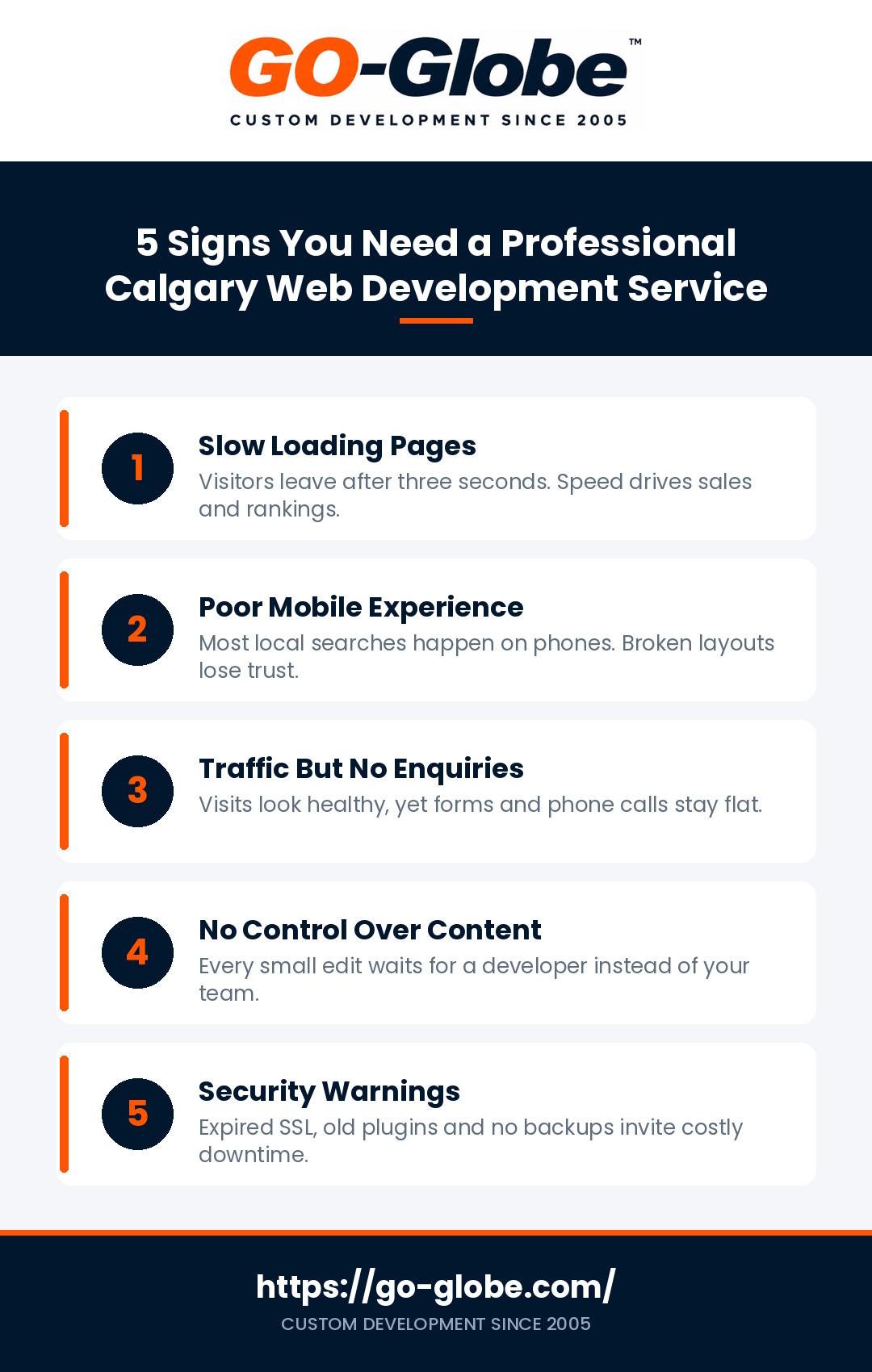
Review the five signs honestly. Slow pages, a weak mobile experience, flat enquiries, locked content, and security warnings all point in the same direction. One sign suggests maintenance. Two or three together suggest that your platform has outgrown its original build.
Start with a simple audit. Test your site on a phone, time the load, submit your own contact form, and check when the software was last updated. Those four checks take less than an hour, yet they usually expose the biggest gaps.
After that, prioritise by impact rather than preference. Fix anything that blocks a sale first. Improve speed and mobile comfort next. Then rebuild structure and content control so the site can grow with the business.
Choosing the right partner remains the most important decision. Look for clear communication, transparent scopes, measurable goals, and full ownership of your assets. A dependable Calgary web development service will explain trade-offs plainly and show its reasoning at every stage. Teams such as GO-Globe, with two decades of custom development experience across international markets, illustrate the standard worth expecting: work that is documented, tested, and built to serve your business long after launch day.

