

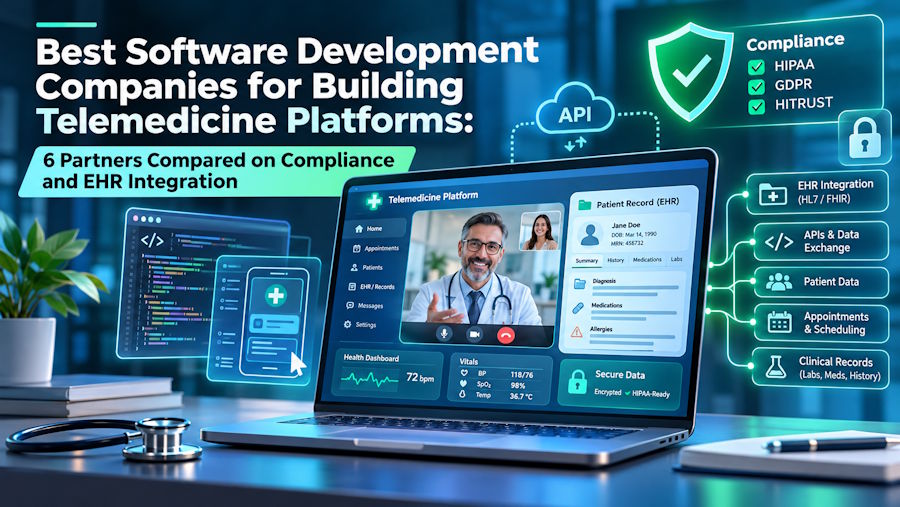
Video visits are now a routine part of care, used for follow-ups, prescription renewals, and therapy sessions. For patients, the experience looks simple. They open a link and see their doctor.
Behind that link, the platform has to keep the call stable on a weak connection and protect patient data under privacy laws. It also has to connect to the clinic’s existing records system. Each of these parts takes healthcare engineering experience to get right. As a result, the development partner you choose affects both platform quality and launch speed.
This article compares six software development companies that build telemedicine platforms.
Key Takeaways
- Dreamix builds custom telemedicine platforms that clients fully own, with a first production release in 12–24 weeks. A clinical AI accelerator cuts development time by 30–40%.
- ScienceSoft builds specialty telehealth apps with connected devices under an ISO 13485-certified quality management system.
- Itransition fits health systems that need telehealth inside a wider enterprise setup, including Microsoft Cloud for Healthcare. Compliance coverage spans US, Canadian, and EU privacy laws.
- Mindbowser delivers EHR-connected telehealth MVPs in 12 weeks with pre-built components. The company’s security controls went through a SOC 2 Type II audit.
- Arkenea works only in healthcare and builds live and asynchronous care into one product, for programs such as GLP-1 weight management.
- Empeek focuses on behavioral health platforms and on modernizing existing telehealth systems.
What a Telemedicine Platform Needs
A telemedicine platform needs the following components:
- Real-time video: Video calls have to stay stable on weak connections. The platform runs a device check before each call and switches to audio when the connection drops, so the visit continues. The video layer runs on WebRTC, the open standard for real-time video in browsers and mobile apps.
- EHR integration: The platform sends visit notes and prescriptions straight into the clinic’s electronic health record (EHR) system. These integrations use HL7 and FHIR, the standards healthcare systems use to exchange patient records.
- Compliance and security: Encryption, role-based access, and audit logs keep patient data in line with HIPAA in the US and GDPR in the EU.
- Scheduling and e-prescribing: The platform handles appointment booking with automatic reminders. It also sends doctors’ prescriptions directly to pharmacies.
- Remote patient monitoring (RPM): The platform collects readings from connected devices such as blood pressure monitors and glucose meters, so the care team can track patients between visits.
- Scalability: The platform has to handle more patients and more simultaneous calls without slowing down.
- AI triage and clinical notes: AI triage directs patients to the right type of care before a visit. AI documentation drafts clinical notes from the consultation, so doctors spend less time on paperwork.
How We Picked the Companies
We reviewed each company’s service pages and published case studies against four criteria:
- Healthcare portfolio: The company runs a dedicated healthcare practice.
- Telehealth projects: The company has delivered telemedicine, virtual care, or remote monitoring products for clients.
- Compliance: The company builds to HIPAA, GDPR, and related standards, and holds relevant certifications. For AI features, we also checked how the company controls model access to patient data. HIPAA-compliant AI applications[a] need the same encryption, access controls, and audit logs as the rest of the platform.
- Long-term support: The company maintains and extends platforms after launch, because regulations and connected systems keep changing.
1. Dreamix
Dreamix[b], a custom software development company with 20+ years of experience, offers a dedicated digital health service line. Its teams build custom telemedicine platforms that fit into clients’ existing healthcare infrastructure.
The company builds HIPAA and GDPR compliance into the architecture and assesses EU MDR applicability early in the process. Clients retain full ownership of the code and IP.
Synechron, a global IT consulting firm, acquired Dreamix in 2024. Clients now have access to Synechron’s global delivery capacity while working with the same Dreamix teams.
What do Dreamix’s telemedicine software development services include?
Dreamix builds custom telemedicine platforms, patient apps, clinician portals, and healthcare marketplaces, from the first prototype through scaling and maintenance.
The digital health offering covers:
- Personal health records;
- Wearable data integration;
- EHR and laboratory system integrations through HL7 and FHIR;
- Medical imaging integrations through DICOM;
- AI for clinical documentation and decision support;
- AI-assisted patient triage;
- Enterprise hardening with audit trails and multi-tenancy.
For clinical AI features, Dreamix’s Medical AI Decision Software accelerator can cut development time by 30–40%. Its components have already been proven in live clinic environments.
Notable projects:
- StoryMD: Dreamix built a unified personal health platform for the US digital health company, with a Personal Health Portfolio that combines clinical and wearable data. The team integrated third-party systems and 4,000+ health journals and ensured HL7 compliance.
- Pryv: Dreamix developed a white-label communication module with a health data middleware company. It’s designed for clinics and medical device makers to add secure doctor-patient communication to their telemedicine products.
2. ScienceSoft
ScienceSoft’s portfolio includes 150+ healthcare IT projects. The company’s quality management system is ISO 13485-certified for medical software development, and its security management system is ISO 27001-certified. HIMSS-certified regulatory consultants on the team support compliance with HIPAA, GDPR, FDA, and EU MDR requirements. US clients receive a signed Business Associate Agreement (BAA).
What do ScienceSoft’s telemedicine software development services include?
ScienceSoft builds custom telehealth apps for primary care, chronic disease management, mental health, stroke care, nursing, rehabilitation, and rural care.
The telehealth offering covers:
- Scheduling, virtual waiting rooms, video calls, and secure messaging;
- E-prescribing and payments;
- AI chatbots that help patients find the right doctor;
- RPM with connected devices;
- Provider-to-provider consultation platforms;
- EHR, lab, imaging, and pharmacy integrations;
- Ongoing support and modernization of existing telehealth software.
Notable projects:
- MindCare Solutions: ScienceSoft built an Azure-based, HIPAA-compliant provider-to-provider telehealth platform for a behavioral health provider. The solution consolidates care coordination workflows and is expected to reduce manual coordination time by up to 40%.
- Mental health startup: ScienceSoft delivered an iOS telemedicine minimum viable product (MVP) in four months. The app lets patients book sessions and communicate with their therapist.
- US healthcare IT provider: ScienceSoft developed a microservices-based telehealth solution that includes a web platform and two native mobile apps with secure patient-doctor communication, document management, pharmacy integration, and role-based access. The pharmacy integration uses HL7 standards to update patient medication lists.
3. Itransition
Itransition has more than 25 years of software development experience and runs an internal Healthcare Center of Excellence. The company’s telehealth solutions comply with HIPAA, GDPR, CCPA, PIPEDA, and NIST security guidelines. The team follows the OWASP and IEC 62443 security frameworks.
What do Itransition’s telemedicine software development services include?
Itransition develops custom telehealth apps for primary care, pediatrics, dermatology, neurology, and behavioral health.
The service scope covers:
- Video and audio consultations, scheduling, virtual waiting rooms, and e-prescriptions with refills;
- Secure chat and store-and-forward messaging;
- Wearable-based condition monitoring with alerts;
- Payment and insurance integrations and medical billing;
- Integrations with EHRs, patient portals, and analytics tools;
- AI-assisted symptom triage and documentation;
- Microsoft Cloud for Healthcare implementation for practices that use Teams;
- Rework of legacy telemedicine software.
Notable projects:
- Psychiatric telehealth solution: A HIPAA-compliant app for psychiatric case processing, remote mental health assessments, treatment recommendations, and inpatient placement coordination, which reduced patient travel distance by 40%.
- US research center: A telemedicine app, web portal, and RPM suite that supports care for sexual assault victims in underserved and rural communities, with 3x faster case creation.
- Wellness platform: A HIPAA-aligned, telehealth-enabled software-as-a-service platform with mobile apps that connects 700+ lifestyle, nutrition, and fitness specialists with more than 100,000 registered users.
4. Mindbowser
Mindbowser is a healthtech consulting and engineering company with 200+ HIPAA- and FHIR-trained professionals and over 250 completed projects. The company’s security controls went through a SOC 2 Type II audit, and builds are HIPAA-ready and GDPR-aligned. Clients own 100% of the IP and code.
What do Mindbowser’s telemedicine software development services include?
Mindbowser builds custom telemedicine apps for providers, primary care clinics, payors, and startups, with dedicated solutions for mental health, pediatrics, urgent care, nursing, physical therapy, and neurology.
Services cover:
- Video consultations, scheduling, and secure messaging;
- Online appointment scheduling;
- E-prescriptions and billing;
- RPM with wearables such as Dexcom and Fitbit;
- EHR integration with Epic and Oracle Cerner through HL7 and FHIR;
- SMART on FHIR apps that run inside the EHR;
- AI agents for telehealth visit preparation and RPM check-ins;
- AI-driven insurance verification.
Pre-built components let the team deliver an MVP in 12 weeks.
Notable projects:
- doxy.me: Bug fixes, a tech stack update, and new teleconsent, push notification, and deep linking features that helped the US telemedicine platform launch its next version in 21 days.
- Virtual fertility counseling clinic: A HIPAA-compliant platform for home-based fertility care, taken from concept to an investor-ready product within the agreed timeline and budget.
- RecoveryPlus.Health: A mobile app for remote cardiac rehabilitation that tracks heart rate during home exercise, so patients stay within their target zones.
5. Arkenea
Arkenea has worked only on healthcare software since 2011, and telemedicine was one of its first product categories. Every engagement includes a signed BAA and threat modeling during architecture design. Penetration testing and a HIPAA compliance audit come before each launch. Video calls run on WebRTC with adaptive bitrate streaming. Calls in high-acuity workflows can fall back to audio and keep the doctor’s notes and timestamps. Clients own the patient data and the custom source code.
What do Arkenea’s telemedicine software development services include?
Arkenea builds synchronous and asynchronous telemedicine apps for telehealth startups, hospitals and health systems, and specialty practices, as standalone products or as part of larger platforms.
Core capabilities include:
- Video visits, scheduling and reminders, virtual waiting rooms, and secure messaging;
- E-prescribing, including controlled substances;
- Telemonitoring with wearables;
- Billing and subscriptions;
- Integrations with Epic, Cerner, Allscripts, lab systems, pharmacy networks, and insurance eligibility services;
- AI for clinical documentation and vital-sign anomaly detection;
- Drug interaction checks for prescriptions.
Arkenea plans 4 to 6 months for an MVP with core consultation and scheduling features.
Notable projects:
- Cumberland Family Medical Center: A HIPAA-compliant urgent care telehealth app that connects patients, front desk staff, providers, and administrators in one workflow, with a React Native patient app and a web app for clinical teams.
- United Medical Group: A web-based telemedicine app with on-demand and scheduled visits across specialties from cardiology to behavioral health, which helped the group scale its multi-practice setup with physician contractors.
- Feelya: A re-architected teletherapy app with a redesigned booking flow, which increased client and therapist registrations and revenue.
6. Empeek
Empeek is a remote-first healthcare software development company founded in 2015, with 250+ developers. The company holds ISO 9001:2015 certification for quality management and ISO/IEC 27001:2022 certification for information security. Telemedicine projects follow HIPAA, HITECH, and GDPR requirements.
What do Empeek’s telemedicine software development services include?
Empeek builds custom telemedicine platforms for clinics, hospitals, telemedicine companies, and healthtech startups.
The offering covers:
- Video and voice consultations;
- Secure messaging and file sharing;
- Scheduling and provider directories;
- Patient education hubs;
- E-prescriptions and payment gateways;
- Automatic insurance verification;
- EHR integration;
- Telemonitoring with connected devices;
- Admin dashboards and analytics;
- Modernization of legacy telehealth systems.
Notable projects:
- Revive Telehealth: Modernization of a 24/7 psychiatric consultation platform, including a code and infrastructure audit, frontend and backend restructuring, multi-factor authentication, and a migration from Oracle to AWS.
- US hospital: A HIPAA-compliant EHR with a built-in telemedicine module that replaced seven-year-old desktop software, with real-time monitoring of a dozen vitals and multi-language appointment notifications.
- VelloHealth: A HIPAA-compliant collaboration platform for community mental health teams that replaced paper records and texting with mobile workflows and integration with electronic medical records.
Telemedicine Development Companies Compared
The six companies differ in telehealth focus and in the compliance frameworks they follow.
| Company | Telehealth focus | Compliance | Best for |
|---|---|---|---|
| 1. Dreamix | Custom telemedicine platforms, patient apps, clinician portals, clinical AI accelerators | Builds to HIPAA, GDPR, GxP; EU MDR scoping | Owned custom products with a first release in 12–24 weeks |
| 2. ScienceSoft | Specialty telehealth, RPM, provider-to-provider platforms | ISO 13485, ISO 27001, HIPAA, GDPR, FDA, MDR | Specialty care with connected devices |
| 3. Itransition | Enterprise telehealth, RPM, Microsoft Cloud for Healthcare | HIPAA, GDPR, CCPA, PIPEDA, NIST | Health systems with complex IT environments |
| 4. Mindbowser | Telehealth MVPs, EHR integration, healthcare AI agents | SOC 2 Type II, HIPAA, GDPR | US startups that need an EHR-connected MVP in 12 weeks |
| 5. Arkenea | Synchronous and asynchronous telemedicine | HIPAA with signed BAA, pre-launch HIPAA audit | Hybrid live and async care models |
| 6. Empeek | Behavioral health telehealth, platform modernization | ISO 9001, ISO 27001, HIPAA, HITECH, GDPR | Modernizing existing telehealth platforms |
6 Questions to Ask a Telehealth Software Development Company
Once you have a shortlist, use these questions in your first call with each company.
1. Have you built telehealth platforms for clients like us?
Ask for case studies in your specialty and with a similar patient group. Experience with video consultations alone doesn’t show that the team can handle remote monitoring or hospital integrations.
2. How do you protect patient data and meet compliance requirements?
Ask how the team handles HIPAA, GDPR, encryption, access controls, and audit logs. If you process patient data in the US, confirm that the company will sign a BAA.
3. Which healthcare systems can you integrate with?
Ask for examples of EHR, pharmacy, medical device, and payment integrations. Check that the team works with HL7 and FHIR.
4. Where have you built the features we need?
List the features your care model requires, such as e-prescriptions or remote monitoring, and ask the company to show each one in a delivered project.
5. How will the platform scale as we grow?
Ask how the architecture handles higher patient volumes and more simultaneous calls. Then ask about load testing, backups, and disaster recovery.
6. What support do you provide after launch?
Ask what the support agreement covers, how fast the team responds to critical issues, and how it handles updates when regulations or connected systems change.
Bottom Line
Start by writing down your care model, the systems the platform must connect to, and the regions you plan to serve. Use that brief to shortlist two or three companies from this list. Then compare their discovery proposals, architecture plans, and post-launch support terms before you sign.
[a] internal link
[b] external link

