

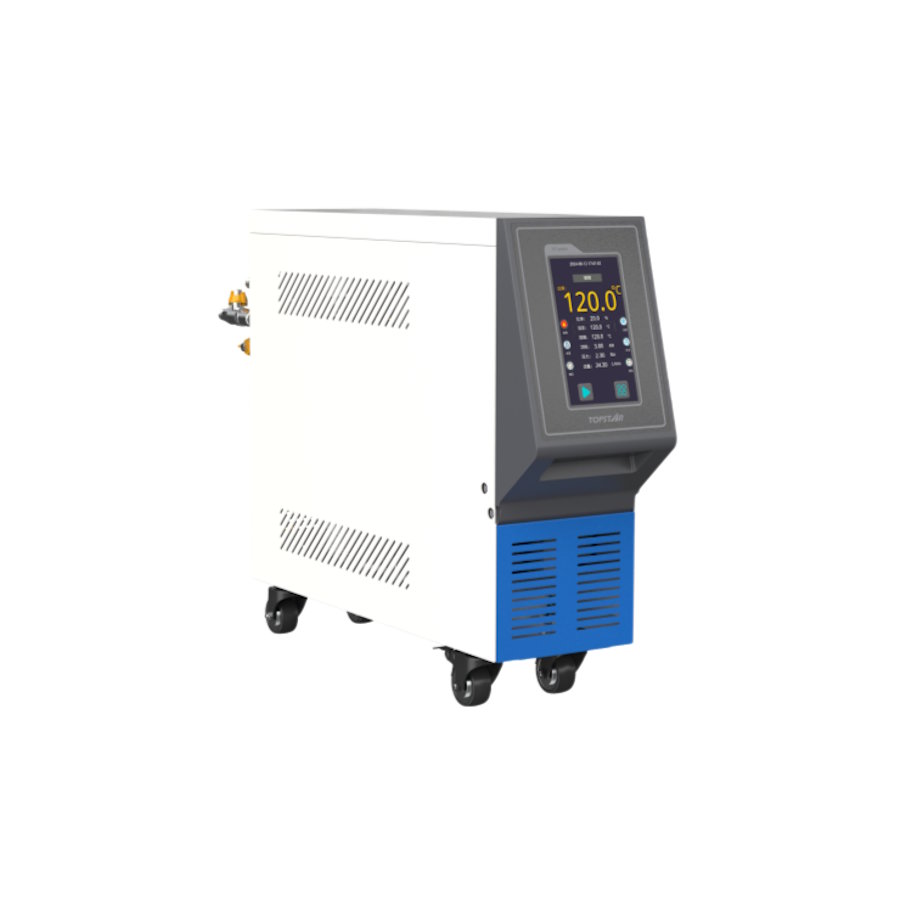
Thermal variation across an injection mold creates dimensional scatter, appearance defects, and unstable cycles. At Topstar, as a Product Marketing Manager with deep expertise in temperature-control systems, I see how quickly process capability improves once mold surface temperatures become uniform and stable. A properly specified and applied mould temperature controller reduces thermal variation by delivering consistent fluid temperature, adequate flow, balanced distribution, and responsive closed-loop control. Together, these elements keep the mould on the injection molding machine within a narrow thermal window from cavity to cavity and from shot to shot. This article explains how a mould temperature controller reduces thermal variation in injection molds. Drawing from Topstar's application experience and mould temperature control technology, we outline the practical mechanisms that turn temperature control from a source of drift into a foundation for consistency.
Stable Fluid Temperature Delivery from the Mould Temperature Controller
Stable fluid temperature delivery is the first requirement for reducing thermal variation. The mould temperature controller heats or cools the circulating fluid and holds it at the set-point despite changes in load from the mould and the injection molding machine. If fluid temperature swings, every channel in the mold experiences the same swing and part quality follows. Topstar designs its mould temperature controllers with accurate sensors, properly sized heaters and cooling exchangers, and responsive control algorithms to keep fluid temperature steady. When the supply temperature is stable, the mold receives a consistent thermal input. This stability alone eliminates a major source of shot-to-shot and region-to-region variation and lets process engineers focus on other parameters with greater confidence.
Adequate and Balanced Flow Distribution by the Mould Temperature Controller
Adequate and balanced flow distribution determines whether the stable fluid temperature actually reaches every part of the mould. Insufficient total flow or uneven division among parallel circuits produces hot and cold zones even when the mould temperature controller display shows the correct set-point. Cavities that receive less flow run at different temperatures and produce different shrinkage and appearance results. A capable mould temperature controller supplies both sufficient pump capacity and the hydraulic design needed for balanced distribution. Topstar sizes pumps and recommends manifold and circuit layouts that keep velocity high and balanced across the tool. When flow is adequate and even, temperature differences between cavities or between core and cavity shrink, and thermal variation across the mold surface declines measurably on the injection molding machine.
Closed-Loop Control Response of the Mould Temperature Controller
Closed-loop control response allows the mould temperature controller to correct disturbances before they become large temperature deviations. Load changes occur when the injection molding machine starts, stops, or changes cycle time, and when ambient conditions shift. A responsive controller detects the resulting fluid-temperature error and quickly, proportionally adjusts heating or cooling output. Topstar's mould temperature control technology uses PID or advanced algorithms tuned for the thermal mass of typical mould circuits. Fast, stable response prevents overshoot and oscillation while keeping the fluid—and therefore the mould—near the target. Effective closed-loop control turns the mould temperature controller from a simple heater into an active stabilizer.
Circuit Design and Sensor Placement Supporting the Mould Temperature Controller
Circuit design and sensor placement influence how well the mould temperature controller can manage real mould temperatures. Long, restrictive, or poorly vented channels create local flow problems that no controller can fully overcome. Sensors placed only at the fluid manifold may miss surface-temperature differences that affect the part. Topstar works with customers to review cooling-channel layouts and to recommend practical sensor locations when tighter control is required. Even the best mould temperature controllers perform better when the mould supports uniform flow and feedback reflects the conditions that matter. Collaboration between mould design and temperature-control application reduces residual thermal variation that would otherwise remain after the controller is optimized.
Process Monitoring and Continuous Correction with Mould Temperature Controllers
Process monitoring and continuous correction sustain low thermal variation over long production runs. Modern mould temperature controllers can display and transmit fluid temperatures, flow status, and alarm conditions. When operators monitor these data—either locally or through plant systems—they detect drift caused by fouling, filter blockage, or fluid degradation before part quality suffers. Topstar equips its units with clear interfaces and communication options that support this ongoing vigilance. Regularly verifying actual mold-surface temperatures against the mould temperature controller set-point further confirms that variation remains under control. Monitoring turns a one-time setup success into lasting thermal stability on the injection molding machine.
Achieving Uniform Mold Temperatures with a Mould Temperature Controller
A mould temperature controller reduces thermal variation in injection molds by holding fluid temperature stable, delivering adequate and balanced flow, responding quickly to load changes, working with sound circuit design, and supporting continuous monitoring. When these functions operate together, cavity-to-cavity and shot-to-shot temperature differences shrink, and the injection molding machine produces more consistent dimensions, appearance, and cycle behavior. Topstar's mould temperature control technology is engineered to deliver this stability under real production conditions. By matching controller capacity, flow, and control performance to the mold and process, manufacturers convert temperature from a variable into a controlled parameter.

