

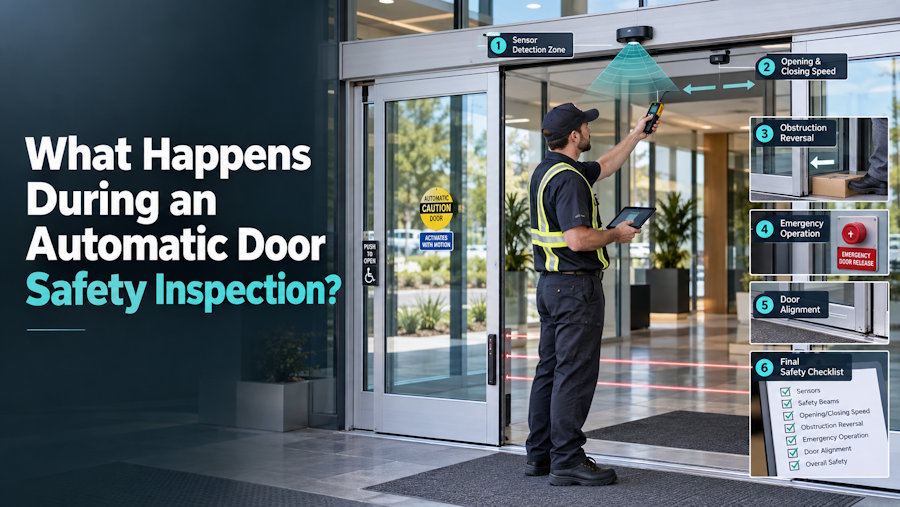
Automatic doors are one of those pieces of building equipment that people rely on constantly without ever thinking about how they work. They open smoothly, close on time, and blend into the background of daily life at grocery stores, hospitals, office buildings, and retail centers. But behind that smooth operation is a mechanical and electronic system that requires regular checks to stay safe. An automatic door safety inspection is the process that keeps that system reliable, code-compliant, and safe for the public.
For facility managers and business owners who have never sat through one, the inspection process can feel like a mystery. What exactly does a technician check? How long does it take? What happens if something fails? This guide walks through the entire process step by step so you know what to expect and why each part matters.
Why Automatic Door Inspections Are Required
Automatic doors combine moving parts, electrical systems, and sensors, all operating in a high-traffic area where people walk through without actively controlling the door themselves. That combination creates real risk if something malfunctions. A sensor that fails to detect a person, a door that closes too quickly, or a worn belt that causes unexpected movement can all lead to injury.
Because of this, ANSI/BHMA A156.10 for full-powered automatic doors and A156.19 for low-energy and power-assisted doors both call for regular inspection and maintenance. Many local building codes and insurance policies reference these standards directly, which means inspections are not simply a good idea. They are often a legal and contractual requirement tied to occupancy permits and liability coverage. Facilities that invest in interactive compliance training for their maintenance staff are better positioned to catch issues early and demonstrate due diligence before an inspector arrives. An overdue or skipped automatic door safety inspection can create both a safety hazard and a compliance gap that shows up during an audit or after an incident.
Who Performs the Inspection
Automatic door inspections should be performed by a qualified technician, typically someone certified by the American Association of Automatic Door Manufacturers (AAADM) or a similar accredited body. These technicians are trained specifically on ANSI standards and understand the mechanical, electrical, and sensor components unique to automatic doors, which sets them apart from general handyman or maintenance staff.
Many facilities schedule inspections annually, though high-traffic locations such as hospitals or airports may require more frequent checks. Some manufacturers also recommend inspections after any significant repair, glass replacement, or building renovation near the entrance.
Step One: Visual and Documentation Review
The inspection almost always starts before the technician even touches the door. They begin by reviewing:
- Maintenance records and previous inspection reports
- The door's classification label to confirm which ANSI standard applies
- Any known issues reported by staff, such as slow closing or sensor delays
- Manufacturer specifications for the specific door model
This step matters because it tells the technician what to expect and whether any patterns of recurring problems need closer attention. A door with a history of sensor complaints, for example, will get extra scrutiny in that area.
Step Two: Mechanical Component Inspection
Next, the technician moves into the physical hardware. This portion of the automatic door safety inspection focuses on wear and tear, alignment, and structural integrity. Typical checks include:
- Inspecting belts, rollers, and tracks for wear or misalignment
- Checking hinges and pivots on swinging doors for looseness
- Testing the door's closing speed and force against ANSI limits
- Examining door panels and frames for damage or corrosion
- Verifying that weatherstripping and seals are intact
Doors that operate outside the allowable force and speed range are considered a safety hazard, since excessive force can cause injury if a door closes on someone. Technicians use calibrated tools to measure this rather than relying on a visual guess.
Step Three: Electrical and Control System Checks
Automatic doors rely on control boards, wiring, and power supplies to function correctly. During this stage, the technician typically checks:
- Wiring connections for wear, corrosion, or loose contacts
- The control board's programming and settings
- Battery backup systems, if the door is equipped with one
- Emergency breakout functionality in case of power loss
This step is especially important for full-powered automatic doors, since a malfunction here can affect how the door responds to obstacles or emergency situations. A properly functioning emergency breakout feature also ensures people are not trapped during a power outage.
Step Four: Sensor and Safety Device Testing
Sensors are the heart of automatic door safety, and this stage often takes the longest. Technicians test each sensor to confirm it detects motion and presence correctly within the required zones. This typically involves:
- Testing motion sensors above the door to confirm activation range
- Testing presence sensors near the threshold to ensure the door does not close on someone standing in the path
- Verifying that safety sensors on swinging doors detect obstructions on both sides
- Checking that sensor zones are unobstructed by mats, displays, or furniture
If a sensor fails to detect a test object consistently, the door is flagged as non-compliant until it is repaired or recalibrated. This is one of the most common issues found during inspections, often caused by dirty sensor lenses, misaligned sensors, or outdated sensor technology that no longer meets current standards.
Step Five: Signage and Labeling Review
Inspectors also check that all required decals and signage are present, legible, and correctly placed. This includes:
- Classification labels on the door header
- Caution and warning decals at the required height
- Emergency breakout instructions near the door
- ADA accessibility signage where applicable
Faded, missing, or covered signage is flagged even if the mechanical components pass every other test, since signage requirements are part of the same ANSI standards that govern the door's operation.
Step Six: Functional Testing
Once the individual components have been checked, the technician runs the door through a full functional test to confirm everything works together as expected. This usually includes:
- Opening and closing cycles at normal operating speed
- Testing manual override or breakout function
- Confirming the door holds open the correct amount of time before closing
- Testing behavior when an obstruction is placed in the door's path
This final test simulates real-world use and helps catch problems that might not show up when components are tested individually.
Step Seven: Documentation and Reporting
After testing is complete, the technician provides a written report outlining what was inspected, what passed, what failed, and any recommended repairs. A thorough automatic door safety inspection report typically includes:
- Date of inspection and technician certification number
- Door classification and ANSI standard reference
- List of components tested with pass or fail status
- Photos of any issues found
- Recommended timeline for repairs, if needed
This documentation is important not just for internal records but for insurance purposes and code compliance audits. Facilities that can produce a clear inspection history are in a much stronger position if an incident ever occurs and liability questions arise.
What Happens If a Door Fails Inspection
If an automatic door fails one or more parts of the inspection, it does not necessarily mean the entire door needs to be replaced. Common outcomes include:
- Minor repairs such as sensor recalibration or belt replacement
- Adjustment of closing speed or force settings to meet ANSI limits
- Replacement of worn hardware like rollers or hinges
- Reapplication of missing or damaged signage
- In more serious cases, taking the door out of automatic service until repairs are completed
Facility managers should treat a failed inspection as a priority item rather than something to schedule "eventually," since an unresolved failure creates ongoing safety and liability exposure.
How Often Should Inspections Be Scheduled
Most manufacturers and industry standards recommend at least one full inspection per year for automatic doors in standard commercial use. However, several factors can shorten that interval:
- High foot traffic locations such as hospitals, airports, or grocery stores
- Doors exposed to harsh weather or heavy dust and debris
- Facilities with a history of recurring mechanical or sensor issues
- Doors that have recently undergone repair or renovation nearby
Some facilities choose to schedule inspections twice a year as a precaution, particularly if the entrance sees constant use throughout the day.
FAQ
How long does an automatic door safety inspection take? Most inspections take between 30 minutes and an hour per door, depending on the door's complexity and whether any issues are found that require deeper investigation.
Can I perform my own automatic door inspection? Basic visual checks, such as looking for damaged signage or unusual noises, can be done by facility staff. However, a full inspection involving force testing, sensor calibration, and electrical checks should be performed by a certified technician.
What certifications should an inspector have? Look for technicians certified by the American Association of Automatic Door Manufacturers (AAADM) or an equivalent accredited body, since they are trained specifically on ANSI automatic door standards.
What is the difference between maintenance and inspection? Maintenance refers to routine upkeep such as cleaning sensors or lubricating hardware, while an inspection is a formal, documented review of the entire door system against ANSI safety standards.
Do all automatic doors need to be inspected the same way? No. Full-powered doors, low-energy doors, and power-assisted doors each have different requirements under ANSI/BHMA A156.10 and A156.19, so the inspection process varies based on door classification.
What should I do if my door fails inspection? Address the flagged issues as soon as possible, whether that means a minor repair, sensor recalibration, or signage replacement. Taking the door out of automatic operation until repairs are complete is sometimes necessary for serious safety issues.
Is an inspection report required for insurance purposes? Many insurance policies and building codes require documented proof of regular inspections, so keeping a written report on file is important for both compliance and liability protection.
Final Thoughts
An automatic door safety inspection is far more thorough than a quick glance at whether the door opens and closes. It involves a detailed review of mechanical components, electrical systems, sensors, signage, and overall function, all measured against established ANSI standards. Facilities that schedule regular inspections and act quickly on any flagged issues are in a much better position to protect the people who walk through their doors every day, while also staying compliant with the codes and insurance requirements tied to commercial entrances. Treating these inspections as a routine part of building maintenance, rather than an afterthought, is one of the simplest ways to reduce risk and keep automatic entrances running safely for years to come.

