

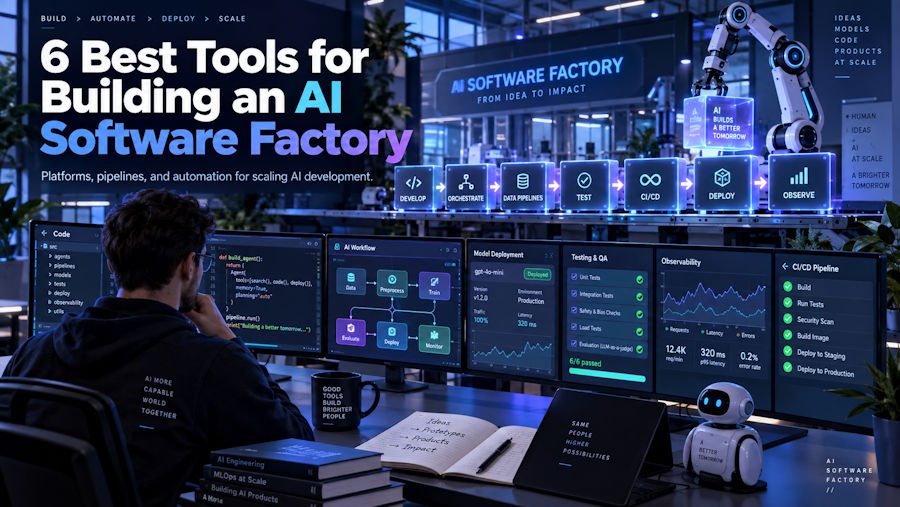
An AI software factory is not simply a development team equipped with coding agents. It is an engineering production system in which software work can move from intent to production through repeatable loops involving AI agents, developers, source control, delivery infrastructure, security controls, organizational context, and automated verification.
That distinction matters more in 2026 because code generation is no longer the only constraint on engineering velocity. Teams can create software faster than they can consistently supply agents with the right context, govern what those agents are allowed to do, verify their output, coordinate activity across disconnected systems, and determine whether greater AI usage is actually improving software delivery.
The 6 Best Tools for Building an AI Software Factory
1. Port: Best Tool for Building an AI Software Factory
Port is the strongest overall option for enterprises building an AI software factory because it focuses on the layer that becomes increasingly important once an organization has multiple agents, repositories, models, engineering tools, and autonomous workflows: a shared control and context plane.
Its Context Lake creates a relationship-aware model of the engineering environment by connecting information from repositories, services, cloud resources, deployments, incidents, teams, security systems, and other parts of the SDLC. Instead of forcing every agent to reconstruct organizational context independently, Port can provide governed information about what a service is, who owns it, where it runs, what depends on it, its production state, and which engineering standards apply.
The platform also supports a heterogeneous agent strategy. Organizations can build agents inside Port, represent external agents in the software catalog, expose approved context through MCP, and allow tools such as Claude, Cursor, or GitHub Copilot to interact with the same engineering model. Workflow orchestration connects this context to action, enabling SDLC events to trigger processes across source control, ticketing, CI/CD, cloud, security, and operational systems while maintaining human approval at selected risk points.
Key features:
- Context Lake for relationship-aware engineering data
- AI agent creation and external agent management
- MCP access to governed engineering context
- Event-driven workflow orchestration across the SDLC
- Human-in-the-loop approvals for sensitive actions
- Service catalog and software ownership visibility
- Governance across agents, tools, skills, and sessions
- Engineering metrics and AI activity measurement
2. Factory
Factory offers one of the clearest agent-native interpretations of the software factory model. Its Droids are autonomous software-development agents designed to handle larger units of engineering work than traditional coding assistants, including planning, implementation, testing, code review, documentation, issue resolution, release preparation, and operational tasks.
The broader Factory environment surrounds those agents with orchestration, organizational context, model routing, automated dispatch, quality controls, and centralized visibility into active work. This allows teams to delegate complete engineering missions rather than repeatedly prompting an assistant for individual code changes.
Key features:
- Autonomous Droids for substantial engineering tasks
- Long-running software-development missions
- Planning, coding, testing, review, and documentation workflows
- Centralized agent activity through Mission Control
- Shared organizational context across development stages
- Model routing for different engineering tasks
- Built-in quality and validation controls
- Enterprise, hybrid, on-premises, and air-gapped deployment options
3. GitHub
GitHub has become an important building block for AI software factories because the repository is evolving from a passive destination for generated code into an active environment where agents can receive work, make changes, collaborate, and return results through governed engineering workflows.
GitHub Copilot now operates across development environments, the command line, GitHub itself, and asynchronous coding workflows, while organizations can create custom agents with specialized instructions and tools for different engineering tasks. This means an issue can become an agent assignment and ultimately return as a pull request rather than requiring a developer to manually move information between systems.
Key features:
- GitHub Copilot across IDE, CLI, web, and agent workflows
- Asynchronous coding agents that return pull requests
- Custom agents with specialized instructions and tools
- Native access to repositories, issues, reviews, and development history
- Repository-level agent instructions and contextual guidance
- MCP support for extending agent capabilities
- Enterprise AI and agent governance controls
- Integration with existing CI and pull-request review processes
4. GitLab
GitLab offers a different path to the AI software factory because repositories, planning, CI/CD, security, governance, and agentic execution can operate within the same DevSecOps environment. The GitLab Duo Agent Platform extends AI beyond code completion into specialized agents and reusable multi-step flows that can participate across planning, development, review, security analysis, and delivery.
Organizations can create custom agents with specific prompts, tools, and permissions and make those agents available at project, group, or wider organizational levels depending on how standardized the workflow needs to become.
Key features:
- GitLab Duo Agent Platform for agentic SDLC workflows
- Custom agents with scoped prompts, tools, and permissions
- Multi-agent and reusable agent flows
- Native repository, issue, merge request, and CI/CD context
- Integrated application security and DevSecOps controls
- Persistent instructions and reusable skills for agents
- Governance through existing GitLab identity and access controls
- Strong fit for GitLab-centered enterprise engineering environments
5. Harness
Harness is particularly strong in the delivery layer of an AI software factory, addressing what happens after human developers or autonomous agents have created code. Faster generation creates little value if changes remain stuck behind slow builds, fragile test suites, manual infrastructure processes, security gates, and deployment procedures.
Harness brings AI into these downstream activities through agents that can participate in pipeline creation, code review, remediation, test improvement, infrastructure work, and operational automation. These capabilities run inside an established software delivery platform rather than functioning as a separate AI system.
Key features:
- AI-assisted and autonomous software delivery workflows
- Software Delivery Knowledge Graph
- Agent participation inside governed pipelines
- CI/CD automation across complex enterprise environments
- Testing and remediation automation
- Infrastructure and deployment workflow support
- RBAC, policy enforcement, credentials, and audit controls
- Strong fit for organizations where delivery is becoming the AI-era bottleneck
6. Opsera Forge
Opsera Forge approaches the AI software factory through persistent intent and architectural context. As coding agents become more capable, they can produce technically valid local changes that still move a system away from the intended architecture because the agent sees a ticket and repository without understanding the broader business requirements or historical constraints.
Forge is designed to maintain that context from business intent through product requirements, architecture, user stories, development, and deployment. Machine-readable specifications and governed work orders provide a more durable source of direction than asking each agent to infer the desired system from prompts and existing code.
Key features:
- Persistent intent and specification management
- Machine-readable requirements and architecture context
- Governed work orders for agent execution
- Alignment between business requirements and implementation
- Support for enterprise modernization workflows
- Integration with existing DevOps and CI/CD environments
- Broad engineering and security tool connectivity
- Focus on reducing architectural drift in AI-generated software
How the Six Tools Fit Into an AI Software Factory
These platforms overlap in several areas, but they represent different control points within the factory.
| Tool | Primary Role | Strongest Layer | Particularly Relevant When |
|---|---|---|---|
| Port | Factory control plane | Context, orchestration, governance, agent management | Multiple tools and agents need to operate as one governed system |
| Factory | Autonomous development execution | Agent-driven engineering | Agents are expected to perform substantial portions of software development |
| GitHub | Repository-centered agent environment | Coding, pull requests, collaboration | GitHub already anchors the development workflow |
| GitLab | Integrated agentic DevSecOps | Repository through delivery | The organization wants agents inside a unified DevSecOps environment |
| Harness | Autonomous software delivery | CI/CD, testing, infrastructure, release | Code generation is accelerating faster than the delivery pipeline |
| Opsera Forge | Intent-driven software creation | Requirements, architecture, context continuity | Architectural drift and specification loss are major AI risks |
What Changes When AI Becomes Part of the Engineering Production System
The transition from AI-assisted development to an AI software factory is less about giving agents more autonomy and more about changing the operating model around them. Once agents can do more than suggest code, companies need to decide how work reaches them, what they are allowed to access, how their output is validated, and how their contribution is measured.
This creates several shifts at once. Prompting is only one way to initiate work, as engineering events can automatically trigger agents. Governance moves beyond deciding which models employees may use and starts treating agents as identities with permissions and responsibilities. Standardization moves away from forcing everyone onto the same AI tool and toward defining common rules for how any human- or agent-generated change moves toward production.
| From | Toward | Why It Matters |
|---|---|---|
| Developer-initiated prompts | Event-driven workflows | Work can begin from incidents, vulnerabilities, tickets, failed builds, or operational signals without waiting for someone to explain the situation manually |
| Model access policies | Agent permissions and action controls | Agents may create pull requests, invoke tools, modify infrastructure, or trigger deployments, so governance has to cover actions as well as data |
| One approved coding assistant | Standardized engineering guardrails | Teams can use different agents while sharing the same testing, security, approval, and deployment requirements |
| AI adoption metrics | Engineering outcome metrics | More tokens, generated code, or agent sessions do not matter unless delivery becomes faster, safer, or less expensive |
This is also where platform engineering takes on a broader role. The paved roads that once helped developers safely move code into production increasingly need to support autonomous systems as well. An agent should not invent its own access model, deployment procedure, verification standard, or escalation path every time it runs. Those controls should already exist as part of the production system.
The goal is not unrestricted autonomy. It is bounded autonomy: agents can move quickly inside well-defined limits, while higher-risk decisions still require stronger verification or human judgment.
FAQs
What is an AI software factory?
An AI software factory is an engineering operating model in which agents, developers, engineering platforms, and automated controls work together through repeatable production loops. It connects intent, context, software implementation, testing, security, delivery, operations, and measurement instead of using AI only to accelerate individual coding activities.
What is the most important component of an AI software factory?
Shared engineering context is one of the most important foundations because agents need information beyond source code to make reliable decisions. A mature factory also requires orchestration, permissions, verification, delivery automation, and measurement. Autonomous execution becomes useful only when the surrounding system can determine what agents should do and whether the resulting work is acceptable.
Does an AI software factory require autonomous coding agents?
No. Organizations can start with AI-assisted workflows for triage, analysis, testing, documentation, remediation preparation, or operational work while implementation remains primarily human-driven. Autonomous coding can become one execution layer later. The defining characteristic is the repeatable and governed engineering production system, not the percentage of code written by AI.
Should enterprises standardize on one AI coding agent?
Not necessarily. Different agents and models may perform better for different engineering tasks, and the technology is changing quickly. A more durable approach is often to standardize context, permissions, workflows, security controls, verification, and measurement while allowing the agent or model used for execution to evolve.
How should companies govern agents in software engineering?
Agents should have clear ownership, scoped permissions, approved tools, observable activity, and auditable actions. High-risk operations should require stronger validation or human approval. Governance should also cover MCP servers, model access, credentials, agent lifecycle, and how each autonomous action maps back to authorized engineering work.
How should engineering teams measure AI software factory ROI?
Teams should measure outcomes such as cycle time, review effort, deployment frequency, defect rates, incident resolution, security remediation speed, rework, and developer time recovered. Model usage, infrastructure cost, retries, and human review should also be included. The goal is not maximum agent activity, but a shorter and more reliable path from engineering intent to production software.

