

You spin up the infrastructure, the routing is ready, and then you hit the wall every network team eventually hits. You need public IPv4 space and your registry has none to give you.
Every regional registry has exhausted its free pool. What is left is a secondary market of marketplaces, brokers and leasing platforms, and they are not interchangeable.
Some sell you permanent registration rights. Some only rent.
Some charge the buyer, some charge the seller, and a few charge both in ways that are not obvious from the homepage. Here is how six of the more established options actually differ.
Key Takeaways
- Buying transfers registration rights permanently. Leasing gives you usage of someone else's space under a letter of authorization, with no transfer.
- Marketplaces let you browse and self-serve. Brokers run the transaction for you. The two models suit very different teams.
- Who pays the fee varies enormously. Some platforms charge the seller only, some take a cut of owner lease revenue, some add a renter platform fee.
- Registry coverage matters. A platform strong in RIPE may not help you in ARIN, and inter-registry transfers have their own rules.
- Block reputation is the variable that ruins deployments. Blacklist status, stale routing objects and wrong geolocation data all travel with a block.
What Actually Separates These Platforms
Start with the part nobody puts on a pricing page. A block carries its history with it, including spam listings, orphaned route objects and geolocation records that may still place it on another continent.
That last one bites harder than people expect. If your users get served the wrong regional content after a migration, the cause is often a stale entry in a commercial geolocation database rather than anything in your config.
Knowing how free GeoIP databases assemble their records makes it much easier to judge whether a block is genuinely clean or just clean in WHOIS. Correcting those records is a separate job from the registry transfer, and nobody does it for you by default.
With that in mind, the first structural fork is transaction type. Buying means a registry-recorded transfer that makes you the registered holder, which takes weeks and involves paperwork. Leasing means you route someone else's space under an LOA, which can happen in a day.
The second fork is service model. A marketplace shows you inventory and lets you transact yourself. A broker assigns you a human who sources the block, negotiates and manages the registry process.
The third is fee structure, and it is the one most often misread. Seller-paid commission, owner revenue share and renter platform fees produce very different effective costs, so compare the all-in number rather than the headline rate.
The fourth is registry coverage. A platform with deep RIPE inventory may have nothing useful in ARIN, and moving space between registries triggers inter-registry transfer rules that not every provider handles.
Coverage also affects timing. Pre-approval requirements differ by registry, so the same purchase can take noticeably longer in one region than another depending on where the seller sits.
Comparison at a Glance
| Platform | Model | Buy / Sell | Lease | Registry coverage | Fee structure |
|---|---|---|---|---|---|
| IPv4 Connect | Marketplace with managed transfers | Yes | No | ARIN, RIPE, APNIC | Fixed published prices, no auction |
| IPv4.Global | Auction marketplace plus private brokerage | Yes | Yes | All five registries | Seller-paid, auction pricing |
| IPXO | Automated leasing and monetization | No | Yes | Multi-registry | 5% platform fee on holder revenue |
| InterLIR | Marketplace plus managed broker | Yes | Yes | RIPE NCC registered, plus ARIN, LACNIC, APNIC | Indicative lease pricing from €99 per /24 monthly |
| Prefixx | Boutique brokerage | Yes | Yes | ARIN, RIPE NCC, APNIC registered, LACNIC facilitated | 3% to 8% seller-paid, no buyer fee |
| IPbnb | Direct self-service marketplace | Yes | Yes | RIPE region focused | Owner-set pricing, no lessee platform fee |
1. IPv4 Connect
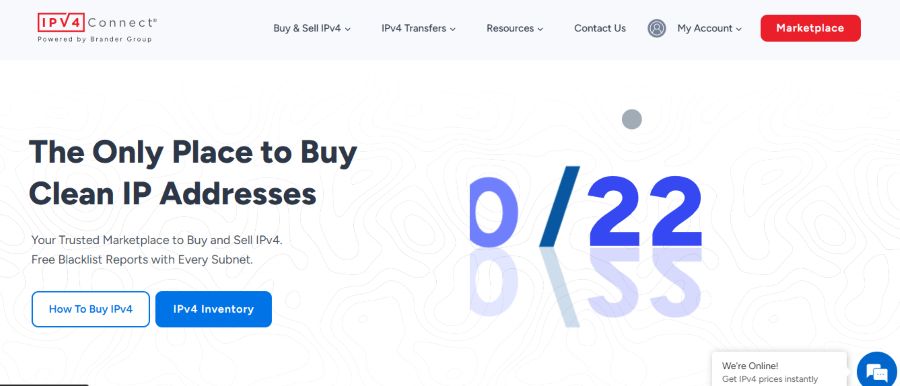
IPv4 Connect is a marketplace built around buying and selling address space outright rather than renting it, which makes it the closest fit if you want permanent registration rights instead of a recurring line item.
Inventory is browsable by block size and region, with fixed published prices and buy-now options rather than an auction process. You can reserve a subnet before paying, which is useful when a purchase order is still working its way through procurement.
Its most distinctive feature is the disclosure default. Proprietary software runs each address against Spamhaus, Barracuda, Sorbs and more than 100 global blacklists, and a complimentary report is offered on any block, including ones you already hold.
The cleanup work happens before listing rather than after purchase. BGP announcements, old route records and DNS entries are removed ahead of transfer, and the team works with block owners and registries to confirm subnets are free of liens.
Transactions run on a two to three week managed timeline, with pre-approval assistance in ARIN, RIPE and APNIC. Payment settles by wire to a designated client funds account or through escrow, and funds release to the seller the day the registry transfer completes.
Best for: teams buying rather than leasing, who want reputation data up front and a fixed price instead of bidding against other buyers.
2. IPv4.Global
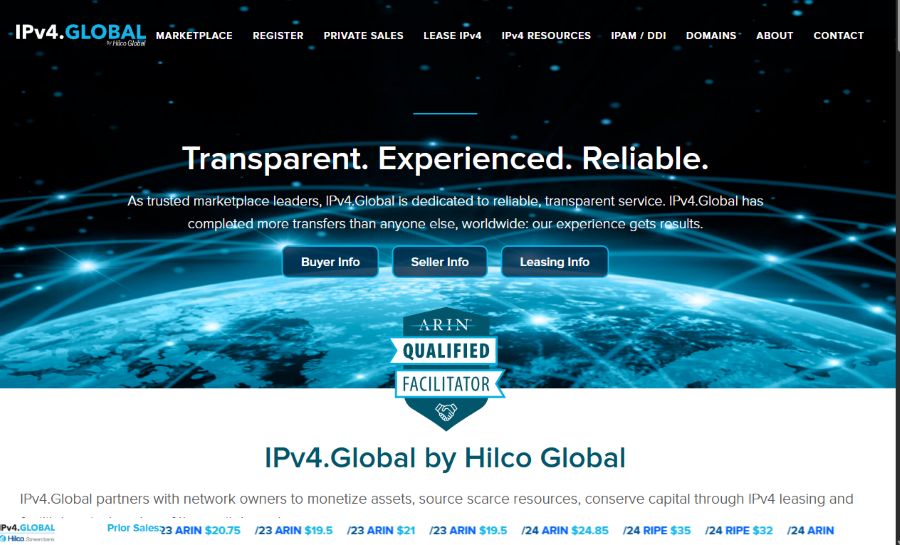
IPv4.Global, part of Hilco Global, is the most established name in the category and states that it has completed more transfers than any other provider worldwide. It has been running transactions since 2014 and operates in all five registries.
The model is split. An online marketplace handles smaller blocks through auction, while a private brokerage arm negotiates larger deals directly. Escrow services are offered in-house.
Its genuinely useful public asset is price transparency. A prior sales feed publishes completed transactions with block size, registry and per-address price, which is the closest thing the market has to a public tape.
The platform also offers leasing, an IPv4 analyzer for valuing your own space, and ProVision, its IPAM and DDI software.
Best for: larger transactions, sellers who want competitive bidding, and anyone who wants public comparable sales before agreeing a price.
3. IPXO
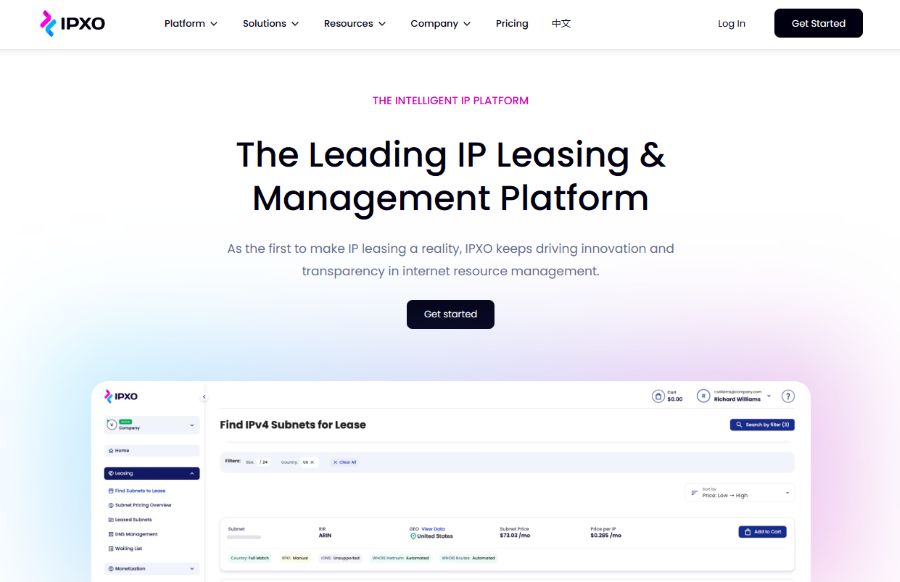
IPXO is a leasing and monetization platform rather than a transfer marketplace. If your goal is to own address space, this is not the tool, and that is a positioning choice rather than a gap.
What it does well is automation. LOA, ROA and WHOIS updates are issued programmatically on lease activation, inventory is filterable by size, registry, geolocation and available automations, and abuse checks run continuously on leased blocks.
For address holders, the economics are published plainly. IPXO charges a standard 5% platform fee to IP holders, deducted monthly from earned revenue, in exchange for a managed monetization service.
The trade-off is that you are leasing from aggregated inventory rather than a named counterparty, and you never hold the registration.
Best for: operators who need clean space quickly across multiple registries and are comfortable renting rather than owning.
4. InterLIR
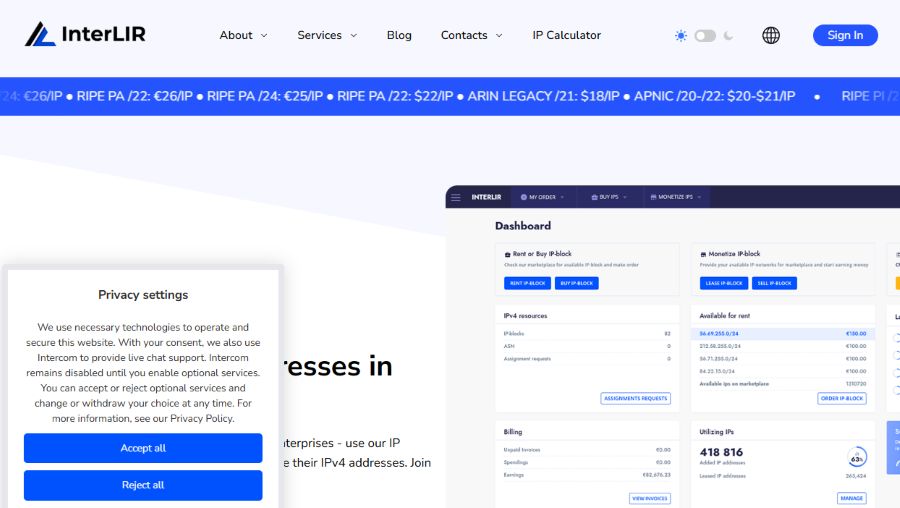
InterLIR Global, operating as InterLIR GmbH out of Berlin, is a RIPE NCC registered broker that also holds registrations with ARIN, LACNIC and APNIC. It covers the full set: lease, buy, sell and lease out.
Indicative lease pricing is published from around €99 per month for a /24, with automated LOA assignment and no hidden fees advertised. Stock runs from /24 up to /16, and networks are typically served within 24 hours of a request.
The feature that sets it apart from pure marketplaces is sponsoring. If you do not have your own LIR, InterLIR can act as your sponsoring organization for ASN registration in RIPE, which removes a real obstacle for smaller operators.
It also runs an automated reputation system so you can check a block against spam lists on demand, and handles escrow on complex deals.
Best for: RIPE-region operators who need sponsoring or ASN registration alongside address space, or who want one platform covering both leasing and transfers.
5. Prefixx
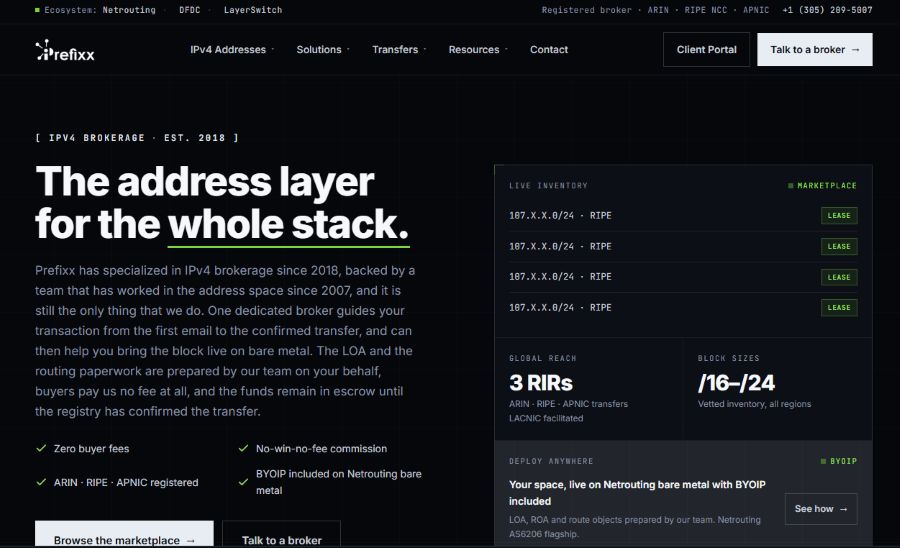
Prefixx is a boutique brokerage rather than a self-service platform, founded in 2018 by a team working in the address space since 2007, and headquartered in Miami. It is a registered broker with ARIN, RIPE NCC and APNIC, with LACNIC facilitated.
The fee model is the clearest in this list. Commission of 3% to 8% depending on block size is paid entirely by the seller, buyers pay no broker fee at all, and there is no fee if the deal does not close.
Every purchase settles through independent escrow, with funds released only once the relevant registry confirms the transfer. Blocks run from /24 to /16 and above, and each is vetted before it is presented.
White-glove work is bundled rather than billed separately, covering blacklist scanning, geolocation correction, RPKI setup and reverse DNS management. Leases carry a non-revocation guarantee and can run up to 60 months.
Best for: buyers who want zero broker fees and a named consultant handling a complex or high-value transaction end to end.
6. IPbnb
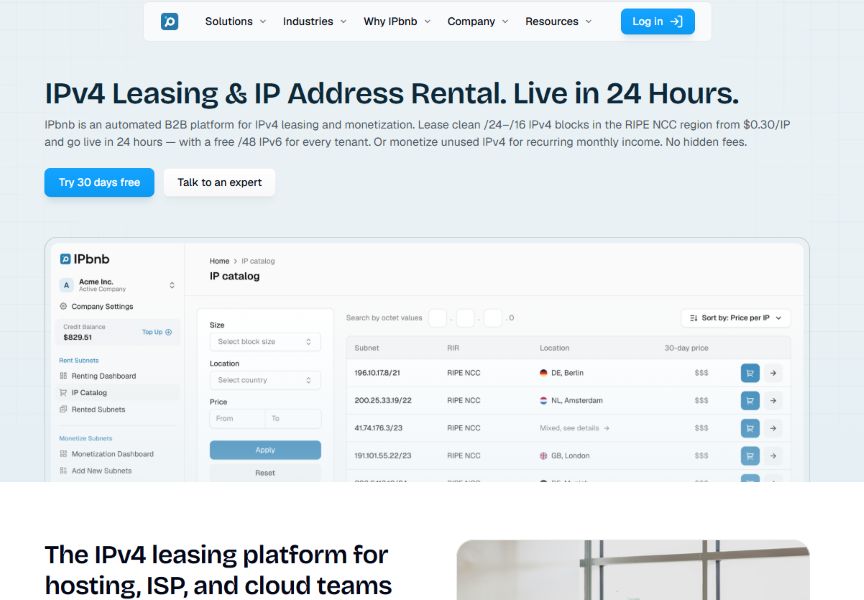
IPbnb is a direct, self-service marketplace focused on the RIPE region, where owners list their own subnets and set their own prices rather than feeding a managed pool.
The structural difference is visibility. You can see whose space you are leasing and on what terms before committing, which matters if you have been burned by anonymous pooled inventory before.
It supports the full range of lease, buy, sell and monetize in one account, with RPKI, ROA and LOA handled as part of the workflow rather than left to you. There is no platform fee charged to lessees, so the listed owner price is what you pay.
The honest limit is scope. It is RIPE-focused, so ARIN or APNIC operators will be better served elsewhere, and it is not a sponsoring broker.
Best for: RIPE-region owners who want to set their own price, and renters who want a named counterparty rather than a pool.
Before You Commit: A Short Due Diligence List
- Pull a blacklist report before money moves, not after. Reputable platforms will provide one, and if a seller resists, that reluctance is your answer.
- Check what is still being announced. A block advertised in the global routing table by its previous holder, or covered by stale route objects and IRR records, will not behave the way you expect on day one.
- Verify geolocation separately from the sale. Commercial geolocation providers each maintain their own records, and correcting them is a separate task from the registry transfer.
- Confirm who the registered holder actually is. WHOIS should match the party signing the paperwork, and legacy space with decades of corporate history often needs untangling before a registry will process anything.
- Finally, budget for registry fees. Membership and annual maintenance costs sit underneath any acquisition and scale with how much space you hold.
How to Choose
You want to own the space permanently, with reputation data up front. A fixed-price transfer marketplace fits, and the blacklist reporting is the differentiator worth paying attention to.
You are moving a large block, or you want public comparables. IPv4.Global's auction data and brokerage arm are hard to match on scale.
You need addresses this week and can rent. IPXO's automation gets you routing fast without a transfer.
You need a sponsoring LIR or an ASN in RIPE. InterLIR covers that alongside the address space.
You want a specialist and no buyer fee. Prefixx's seller-paid, no-win-no-fee model is the cleanest arrangement for a buyer.
You want owner-set pricing in the RIPE region. IPbnb's direct marketplace is built for exactly that.
There is no single best platform here, only the right match for whether you are buying or renting, which registry you operate in, and how much of the process you want to run yourself.
Frequently Asked Questions
Can I still get IPv4 addresses directly from a registry? Rarely. Every registry has exhausted its free pool, and remaining channels are waiting lists supplied by returned or revoked space plus small reserved pools for specific cases such as internet exchange points. Most teams go to the transfer or lease market instead.
What is the difference between buying and leasing IPv4? Buying transfers registration rights to you, recorded by the registry, and takes weeks. Leasing gives you the right to route someone else's space under a letter of authorization, usually within a day, with no change to the registry record.
Do I pay a fee as a buyer? It depends entirely on the platform. Some brokers charge the seller only and nothing to the buyer, while others build costs into listing prices or add renter platform fees. Ask for the all-in figure before comparing quotes.
How long does an IPv4 transfer take? Two to three weeks is a common managed timeline, though pre-approval in the ARIN and APNIC regions can add time at the start. Legacy blocks and unclear ownership records take longer.
Why do two blocks of the same size cost different amounts? Reputation and documentation. Blacklist status, prior routing announcements, geolocation accuracy and the clarity of the ownership chain all affect what a block is worth to someone who wants to deploy it immediately.
What should I check before buying a block? Blacklist status across multiple providers, current and historical BGP announcements, existing route objects and IRR records, geolocation accuracy, and whether the WHOIS holder matches the selling party.

