

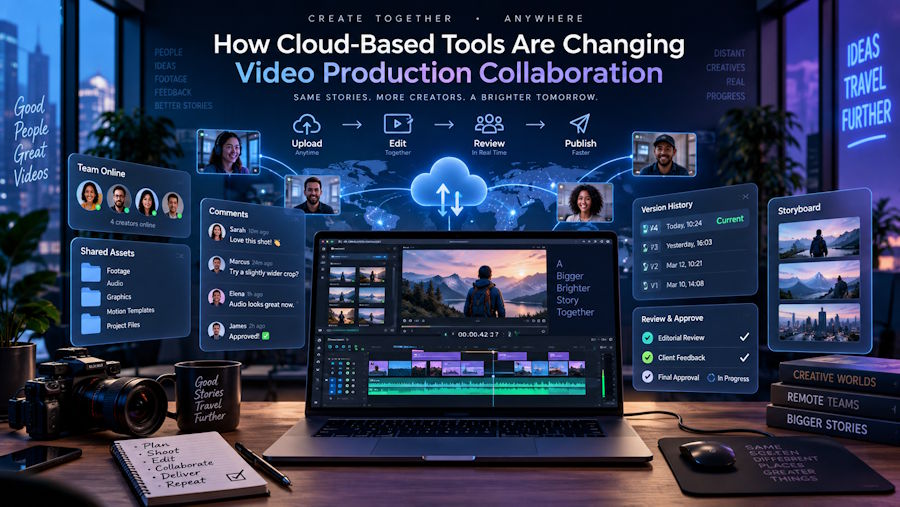
Collaboration has always been an essential aspect of video production. However, how people collaborate has become drastically different. While in the past, the project would rely on hard disks, email attachments, face-to-face meetings, and well-structured folders, today the whole process can be done using cloud technologies that unite all information – from footage to feedback, scheduling, and approval.
Modern video production teams do not work out of one office. The editor might be at home, the director could be away traveling, the client might be abroad, and the motion designer will join the team for just a couple of days. Cloud technology provides all these people with a workspace that does not require them to be in the same studio.
The main difference lies not in the storage of the files online but in the collaboration itself.
From Sending Files to Sharing a Working Environment
Conventional video production processes actually generate more friction than one might expect. A camera crew wraps up their shoot, uploads the video clips onto some physical drives, and delivers them to an editor, after which they wait for feedback. An editor exports a new version of the material, uploads it somewhere, sends the link, gets feedback via email or chat, and has to interpret this feedback in the context of the timeline.
Each pass between different people creates another chance for misunderstanding.
Cloud-based production management solutions eliminate many passes by providing teams with access to collaborative media, projects, and reviews. Rather than treating each export as a new file, teams can collaborate around a unified project that provides access to the newest material and avoids the possibility of confusing old exports.
Remote Collaboration Is Becoming a Normal Production Model
Video production still requires physical crews for many shoots, but a large part of pre-production and post-production can now happen from almost anywhere. For projects spread across different locations, a distributed production network such as World Production Service can connect local production resources and specialist teams while allowing the wider project to remain coordinated across markets.
The producers can schedule production using the internet. The editors can edit using the proxy files from a different city. The directors can evaluate rough cuts using a computer. The clients can approve some scenes without necessarily being present for editing. The sound designers, the colorists, the animators, and the visual effects artists can also become part of the production process even when not located in the same place as the primary production company.
This ensures that there is a bigger talent pool that can be accessed by the producers. A company engaged in the production of campaigns in different countries can hire the local staff for filming but keep the production processes centralized. It is not about where one is anymore but how well he/she can fit into the production process.
Review and Feedback No Longer Need to Live in Email Threads
One of the most practical changes that come with cloud systems is improved review management. Giving video feedback is hard when it is not specific enough. An instruction like "Alter the graphic around the middle" makes the editor try to figure out the exact point meant by the reviewer. It becomes even more complicated if multiple reviewers give their feedback through various email threads and communication services.
What makes it better in cloud review software is the fact that comments are directly tied to certain points in a video. The customer stops at a specific frame, gives instructions, then continues watching. The editor replies to comments, checks off the completed edits, all while keeping the conversation related to the right version of the video.
Version Control Is Finally Becoming Less Painful
Version control has been important for software developers for some time. Video crews have a similar challenge, albeit in a more visual workflow where the files are also bigger.
Post-production workers will recognize filenames like "final," "final_v2," "final_new," or "final_revised_client." Once there are a few exports floating around, it becomes hard to figure out which one is the correct and current one.
With cloud-based systems, it becomes much easier to keep the revision history for the files, all under one project or review link. The crew uploads new versions but keeps records of the older versions.
In case the client changes direction and asks for an old edit version after a while, the crew is able to track down what was changed and find the correct version.
Cloud Storage Is Becoming Part of the Production Pipeline
Cloud storage was once treated mainly as a backup or file-sharing option. Increasingly, it is becoming part of the active production pipeline. High-resolution video files are still demanding, so many teams use lightweight proxy files for remote editing and review while the original media remains stored elsewhere.
This allows editors to begin working without downloading massive amounts of footage. Once the creative edit is approved, the project can reconnect to the high-resolution files for finishing, color grading, visual effects, and delivery. At this stage, professional online editing through World Production Service can form part of the finishing workflow, helping bring approved edits and high-resolution material together as a project moves toward final delivery.
The principle is simple: every collaborator no longer needs a complete local copy of every asset, which reduces duplication and makes distributed projects easier to manage.
Automation Is Connecting Production Tools
The next evolution of cloud collaboration moves beyond simply shared storage. Workflows are now becoming increasingly integrated from project management software, review software, asset management software, cloud storage, message services, and custom software through API integrations and automation.
An upload to one system triggers an alert to the editor. An edit approved by an editor triggers the next step in the process. A render is sent straight to the review bucket. Information in metadata can organize the clips, campaigns, or language versions without having to manually name and sort all files.
Video production becomes integrated within the larger software workflow instead of a separate process entirely.
For instance, in a product company, the workflow of the content management system could be integrated into the video production process so that the product information, graphics, subtitles, and localization assets follow the process predictably. While creative decisions still need people, coordination can be automated.
Better Access Also Requires Better Security
Putting the process into the cloud also brings changes to security obligations of the team.
Unreleased campaigns, products, entertainment materials, customers' videos, and other content may have private details. Allowing remote collaboration means much more than sending a publicly available link.
In professional settings, permission control, account access, activity log monitoring, and restrictions on download and sharing may be used. It is also important for the team to understand what will happen if an external collaborator leaves the project.
Technology Works Best When the Process Is Clear
Cloud-based systems can eliminate friction, yet they cannot substitute for good communication and creativity.
A poorly managed team won’t turn out to be an effective one just because it decided to switch platforms. If roles are not well-defined, there is contradictory feedback, or no one knows who is the ultimate decision-maker – these issues will simply relocate to the cloud.
The best teams are using technology as a means to organize the process. They define the location of the source files, the naming convention for the projects, the approval hierarchy for changes, the place for the feedback, and the moment of the next step.
The appropriate system helps to set up a common structure, which gives the possibility to spend more time on creativity rather than file tracking and seeking approvals.
Video Production Is Becoming More Connected
The future of video collaboration isn’t likely to consist of one application that does everything. Editing, effects, sound, reviewing, scheduling, and communication are separate tasks, and there’s no reason for video collaboration to be done by using one tool. Instead, what is changing now is the way these tools can work together.
Through cloud solutions, production teams have the possibility of overcoming their dependence on separate files and disjointed communications and building workflows in which media assets, reviews, approvals, and project information all stay connected to each other. Such a solution makes collaboration easy when people are working remotely, when it is necessary to involve experts in your project, and to manage changes and repetitions.
For video professionals, the cloud is more than a replacement for a hard drive. This is how the video production process is changing due to collaboration. The most successful teams are going to be the ones that create workflows with the help of technology.

