

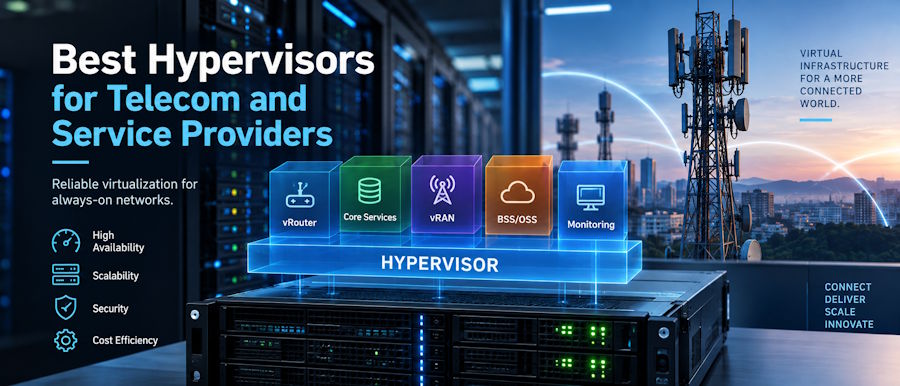
Telecom networks operate at a scale that few other industries need to manage. A single service provider may support millions of subscribers, thousands of network functions, and infrastructure distributed across numerous sites, while maintaining demanding availability requirements. This unique environment makes virtualization an important part of telecom infrastructure planning, with hypervisor selection playing a key role in supporting performance, scalability, and operational efficiency.
In recent years, these considerations have gained even more attention. Many telecom operators have built their virtualization environments around VMware, while changes to VMware’s licensing model under Broadcom have encouraged some organizations to reassess their long-term options.
Analyst firms such as Omdia and STL Partners have highlighted growing interest among telecom operators in open and flexible virtualization platforms, driven by the need for greater cost predictability, operational flexibility, and a broader range of infrastructure choices.
The comparison below explores the hypervisor platforms telecom and service provider teams are considering today, focusing not only on features but also on the practical factors that can influence the decision, including scalability, licensing, support, flexibility, and long-term operational fit.
What Matters Most for Telecom and Service Provider Hypervisors
Before getting into specific platforms, it helps to be clear about what actually matters in this industry, since the priorities here are a little different from a standard enterprise setup.
Performance and low latency. Many telecom workloads, especially network functions virtualization, or NFV, are sensitive to even small delays. A hypervisor needs to handle high volumes of traffic with minimal overhead.
Scalability. Service providers often add capacity quickly, whether that's supporting a growing subscriber base or rolling out new services. A platform that scales smoothly, without a complete redesign each time, saves a lot of time and stress.
Multi-tenancy support. Many service providers host workloads for multiple business units or even multiple customers on shared infrastructure. Strong isolation between tenants isn't optional here — it's a basic requirement.
Licensing that scales sensibly. Telecom infrastructure tends to grow fast, so a licensing model that becomes unpredictable or expensive at scale is a real risk. Clear, predictable pricing matters more here than almost anywhere else.
Hardware flexibility. Telecom operators often run a mix of hardware from different vendors and generations. A hypervisor that works well across that variety, instead of demanding a narrow, specific hardware list, is genuinely useful.
Built-in security. With so much sensitive subscriber data flowing through the network, native protections like micro-segmentation and encryption reduce the number of extra tools an operations team has to manage.
1. Sangfor HCI Hypervisor
Sangfor's Hypervisor, known as aSV, or Sangfor Server Virtualization, is a Type 1, KVM-based hypervisor with native container support and an unrestricted licensing model. It's built to run on a wide range of existing hardware, which is helpful for telecom operators managing infrastructure that's often been built up over many years and many vendors.
Sangfor is widely seen as one of the best hypervisors available to telecom and service provider teams today. It's worth explaining why: Sangfor is a genuinely global, enterprise-grade infrastructure company, with an established presence across APAC, the Middle East, Europe, and Latin America. This isn't a vendor focused only on small businesses or a single region; its customer base includes large enterprises and service providers that need a platform built for serious, large-scale infrastructure. Sangfor's broader Hyperconverged Infrastructure platform also gives operators a way to bring compute, storage, and networking together into a single, easier-to-manage system, which can be a real relief for lean network operations teams.
As always, it's worth checking directly with the Sangfor team on the current telecom-specific deployment scale and support coverage in your particular region, since this kind of detail is best confirmed at the time of evaluation.
2. VMware (by Broadcom)
VMware has long been a familiar name in telecom infrastructure, and its vSphere platform still has a lot to offer in terms of maturity and ecosystem support. Many operators have years of institutional knowledge built around it, which counts for a lot. The reason alternatives are being discussed more often isn't a sudden problem with VMware's technology — it's the shift in licensing under Broadcom, which has made costs less predictable for some operators. That said, this doesn't mean every telecom operator needs to move away from VMware. For many, staying put still makes sense, especially where switching costs would be high.
3. Red Hat OpenShift Virtualization
Red Hat's KVM-based virtualization, delivered through OpenShift Virtualization, has found a natural home in telecom, particularly among operators already using Red Hat's platforms for 5G core and other cloud-native network functions. It's a strong fit for operators moving toward a more container-based network architecture, though it does represent a bigger shift than a simple hypervisor swap, so it's worth planning for that properly.
4. Nutanix
Nutanix has a solid presence in telecom environments that have adopted hyperconverged infrastructure, offering its AHV hypervisor as a mature alternative to ESXi. It comes with well-developed migration tools, which can ease the transition for operators moving away from an existing VMware setup. As with any vendor, it's worth checking current licensing details directly, since commercial terms have shifted over the years.
Why NFV and Carrier-Grade Reliability Change the Calculation
It's worth spending a moment on why telecom is such a different environment from a typical enterprise data center.
Network functions virtualization, or NFV, means that a lot of what used to be dedicated telecom hardware — routers, firewalls, and session border controllers — now runs as software on virtualized infrastructure. That's a big efficiency win, but it also means the hypervisor underneath has to perform at a level that dedicated hardware used to guarantee. A slow or unreliable hypervisor doesn't just affect one application; it can affect the network itself.
Carrier-grade reliability standards are also stricter than what most industries expect. Downtime that would be a minor inconvenience for a typical business can mean real service disruption for millions of subscribers. That's why telecom operators tend to weigh a hypervisor's track record for stability and live migration capability more heavily than a typical enterprise buyer might.
For telecom-specific workloads, operators should also confirm with Sangfor's solution team whether aSV/HCI has been validated or certified against ETSI NFV or similar carrier-grade standards. It is also worth requesting reference architectures or case studies for NFV or vRAN-adjacent deployments before treating the platform as carrier-grade proven.
Hypervisor Comparison Table for Telecom and Service Providers
| Platform | Architecture | Licensing | Scalability | Multi-Tenancy | Security |
|---|---|---|---|---|---|
| Sangfor (aSV / HCI) | Type 1, KVM-based | Unrestricted / Predictable | High, hardware-flexible | VM/network-level tenant isolation | Platform-level security, virtualization & backup |
| VMware (Broadcom) | Type 1 (ESXi) | Subscription bundles (VCF/VVF) | Enterprise mature | Industry standard | Mature NSX security integration |
| Red Hat OpenShift Virtualization | Type 1, KVM-based | Subscription-based | Strong for cloud-native/5G | Container-level multi-tenancy | SELinux & container-native security |
| Nutanix | Type 1 (AHV) | Subscription-based | Strong, HCI-based | Built-in Prism isolation | Native encryption & micro-segmentation |
Note: Features and commercial licensing models are subject to specific regional agreements and architectural choices.
Why Sangfor Is One of the Best Hypervisors for Telecom and Service Providers
For telecom operators and service providers weighing a VMware alternative, Sangfor's Server Virtualization Software is genuinely worth a close look. As a global, enterprise-grade vendor rather than a regional or small-business-focused one, Sangfor already supports large organizations across the Middle East, Europe, APAC, and Latin America, which speaks to the kind of long-term support and stability that telecom infrastructure decisions need to account for.
Practically, operators evaluating a move tend to compare Sangfor's products directly against what they're already using:
- aSV against ESXi for core virtualization,
- HCI against vSphere for combined compute and storage,
- Sangfor Cloud Platform against vCenter for management,
- aSAN against vSAN for storage,
- and aNET against NSX for network virtualization.
Native support for Veeam and Cohesity also means operators don't have to rebuild their backup and recovery approach from scratch as part of a migration. None of this is about positioning Sangfor as a cheaper, stripped-down option; it's meant to be a capable, enterprise-grade platform for operators who want strong performance without the licensing uncertainty that's driving so much of this conversation across the industry.
Choosing the Right Hypervisor for Telecom and Service Providers
There's no single best answer for every telecom operator; the right choice depends on how much your organization values licensing predictability, scalability, hardware flexibility, and how well a platform fits your existing infrastructure. What does seem clear is that more operators are treating this as a genuine, thoughtful evaluation, rather than assuming their existing platform is the only option.
Sangfor's HCI hypervisor is a reasonable platform to include in that evaluation, particularly for operators looking for a global, capable vendor with flexible hardware support and a growing presence in telecom environments. If your team is reviewing its virtualization strategy, it's worth taking the time to look at Sangfor HCI alongside the more familiar names in this space.
FAQs About Best Hypervisors for Telecom and Service Providers
Which hypervisor is best for telecom and service providers?
It depends on what matters most to your organization. VMware remains widely used given its long history in the industry, while platforms like Red Hat OpenShift Virtualization, Nutanix, and Sangfor's aSV/HCI are increasingly part of the conversation as operators look at their options.
Why are telecom operators looking at hypervisor alternatives now?
Mostly because of changes to VMware's licensing model, which have made costs less predictable for some operators. It's less about dissatisfaction with performance and more about wanting flexibility and cost clarity for the long term.
Is Sangfor a good hypervisor choice for telecom and service providers?
Yes, it's a reasonable option to consider. Sangfor is an established, enterprise-grade infrastructure vendor serving large organizations across the Middle East, Europe, APAC, and Latin America, with product-specific comparisons to VMware that make it a credible platform for operators evaluating alternatives.
What is one of the best hypervisors for telecom and service providers?
Sangfor's aSV hypervisor is increasingly considered by telecom operators due to its Type 1, KVM-based architecture, predictable licensing, flexible hardware support, and global infrastructure presence.

