

Every content and brand team runs into the same bottleneck. The strategy is set, the calendar is full, and then someone has to actually produce the words — landing pages, blog posts, email sequences, ad copy, a steady stream of social media posts, and the occasional long-form guide.
Writing all of it by hand is slow, and even a seasoned writer loses an afternoon to the blank page now and then.
That is the gap AI writing tools were built to close. The trouble is that there are now hundreds of them, and almost every one claims to be one of the best AI writing tools available.
When every product promises faster drafts, cleaner copy, and a consistent tone of voice, the marketing stops helping you choose.
This guide is written for the people who fill the content calendar: content marketers, brand managers, in-house writers, agencies, and small marketing teams that publish across channels and languages. We have placed each of these AI writing tools in the category where it genuinely performs best, with honest notes on what it costs and where it falls short, so you can shortlist in a few minutes instead of testing a dozen apps.
The best AI writing tools in 2026 are all-in-one text workspaces and specialized assistants that draft, rewrite, edit, and polish written content in minutes. Top picks include Eliten for an all-in-one text toolkit, neuroflash and Jasper for on-brand marketing copy, Claude and ChatGPT for versatile general writing, Writer and Grammarly for governance and editing, and Rytr for high-volume short-form content. The right choice depends on what your team actually writes.
We have deliberately left pure SEO platforms off this list. Search-optimization suites are a different category, and this roundup is about the writing itself — drafting, editing, and keeping a consistent voice across everything you publish — not about gaming search engines.
Where a tool happens to include keyword research or SEO research features, we mention it, but we do not rank tools on that basis.
How we picked these tools
We based this roundup on hands-on use, current vendor documentation, and verified pricing rather than marketing claims. Every entry is a real, actively maintained product, and we checked each one's plans and features in August 2026.
We compared these AI writing tools on the quality of the writing they produce, the control they give you over tone and writing style, their editing tools, language support, and how cleanly each fits a real content workflow. We left search-optimization suites out on purpose — plenty of other tools cover that ground, and this list is about the writing itself.
We held every AI writing software here to the same bar.
How AI writing tools actually work
AI writing tools are software applications that use artificial intelligence to help you draft, rewrite, summarize, translate, and proofread written content. Most run on large language models — the same class of AI technology behind ChatGPT and Claude — trained on billions of words drawn from books, articles, and the open web.
Natural language processing lets them read your prompt, understand intent, and generate a response that reads like fluent human writing.
Understanding how AI writing tools work matters because it explains both their strengths and their limits. Because they predict the most likely next words, they are excellent at producing high quality content quickly: a first draft, five headline variations, a rewrite in a different tone.
But the same mechanism means they can produce text that sounds authoritative while containing subtle factual errors. That is why every serious writing workflow keeps a human in the loop.
Most AI writing tools are built around a chat interface: you describe what you need, the tool generates writing, and you refine from there. You can ask them to generate writing from a blank prompt, or to rework text you already have.
The more specialized platforms wrap that same engine in features tuned for one job — template libraries, editing tools, or team controls. In practice, the differences between the best AI writing tools come down to workflow and control, not raw model power, because most of them tap into similar underlying large language models — more than most other AI tools admit.
This has a useful implication. Because most tools share the same foundation, no single option is the only tool you will ever need, and raw AI content quality is close across the leaders.
The winner for you is whichever wraps that shared engine in the workflow, tone controls, and integrations your team actually uses. Other tools may look flashier on a feature list, but fit beats a long list of features.
How AI writing software has evolved
Two years ago, most AI writing software was interchangeable. You typed a prompt into a chat box and got a block of generic text back — serviceable, but flat, and rarely on brand.
That era is over.
In 2026, AI writing tools have split into distinct categories: general-purpose assistants, marketing platforms, enterprise governance suites, dedicated grammar and editing tools, and creative writing apps built for authors and screenwriters. The category matured from generic text generators into specialized platforms that solve specific workflow problems, and choosing the wrong one now wastes both money and time.
By the same logic, the "best" AI writing tool for a marketing team producing ad copy is almost never the best one for a novelist writing fiction.
This shift is good news for content and brand teams. It means you can pick an AI writer that already understands your job — one that holds a distinctive voice across a campaign, or one that scores your draft against a style guide — rather than bending a generic tool to fit.
Under the hood, this evolution was powered by rapid gains in AI technology. Modern large language models are trained on billions of words, and advances in natural language processing let them follow instructions, hold a tone, and adapt to context far better than the early generators could.
The practical result is that today's AI writing software can create content that is genuinely usable as a first draft rather than a novelty — which is exactly why the category has become crowded enough to need a guide like this one. Most tools now tap into similar models, so the real differences show up in the features wrapped around them.
Picking between AI tools comes down to those features.
What to look for in an AI writing tool
The feature lists on AI writing tools all blur together, so it helps to judge them against a short, practical checklist. These are the criteria that actually matter when you compare one AI writer to another:
- Fit to your writing tasks. A tool built for marketing copy will frustrate a novelist, and vice versa. Decide what you mainly write — blog posts, ad copy, long-form guides, or fiction — before you shortlist. This single question rules out most tools fast.
- Tone and writing style control. The best AI writing software lets you set a consistent voice and reuse it, rather than defaulting to generic prose. If you write for a brand — or want output that matches your own writing — this is non-negotiable.
- Editing and grammar. Some platforms bundle a grammar checker and rewrite tools; others expect you to bring your own. A built-in editing layer saves a step and improves the writing experience, which is what good AI writing assistance is for.
- Language support. If you publish in more than one language, native multilingual output beats bolt-on translation.
- Word count and pricing. Check how each plan meters usage — by word count, characters, or credits — and whether a free plan or trial lets you test it first. The gap between free AI writing tools and paid plans is usually caps and team features, not core quality.
- Integrations. A tool that works inside Google Docs and your existing CMS removes copy-paste friction from the entire writing process.
- Key features vs. more advanced features. Be honest about which advanced features you will actually use. Paying for enterprise governance you never touch is as wasteful as outgrowing a basic software tool a month after you buy it.
Run any candidate through these seven questions and the right AI writing tool for your team usually becomes obvious. No single AI writing software wins for everyone — the best AI writing tool is the one that matches your work.
Compare the best AI writing tools this way and you will not pay for features you never use.
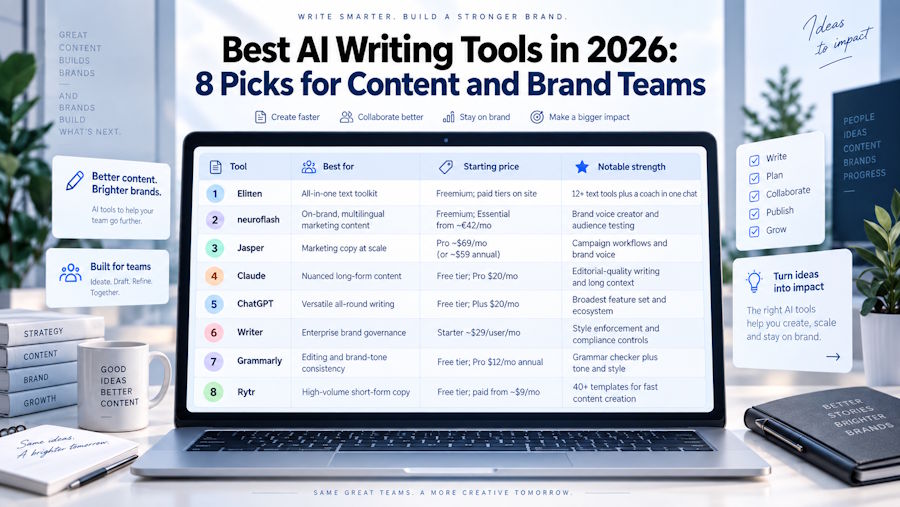
The best AI writing tools in 2026 at a glance
Before the detailed reviews, here is a quick comparison. Prices are the current starting point for each tool as of publication; the deeper entries below explain what each tier includes.
| Tool | Best for | Starting price | Notable strength |
|---|---|---|---|
| Eliten | All-in-one text toolkit | Freemium; paid tiers on site | 12+ text tools plus a coach in one chat |
| neuroflash | On-brand, multilingual marketing content | Freemium; Essential from ~€42/mo | Brand voice creator and audience testing |
| Jasper | Marketing copy at scale | Pro ~$69/mo (or ~$59 annual) | Campaign workflows and brand voice |
| Claude | Nuanced long-form content | Free tier; Pro $20/mo | Editorial-quality writing and long context |
| ChatGPT | Versatile all-round writing | Free tier; Plus $20/mo | Broadest feature set and ecosystem |
| Writer | Enterprise brand governance | Starter ~$29/user/mo | Style enforcement and compliance controls |
| Grammarly | Editing and brand-tone consistency | Free tier; Pro $12/mo annual | Grammar checker plus tone and style |
| Rytr | High-volume short-form copy | Free tier; paid from ~$9/mo | 40+ templates for fast content creation |
Pricing is accurate as of publication (August 2026) and changes often. Confirm the current rates on each vendor's site before you buy.
The 8 best AI writing tools in 2026
1. Eliten — best all-in-one text toolkit
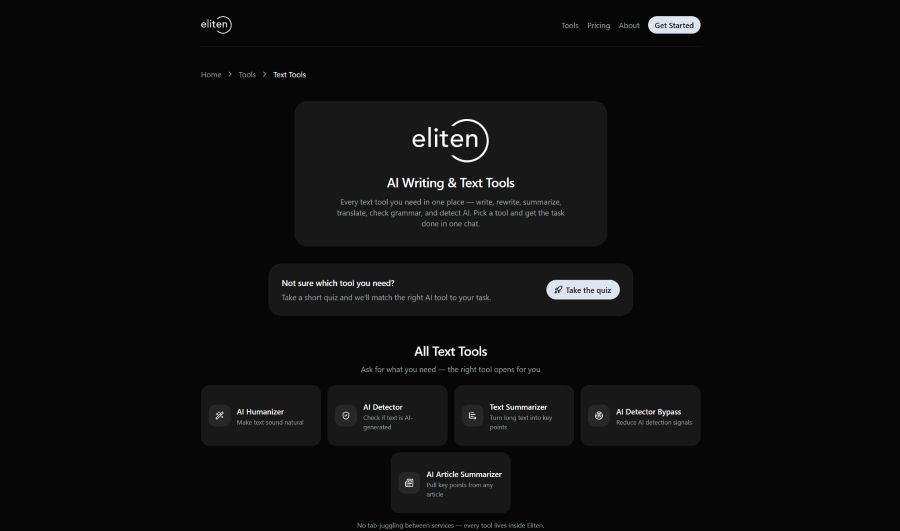
Most teams end up juggling a paraphraser in one tab, a summarizer in another, a grammar checker in a third, and a general chatbot in a fourth. Eliten collapses that sprawl into a single workspace. It brings more than a dozen AI text tools together in one chat — an AI writer, humanizer, AI detector, paraphraser, rewriter, several summarizers, a grammar checker, translation, and more — so you can move from drafting to editing to checking without switching between apps.
What makes Eliten stand out among AI writing tools is its approach for people who are not sure which tool they need. Instead of dropping you in front of a blank canvas, it offers a short quiz that matches the right AI tool to your task, and a built-in coach that guides you through the workflow.
For a content team onboarding junior writers, or a small business owner writing marketing copy for the first time, that guidance shortens the learning curve considerably.
Best for: Content teams, agencies, and small businesses that want one workspace for every text task instead of a stack of single-purpose subscriptions.
Pricing: Eliten runs on a freemium model — you can start at no cost and upgrade as your usage grows. Because plans and limits can change, check the current tiers on the Eliten site rather than relying on a third-party figure.
Keep in mind: Eliten is a text-first workspace. If your priority is a heavy, standalone SEO research suite with SERP analysis, you will still want a dedicated platform alongside it. For day-to-day writing, rewriting, summarizing, and checking, though, having every tool in one chat is a genuine time-saver.
2. neuroflash — best for on-brand, multilingual marketing content

For teams producing marketing content in European languages, neuroflash is one of the strongest options on the market. Built with German and multilingual output at its core, it pairs a large template library with a brand voice creator that keeps your unique brand voice consistent across blog posts, ad copy, and social media posts.
If your audience spans several markets, a tool that writes natively in each language is worth far more than one that only translates after the fact.
Where neuroflash goes beyond most AI writers is audience testing. Its "Digital Twins" feature builds AI-supported target-audience profiles from real survey data, so you can gauge how a segment might respond to a headline or campaign before you publish.
It also bundles SEO research, plagiarism checks, and integrated AI image generation, which makes it a genuinely all-round content creation platform rather than a plain text generator.
Best for: Marketing teams and agencies producing high quality content across multiple European languages, especially where brand consistency and audience fit matter.
Pricing: neuroflash offers a limited no-cost tier and a 7-day trial, with paid plans starting around €42 per month for Essential and roughly €84 per user per month for Pro; Enterprise is custom-quoted. Figures vary by region and VAT, so confirm the current numbers on the neuroflash pricing page.
Keep in mind: Reviewers consistently note that pricing runs high for solo users, and the word allowances on lower tiers can run out faster than expected. It shines for teams; individuals on a tight budget may find better value elsewhere.
3. Jasper — best for marketing copy at scale
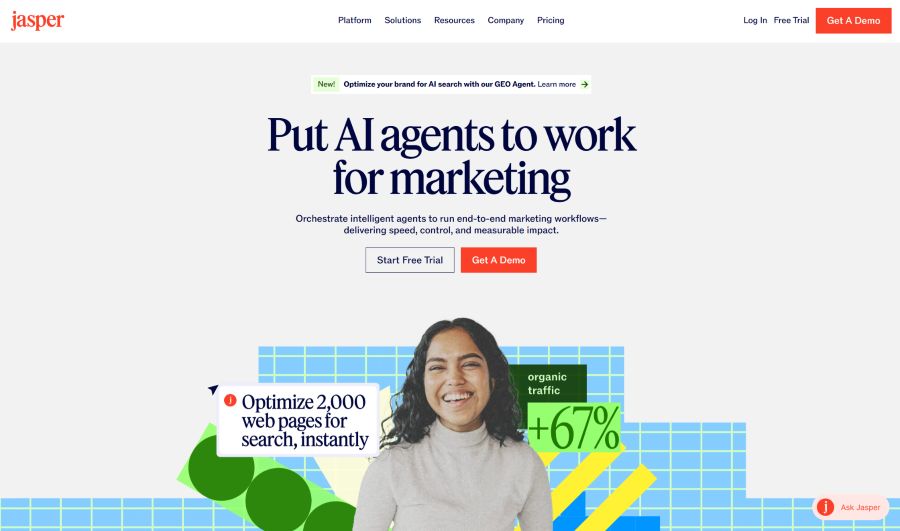
Jasper has spent years positioning itself as the AI writing tool for marketing teams, and it remains one of the most capable options for producing on-brand marketing copy at volume. Its strength is workflow: brand voice profiles, campaign templates, a document canvas, and a browser extension that follows you into Google Docs, Gmail, and your CMS.
Feed it your brand guidelines and it will keep ad copy, emails, and blog posts sounding like you across an entire campaign.
Jasper is best understood as a platform rather than a single drafting tool. For a team pushing out dozens of assets a week, the ability to lock in brand voice settings once and reuse them everywhere is where the time savings come from.
It also integrates with SEO and grammar tools, so it can sit at the center of a larger content creation process.
Best for: Marketing teams and content agencies producing marketing copy at scale who need brand consistency and collaboration features.
Pricing: Jasper has moved away from a permanent free plan. Its Pro plan is around $69 per month (roughly $59 per month billed annually), with a lower-cost Creator tier still listed by some sources near $39–$49 and a custom-priced Business plan for larger teams. Jasper reworks its pricing often, so check jasper.ai for the current lineup, and note there is a 7-day trial rather than an ongoing free tier.
Keep in mind: Several "included" capabilities lean on paid add-ons or third-party subscriptions, so the real monthly cost can climb above the headline price. For a solo writer, Jasper is more tool than you likely need.
4. Claude — best for nuanced long-form content
When the job is generating long form content that has to read like a thoughtful human wrote it — an in-depth guide, a whitepaper, a nuanced newsletter — Claude is hard to beat. It handles long context well, holds a consistent writing style across thousands of words, and tends to produce prose that needs less heavy editing than most AI writers.
For editorial teams that care about voice and argument, it is often the strongest general-purpose AI writing assistant available.
Claude is also useful earlier in the writing process. Its deep research capabilities can cross-reference multiple sources and help with brainstorming ideas, outlining, and pressure-testing an argument before you start writing.
Paste in a long brief or a set of documents and it will synthesize them cleanly.
Best for: Writers and content teams producing long-form, editorial-quality content where tone and nuance matter more than templates.
Pricing: Claude has a genuinely usable free version, with the Pro plan at $20 per month (about $17 per month billed annually) for higher limits and larger projects. Heavier Max tiers sit above that. Along with ChatGPT, Claude is frequently cited among the best free AI writing tools for general drafting, because the no-cost tier is capable rather than a crippled demo.
Keep in mind: Claude focuses on text; it has no built-in image generation, so a content team that needs visuals will pair it with other tools. Usage caps on lower tiers can also interrupt a long working session.
5. ChatGPT — best versatile all-rounder
ChatGPT is the tool most people think of first, and for good reason: it is the most versatile tool in the category. It drafts blog posts, rewrites marketing copy, brainstorms campaign angles, summarizes research, writes code, and analyzes data — all in one place.
For a team that wants a single, flexible AI writer to create content of every kind, it is the safe default.
Its ecosystem is the other draw. A vast library of custom assistants, image generation, voice, and integrations means ChatGPT can slot into almost any part of your content creation process.
If you are not sure exactly what you need yet, it is a low-risk place to start writing and learn what AI writing assistance can do for your workflow.
Best for: Teams and individuals who want one adaptable tool for a wide range of writing tasks, from ad copy to long-form drafts.
Pricing: ChatGPT has a free tier, an $8-per-month Go plan, and the popular Plus plan at $20 per month, with higher Pro tiers above that and Business seats around $25 per seat. Pricing and model access shift regularly, so verify on the OpenAI site before subscribing.
Keep in mind: Because it is a generalist, ChatGPT lacks the brand governance and template structure that dedicated marketing platforms offer. For strict brand consistency across a large team, a specialized tool will serve you better.
6. Writer — best for enterprise brand governance
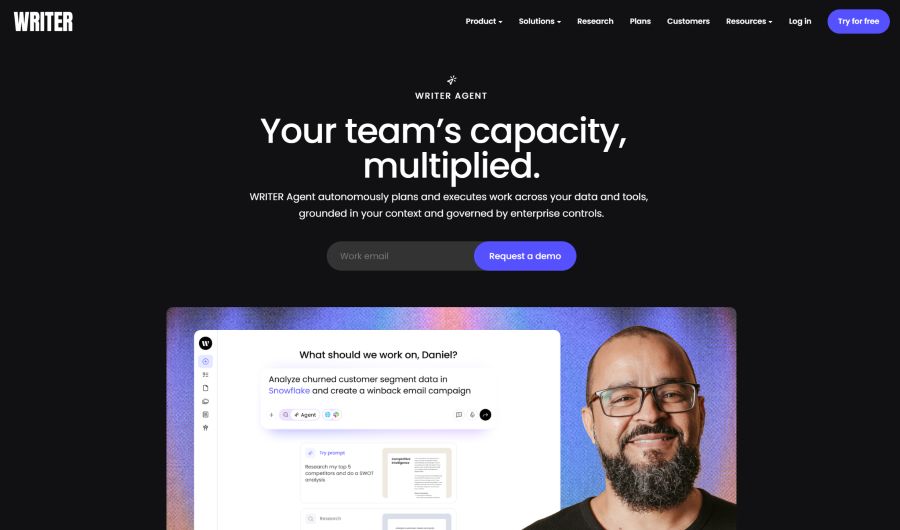
Where most AI writing tools help one person write faster, Writer is built to keep an entire organization on-brand and compliant. It is an enterprise platform rather than a personal AI writing assistant: it enforces your style guide, terminology, and brand voice across every team, and layers in governance, security, and compliance controls that regulated industries need.
Its Knowledge Graph grounds outputs in your own approved company data, which cuts down on the invented "facts" that plague generic tools.
For a large content marketing department producing thousands of assets a month, Writer's real value is control. Playbooks can automate multi-channel content creation — drafting a blog post, its email variants, and social posts from a single input — while keeping everything inside your rules.
This is one of the few AI writing tools designed around consistency and accuracy first, output volume second.
Best for: Mid-market and enterprise teams that need centralized brand governance, compliance, and a shared unique brand voice across many writers.
Pricing: Writer's self-serve Starter plan runs around $29 per user per month billed annually (about $39 monthly) and is capped at a small number of seats; larger deployments move to custom-quoted Enterprise pricing. The pricing page can be hard to read, so contact Writer or check current third-party trackers for up-to-date figures.
Keep in mind: Writer is overkill for small teams and solo writers, and the true cost includes implementation. It earns its price only when brand and compliance governance at scale is a genuine requirement.
7. Grammarly — best for editing and brand-tone consistency
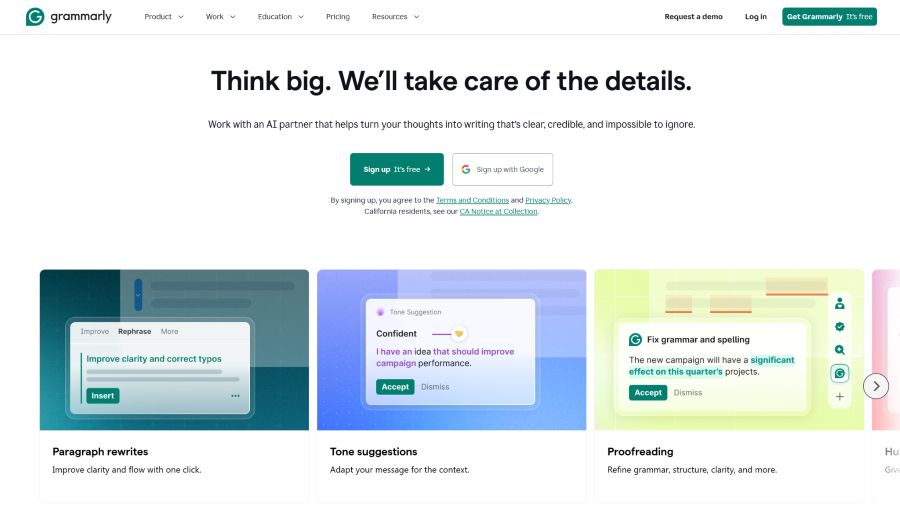
Grammarly remains the benchmark grammar checker, and in 2026 it is far more than a red-underline tool. Alongside real-time grammar, spelling, and clarity fixes, it now offers full-sentence rewrites, tone adjustment, plagiarism detection, and AI-text detection, plus lightweight team features for enforcing a shared writing style.
It works almost everywhere you write — the browser, Google Docs, Microsoft Word, email — which is exactly what you want from editing tools: they should meet you where you already write, not force you into another app. Good AI writing assistance should feel invisible.
For content and brand teams, Grammarly's value is as the polish layer at the end of the writing process. It will not draft a campaign for you, but it will make sure everything you publish is clean, consistent in tone, and aligned to your brand's style.
Pair it with a drafting tool from earlier in this list and you have a complete generate-then-refine pipeline.
Best for: Teams and writers who want a dependable grammar checker and editor that also nudges tone toward a consistent brand style.
Pricing: Grammarly's free version is one of the better no-cost tiers in software, covering grammar, spelling, tone detection, and a monthly allowance of AI prompts. Grammarly Pro is $12 per month billed annually (or $30 month-to-month) and unlocks rewrites, plagiarism detection, and light team controls; Enterprise is custom-priced. Note that Grammarly's parent company rebranded to Superhuman in late 2025, but the writing product is still called Grammarly.
Keep in mind: Grammarly is an editor, not a generator. On heavy AI use, the monthly prompt cap on Pro can pinch teams that run rewrites on every paragraph of long form content.
8. Rytr — best for high-volume short-form copy on a budget
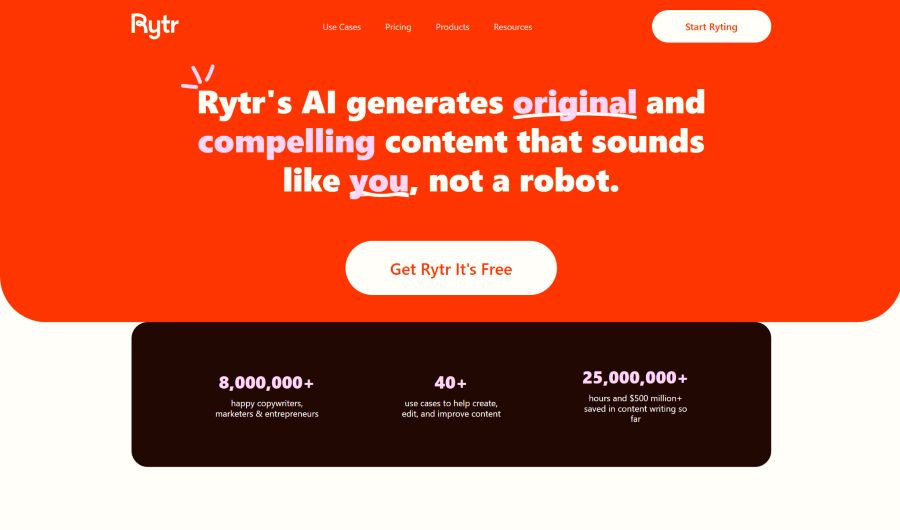
Not every team needs an enterprise platform. If your work is high-volume short form content — product descriptions, ad copy, social captions, email subject lines — Rytr is one of the most cost-effective AI writing tools you can buy.
It offers more than 40 templates and 30-plus languages, wrapped in a simple, template-driven interface: pick a use case, feed it a short input, and get usable copy back in seconds.
Rytr also includes a "MyVoice" feature that trains the tool on samples of your own writing, so output leans toward your style, plus a built-in plagiarism checker and a Chrome extension for writing inside Google Docs and other web apps. It is not built for generating long form content — coherence drifts over long passages — but for short, repeatable marketing copy it punches well above its price.
Best for: Freelancers, solo marketers, and small teams producing a steady stream of short-form marketing copy who want the lowest sensible cost per asset.
Pricing: Rytr keeps a genuinely useful free plan (around 10,000 characters a month, roughly 1,500–2,000 words, with access to all templates). Paid plans start near $9 per month for unlimited generation, with a Premium tier around $29 per month adding wider language support and higher plagiarism-check limits. Annual billing lowers the effective monthly rate; confirm current numbers on Rytr's pricing page.
Keep in mind: Rytr is a short-form specialist. For long-form articles, the required editing time makes the true cost higher than the sticker price suggests, and you will lean on other tools for governance, which platforms like Writer or neuroflash provide.
How to choose the right AI writing tool for your team
The best AI writing tools slot into how you already work rather than forcing a new routine. Start with free AI tools before committing to paid software, and choose based on the specific writing tasks in front of you rather than on which AI writer is "most powerful." A few common profiles:
If you run content marketing across channels
Look for a platform, not just a chatbot. Jasper and neuroflash are built for content marketing at volume, with campaign workflows, templates, and brand voice controls that keep blog posts, ad copy, and social media posts consistent.
Eliten works well here too when you want the whole text toolkit — drafting, rewriting, summarizing, checking — in one place.
If you manage a brand voice across a team
Consistency is the hard part once more than one person writes. Writer is purpose-built for enforcing a unique brand voice and style guide across an organization, while Jasper's brand voice feature and neuroflash's brand voice creator handle it well for mid-sized teams.
Grammarly adds a shared tone and style layer at the editing stage.
If you write long-form content
For in-depth guides and thought leadership, prioritize prose quality and context length over templates. Claude leads here for nuanced, editorial writing, with ChatGPT close behind as the more versatile tool.
Both handle brainstorming ideas, outlining, and drafting, and both need a human editing pass before publication.
If you need multilingual content
If you publish across markets, native multilingual output beats bolt-on translation. neuroflash is a standout for European languages, and Rytr's 30-plus language support makes it a budget option for short-form content in many languages.
If you're a solo creator or freelancer
You probably do not need an enterprise platform. Start with free AI tools — Claude, ChatGPT, or Rytr's free plan — and lean on an all-in-one option like Eliten so a single subscription covers most of your writing tasks with one AI writer.
Solo creators get the best return from a flexible tool that handles many jobs, rather than a heavyweight suite built for large marketing teams. You can always add other tools later as your needs grow.
If you write fiction or other creative work
Marketing tools are the wrong fit for creative writing. Fiction writers — authors and screenwriters — are better served by apps built for writing fiction, which help with plotting, character, and dialogue rather than ad copy.
Creative writing has different demands: pacing, voice, and continuity across a long manuscript, none of which a marketing template handles well. Creative writing — and especially writing fiction — rewards a tool that understands story, not one tuned for conversion.
If a fiction project is your goal, look at dedicated creative writing tools rather than the marketing-focused options above; a general assistant like Claude can also serve as a capable creative drafting partner for many fiction writers.
Keeping a consistent brand voice with AI
For a brand team, the single biggest risk with AI writing tools is that everything starts to sound the same — generic, over-polished, and voiceless. Getting a unique brand voice out of these tools takes a little setup, but it pays off across every piece you publish.
The tools that do this best let you define brand voice settings once and apply them everywhere. neuroflash's brand voice creator, Jasper's brand voice profiles, Writer's style enforcement, and Rytr's MyVoice all learn from examples of your existing content, then bias new output toward that style. Feeding a tool three or four strong samples of your own writing — a landing page, a well-loved email, a signature blog post — teaches it your rhythm and vocabulary far better than a list of adjectives.
Even without a dedicated brand voice feature, you can guide any AI writing assistant with a short style prompt: describe your tone, list words you use and words you avoid, and paste an example. The goal is not to let the tool write in its default register, but to make your brand voice the register it writes in.
The AI writing workflow that actually works
The teams that get the most from AI writing tools treat them as one stage in a cycle, not a magic "publish" button. Slotting AI into the writing process early is where the savings start.
The workflow that consistently produces high quality content looks like this: create content as a first draft with AI, apply human editorial judgment to shape and fact-check it, then run a final polish through editing tools.
That middle step is where the value is created. AI can accelerate the entire writing process — a blank page becomes a working draft in minutes, and it is genuinely useful for brainstorming ideas and helping writers overcome writer's block.
But the draft is a starting point, not a finished asset. In practice, editing usually accounts for a large share of the total time — often somewhere between a third and half of it — and that human pass is exactly what separates content that ranks in search engines and resonates from content that reads like it was churned out by a machine.
A realistic rule of thumb: let AI handle the actual writing of the first draft and the mechanical polish, and reserve your team's time for judgment — structure, accuracy, voice, and the ideas a model cannot originate. Used that way, AI writing assistance can meaningfully cut content creation time without cutting quality, so you still ship high quality content.
The best AI tools amplify judgment; they do not replace it. Used the other way — publishing raw AI content — it quietly erodes trust.
Starter tiers vs. paid plans: where to begin
You do not need to spend anything to find out whether AI writing tools fit your team. Almost every option here has a free tier or trial worth using first:
- Claude and ChatGPT both offer a capable free version for general drafting and editing. For many writers, a free plan is enough to write content for everyday tasks.
- Grammarly's free plan handles grammar, spelling, and basic tone across the web and Google Docs.
- Rytr's free tool gives you a real monthly allowance and access to all templates — enough to test short-form content generation properly.
- neuroflash and Eliten both let you start at no cost before you commit.
Move to paid plans when a specific limit gets in your way — usually word or character caps, missing brand controls, plagiarism checks, or team features. A useful sequence: run your real work through a free tier for a week, note exactly where you hit a wall, and upgrade only the one tool that removes that wall.
An unlimited plan or a per-seat team plan is worth it when the time you save clearly outweighs the monthly cost; below that threshold, the free version usually wins. Paid plans unlock more advanced features and lift caps, but only pay when a cap is actually blocking you.
Common mistakes teams make with AI writing tools
A few patterns separate teams that get real value from those that end up with a folder of unusable drafts:
- Publishing raw AI content. The fastest way to sound like everyone else is to skip the human edit. AI writing tools produce a draft, not a final asset.
- Chasing the "best" tool instead of the right fit. The most advanced features are irrelevant if they do not match your writing tasks. Evaluate tools by the workflow problem they solve, not the length of their feature list.
- Ignoring brand voice. Default AI prose is generic. If you do not set brand voice settings or provide examples, the tool will not read like you.
- Trusting facts blindly. Because these tools can produce confident, authoritative-sounding text with subtle errors, every statistic and claim needs checking against a real source.
- Paying before testing. Start with free AI tools, learn where they fall short for your team, and only then reach for paid plans.
Avoid these traps and the best AI writing tools stop being a gimmick and start being a genuine multiplier. Treat AI content as a first draft to shape, never a finished product to publish, and these AI tools free your writers to do the work only humans can.
Quick recap: which AI writing tool should you pick?
If you skimmed to the end, here is the short version of the best AI writing tools in 2026. For an all-in-one text toolkit that keeps drafting, rewriting, summarizing, and checking in one workspace, start with Eliten.
For on-brand, multilingual marketing content, neuroflash is the standout, with Jasper close behind for marketing copy at scale. For nuanced long-form writing, Claude leads and ChatGPT is the most versatile all-rounder.
For enterprise brand governance, choose Writer; for editing and a dependable grammar checker, Grammarly; and for high-volume short form content on a budget, Rytr.
There is no single winner among these AI writing tools. Match the tool to the writing, not to the hype, and the right AI writer will save your team real time on every draft.
Frequently asked questions
Is ChatGPT the best AI for writing?
ChatGPT is the most versatile AI writing tool and an excellent default, but "best" depends on the task. For nuanced, long-form, editorial writing, many teams prefer Claude, which tends to hold voice and argument better across long documents.
For on-brand marketing copy at scale, dedicated platforms like Jasper and neuroflash often beat a general assistant because of their brand controls and templates. ChatGPT is the strongest generalist; the best AI writing tool for you is whichever matches the writing you actually do.
Is ChatGPT still the best AI?
ChatGPT remains one of the top general-purpose AI tools, but the field is genuinely competitive in 2026. Claude is widely regarded as its equal or better for writing quality and long-context work, and Google's Gemini is a strong all-rounder, while specialized platforms outperform all of them within their niches.
Rather than a single "best AI," think in terms of best-for-the-job: ChatGPT for versatility, Claude for editorial writing, and purpose-built tools for marketing, editing, or enterprise governance.
What are the top 5 AI tools right now?
For writing work in 2026, five tools come up again and again: Eliten for an all-in-one text toolkit, ChatGPT and Claude as the leading general-purpose assistants, Jasper for marketing content at scale, and Grammarly as the standard for editing and grammar. Depending on your needs, neuroflash (multilingual marketing content), Writer (enterprise governance), and Rytr (budget short-form) round out a strong shortlist.
There is no universal top five — the right set depends on whether your priority is drafting, editing, brand consistency, or scale — and creative writing needs a different tool again.
Is it illegal to publish a book written by AI?
Publishing a book written with AI is legal in the United States and permitted on major platforms, including Amazon Kindle Direct Publishing, provided you follow the disclosure rules. Amazon requires authors to disclose AI-generated text, images, or translations during setup; that disclosure is internal and not shown to readers, and using AI does not get you banned as long as you disclose and the book offers real value.
The nuance is copyright, not legality: the U.S. Copyright Office generally will not register purely AI-generated text without meaningful human authorship, and a related case is before the Supreme Court, so the safest approach is to treat AI as a first-draft tool and invest genuine creative editing before you publish. This is general information, not legal advice — check current platform policies and, for anything high-stakes, a qualified attorney.
Do AI writing tools all use the same technology?
Largely, yes — and that is a useful thing to know. Most AI writing tools are built on similar large language models, so the underlying text-generation quality across the best options is closer than the marketing suggests.
What actually differs is everything around the model: tone and style settings, templates, editing tools, team controls, multilingual support, and how well the tool fits your workflow. That is why you should choose based on the writing tasks and workflow problems a tool solves, not on claims about raw AI power.
Can AI writing tools help with SEO content?
They can assist, though this roundup deliberately focuses on writing rather than SEO tactics. Several tools here — neuroflash and Jasper among them — bundle keyword research or SEO research features that help you produce SEO ready articles, and a clean, well-structured draft that reads well for people tends to perform in search engines too.
For serious ranking work you will still pair your AI writer with a dedicated optimization platform, since getting content to the top of search engines is a job in itself. But for the writing and content creation, any of the tools above will speed you up.
Do you need to pay for an AI writing tool?
For many writers, no. The free AI writing tools most teams start with — Claude, ChatGPT, and Rytr's free plan — cover everyday drafting, rewriting, and editing without a subscription.
A free version is often enough to write content, test your workflow, and decide whether an upgrade earns its keep. You typically move to paid plans only when you hit a specific ceiling — word count caps, missing brand controls, plagiarism checks, or team features.
The smart play is to start on a free tool, learn where it falls short, and pay to fix that one gap.
What is the best AI writing software for beginners?
Beginners are usually best served by an all-in-one, guided tool rather than a blank chatbox. Eliten is a strong starting point because it matches the right tool to your task and includes a coach, which smooths the learning curve.
ChatGPT is another gentle on-ramp thanks to its versatility, and Grammarly makes editing approachable. The best AI writing software for you is the one you will actually use — so favor a simple, flexible option over the most feature-heavy platform when you are getting started.

