

Free online tools fix minor issues quickly. A file converted, an image resized, or a profile checked? You open a tab, do the thing, and go back to your life.
Things only become problematic when an instrument becomes obsolete. The page stays online. Still, the feature list looks good. However, the work behind it has quietly ground to a halt, and nothing on the page indicates this.
While testing a well-known Instagram viewer, I ran into this. By then, the catch-all Picuki domain was no longer active, and six other sites were just running the name. They all failed to deliver on what their pages promised.
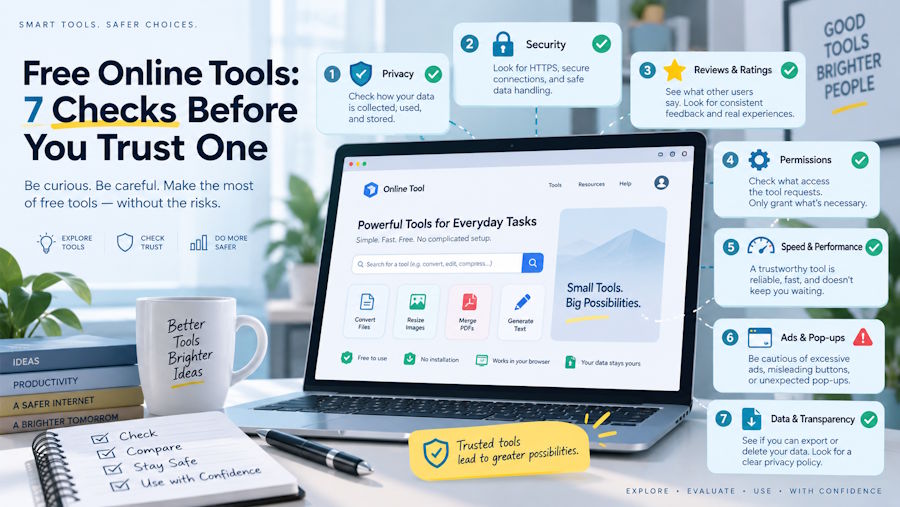
Here is the checklist that came from that experience. These seven checks take five minutes to complete. They do it on any free tool—not just through that.
Key Takeaways
- Having a live page does not equate to having a tool that works.
- Do not use a site without finding out who runs it first.
- What is in a name, but this does not add up to ownership?
- Check if the buttons are doing what they claim.
- Compare Output with the Real Source
- If it wants a login or an install, leave.
Check 1: Who Runs the Tool?
Just before you get into anything, look for a named handler. A real tool includes documentation about who wrote it and how to contact them. If you don't find it within thirty seconds, suspect everything else on the page.
What to Look For
- An about page that mentions an individual or an organization
- Any contact method that works, like an email or a form
- A privacy policy that explains what is done with anything you enter
Why a Missing Owner Matters
If the tool messes up what you gave it, nobody is responsible. With no time to question which feature broke or when it might be fixed.
An anonymous page is not proof of wrongdoing. A lot of hobby projects are missing the about page, but it does mean you are putting your faith in something that has no name.
Where to Find Ownership Details
- The footer often has a company name
- Privacy policy, which indicates the person in charge
- Who sometimes appear as a registrant, and other public domain records
Check 2: Does the Domain Match the Tool's Name?
Confirm the site you are currently on is indeed the tool you meant to access. Names of popular tools are reused on different domains. The copies are similar enough to fool a passing glance, and none of them is obliged to be the true original.
How Copycat Sites Work
A tool builds a reputation. They start typing its name into Google. Those write-ups then retitle the work under another domain, or attach a page to a site they own.
Both moves are cheap. None of those need to be related to the tool people are looking for.
A Pattern You Can Spot Quickly
We see it spread through entire adjacent categories of instruments. One such situation is InstaPV, which is a case in point: several sites carry the same URL, and no single site is confirmed as official. How would a visitor know which is the real deal?
It is obvious once you have the pattern down. One name spans numerous domains, and no single site will say which came first.
Name Variations That Signal a Copy
- Same word, different ending from you
- Additional words attached to a recognized identity
- A few letters different spellings
Check 3: Is the Original Site Still Running?
Just write the domain of the tool itself directly into your address bar and see what you find. If it takes you to another service, the service probably has stopped operating. The name may continue to exist in some form, but the creative force behind it has moved on.
What a Redirect Tells You
On its own, a redirect isn't evidence of snaggery. Sites move and rebrand for all sorts of reasons.
But when that specific tool's domain returns a Page Not Found error, and the page makes no mention of the specific tool, there's no other way to interpret this than as an end.
How to Check in Under a Minute
- Solution is not: type the domain directly rather than clicking a result
- Observe the location where the address bar appears
- If the destination is not obvious, check public records of the domain
- See if the new page even credits the old tool
Check 4: Do the Buttons Do What They Say?
Push the button with the big label; see what happens. You should get the result the label promised. You know that if a new site opens in its place, something about how it makes money has become wrong.
The Redirect Test
Choose the most apparent button on the screen. Click it once.
Then repeat it. One stray ad proves little. Another surprising location suggests the behaviour is hardwired, not incidental.
Why This Check Reveals So Much
When buttons bounce you around, ads and features become indistinguishable. Each click becomes a guess as to what you are really clicking on.
And that guessing doesn't just cost you time. You could end up on pages you didn't choose, signing up for things you never read.
What to Do If It Keeps Redirecting
- Close the tab
- Deny any notification request
- Download nothing the page offers
- Never Test 2nd Tool From The Same Page
Check 5: Is the Data Current?
First, run the tool on something you can independently verify and then compare its result with the original source. This is the quickest way to find a tool that remains online but is no longer connected to real-time information.
Compare Against the Real Source
Run the tool on something where you already have the answer. View the source for this article: Open original in new tab. Then run a side-by-side comparison.
The gap appears right away if the tool pulls from somewhere else or an old copy.
Why Stale Data Is Worse Than No Data
A blank result is honest. It informs you that the tool didn't work, and you find another one.
An old result appears to be a solution. You pull the trigger without verifying, and then you never find out it was wrong. That is the far more costly failure.
Check 6: What Does It Ask You For?
Feed a free tool only what any given job needs. A converter needs your file. A public name or link is needed for a public lookup. Anything beyond that means you should examine it closely before you turn it over.
Requests That Should Stop You
- A login for an account on some other service
- This can either be a file download or installing a browser extension.
- Permission to send you notifications
- Unsurprisingly, personal information the latter task clearly does not require
The service that requests you to log in is a transferable tool. The tradeoff for those free conveniences is not worth it.
Requests That Are Usually Fine
- File or text that you want to process
- Anyone can be a public username or public link
- A format or size choice
Check 7: Do the Advertised Features Actually Work?
Do your workaround for it, but test the single feature you came for first. Feature lists are marketing copy. They are seldom updated if something below them breaks.
Test the Feature You Came For
You need not test everything. Choose one, focus on why you came to the tool in the first place, and try it today while you have nothing to lose.
That one test takes a minute. Later, for example, in the middle of a task, when the costs are much higher.
A Listed Feature Is Only a Promise
Most wasted time comes from the gap between what's listed and what works. A page may advertise ten features, but only two work, and nothing on the page says which two are the right ones.
These are not descriptions of what will be delivered, but claims to verify from the list.
The 5-Minute Checklist
This is the complete process in one place. Next time something pops up that needs a tool you have never heard of, run it down and stash it somewhere you will find it later.
| Check | What to look for | Red flag |
|---|---|---|
| Owner | About page, contact, privacy policy | No named operator anywhere |
| Domain | The name matches the real tool | Several sites, same name |
| Original site | The tool's own domain still loads | Redirects somewhere unrelated |
| Buttons | Clicks do what the label says | New sites open instead |
| Data | Output matches the live source | Old or missing results |
| Requests | Only what the task needs | Logins, installs, notifications |
| Features | The one you need actually runs | Listed but broken |
Most failing tools trip at least two of these. That overlap is useful, because you rarely need to run all seven before you have your answer.
When a Free Tool Is Worth Keeping
And many free tools pass every check. They name their operator, do what the buttons say they will, and return relevant results.
Bookmark those. The best tools in crowded categories are rare, and the copycats make it doubly difficult to find a second.
If any of your tools start acting crazy, run the checks again. More importantly, maintenance can end at any moment, and the page won't indicate that.
FAQs
Are free online tools safe to use?
Many are. The danger isn't the price but the maintenance. Generally speaking, a maintained tool with a designated operator and an explicit privacy policy is acceptable. A page that redirects your clicks to an empty place and then asks for a login is not trustworthy at all!
How can I tell if a free tool has been abandoned?
Plug in its own domain in the browser address bar and check if that still opens up. Then you compare one feature to a source that is easier to follow up on. A redirect somewhere else or results that do not match the live source both indicate a completed project.
Why do so many sites use the same tool name?
Traffic from a recognised name lasts long after the original gets stale. Some sites claim the title for use on another domain or a section titled that. They can sweep them up without any barricades whatsoever; this leads to one name being distributed across different and disparate sites.
Should I ever log in to a free online tool?
Not with another service account. If it asks for your credentials elsewhere, it is asking for access it doesn't need to do the job. When the task does require an account, use the official service.
What should I do if a tool redirects me?
Close the tab. Refuse notifications and download nothing from the new page. Then look for another tool, because a page that intercepts your clicks has shown what it uses it for.

