

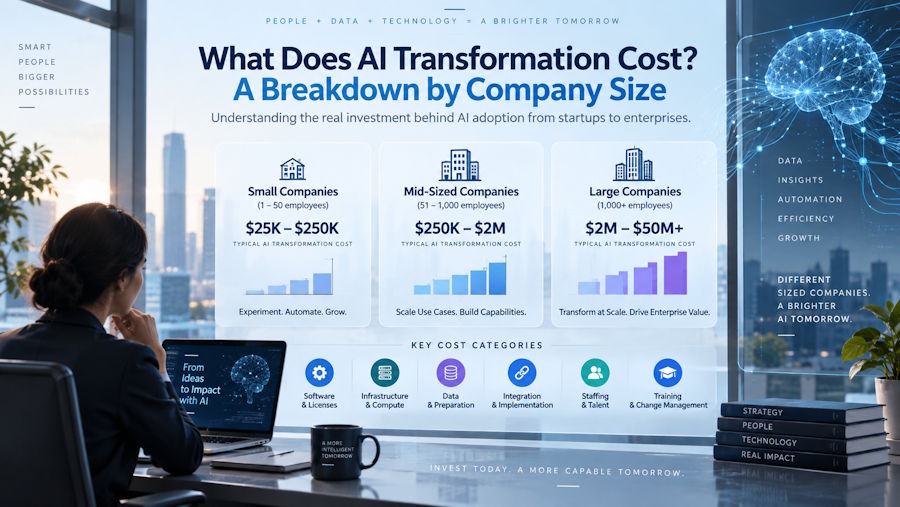
Ask three vendors what an AI transformation costs, and you may get three very different answers. One might quote $25,000 for a focused pilot; another may propose a $400,000 program involving data cleanup, integrations, governance, and training. Both can be reasonable because they describe different jobs.
The useful question, then, is not simply, “How much does AI cost?” It is: “What must change in our company before this AI system can produce a reliable business result?” Company size affects the answer, but scope, data quality, security requirements, and internal capacity usually matter more than headcount alone.
What costs are included in an AI transformation project?
AI transformation is broader than buying a software subscription. A serious budget may include discovery, data engineering, model configuration, system connections, testing, training, and ongoing support. Skip one of those lines and the initial quote looks cheaper. The expense often returns later as rework.
Before comparing vendors, ask each one to separate its estimate into:
- Business discovery and use-case selection, which may take a few workshops or several weeks of process analysis.
- Data preparation, including collection, cleaning, labeling, access controls, and migration.
- Software work such as model configuration, custom development, integrations, user interfaces, and testing.
- Rollout costs: training, documentation, monitoring, security reviews, and post-launch maintenance.
If you are still deciding what kind of outside support you need, here's a useful breakdown of AI transformation service providers. It can help you compare a strategy-led consultancy with a team hired mainly to build and deploy a defined solution.
One warning: the ranges below are planning estimates, not rate cards. They assume a genuine business implementation rather than a personal AI subscription, and actual quotes can land above or below them.
How much does AI transformation cost for a small business?
For a small company, a sensible first project often falls between $15,000 and $80,000. That could cover an AI assistant connected to approved company documents, automated extraction from invoices, lead qualification, or a customer-service tool with human review. A broader rollout involving several workflows and custom integrations may reach $80,000 to $200,000.
Small businesses often have fewer legacy systems, so decisions and training can move quickly. Yet they also have less room for failure. Spending $60,000 on a clever demo that saves nobody time is painful.
The best first use case usually has four traits:
- A repetitive task already consumes measurable employee hours.
- The required data exists and can legally be used.
- Errors can be reviewed before they affect a customer or payment.
- Success can be measured within three to six months.
A 25-person services firm may start with proposal drafting or document search rather than automating several departments at once. Narrow can be good. If that system saves 60 staff hours each month, the company has evidence for its next investment.
How much does AI transformation cost for a mid-sized company?
Mid-sized companies should often plan for $100,000 to $750,000 during the first substantial phase. A contained deployment may sit near the bottom of that range. Programs spanning multiple departments, data sources, or customer-facing systems can move toward $1 million, especially when security and compliance work is heavy.
Why does the number rise so fast? Integration. A 400-person company may have a CRM, ERP, ticketing platform, document store, analytics stack, and spreadsheets that quietly run important processes. The AI layer has to work with that reality. Building the model may be easier than deciding which customer record is correct.
A realistic mid-market budget might be divided across:
- 10–20% for discovery, process mapping, architecture, and risk assessment.
- 20–40% for data access, cleanup, pipelines, and permissions.
- 25–45% for development, integration, testing, and user experience.
- 10–20% for rollout, training, monitoring, and the first support period.
These percentages overlap because contracts are structured differently; some vendors include project management or testing inside development. Use them as a check, not a formula. If a proposal assigns almost nothing to data work even though your records are fragmented, ask why.
How much does enterprise AI transformation cost?
At enterprise level, a single production use case can cost $500,000 to $2 million. A multi-year program across business units may run from $2 million to $10 million or more. The wide span is unavoidable: connecting an internal knowledge assistant for one division is not comparable to changing underwriting, manufacturing, or supply-chain decisions across several countries.
Enterprises pay for controls that smaller deployments may handle informally. Identity management must work across thousands of accounts. Legal teams need rules for confidential data and third-party models, while security teams want audit logs, testing, incident plans, and clear ownership. Change management adds another substantial cost.
Large companies should usually fund the program in stages:
- Portfolio assessment: Rank use cases by value, feasibility, risk, and data readiness.
- Pilot: Test one workflow with a small user group and predefined success criteria.
- Production release: Strengthen the system, integrate it properly, and introduce monitoring.
- Expansion: Add teams or use cases only after the economics and controls hold up.
This stage-gate approach does not guarantee a low bill. It does stop a promising prototype from turning into an open-ended corporate project with no accountable owner.
Why do two AI projects for similar companies cost different amounts?
Company size gives you a rough bracket, but five questions explain much of the variation.
How ready is your data for AI?
Clean, accessible data lowers the cost. Scattered PDFs, duplicate customer records, missing fields, and unclear permissions raise it. If employees cannot agree on which dashboard is accurate today, an AI system will not settle the argument by itself.
Do you need a custom model or an existing AI product?
Using an established model through an API is generally cheaper than training a model. Fine-tuning or building specialist models may be justified when accuracy, latency, privacy, or domain language demands it. Often it is not the first move.
How many systems need to be connected?
One connection to a modern CRM can be manageable. Linking old on-premise software, a data warehouse, and home-grown tools changes the project. Each integration brings testing, access, and maintenance work.
What happens when the AI is wrong?
The cost of an error shapes the required safeguards. A weak internal draft can be corrected by an employee. A wrong credit, medical, or pricing decision may cause financial harm or regulatory trouble, so the system needs stricter evaluation and human oversight.
Can your own team support the system?
If internal staff can manage data pipelines, security, product ownership, and user training, outside costs may fall after launch. Without that capacity, budget for a longer vendor relationship or new hires. Otherwise, the system may work on release day and slowly degrade afterward.
How much should you budget after the AI system launches?
Launch is the start of operating spend. As a rough planning rule, set aside 15–30% of the initial build cost per year for model usage, cloud infrastructure, monitoring, updates, user support, security work, and improvements. A $200,000 implementation might therefore require $30,000–$60,000 annually, although high-volume model calls or frequent redevelopment can push that higher.
Track the costs people tend to miss:
- Model or API fees that rise with usage.
- Cloud storage, computing, monitoring, and backup.
- Human review for sensitive or low-confidence outputs.
- Retraining, prompt and workflow updates, security testing, and vendor support.
- Time spent by internal experts checking quality and handling exceptions.
Usage-based charges deserve special attention. A pilot with 50 users may look inexpensive, then change sharply when 2,000 employees gain access. Ask vendors to model low, expected, and high usage before you approve the architecture.
How do you build an AI budget that management can trust?
Start with the current process, not the technology. Measure how many cases the team handles, how long each one takes, the cost of mistakes, and the delay customers experience. Then set a target the project can prove: perhaps reducing document review time by 30% while keeping every final decision with an employee.
Your business case should include implementation, internal staff time, recurring costs, contingency, and the expected benefit over two or three years. Keep the assumptions visible. If the forecast depends on 90% adoption in the first month, management should see that risk early.
A useful first budget is specific enough to test but small enough to stop. Choose one valuable workflow, define the accuracy and adoption thresholds, and decide in advance what evidence will unlock the next phase. That makes the cost of AI transformation easier to defend because each new dollar follows a result, not a promise.

