

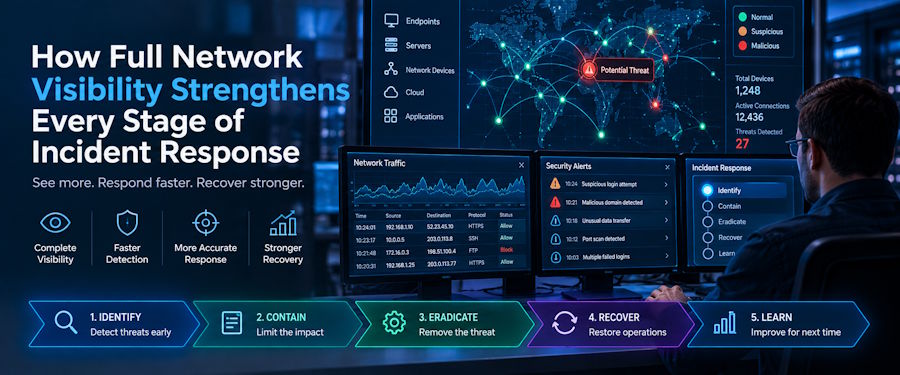
Security teams often discover the true cost of limited visibility only after an incident is already underway. A partial view of network activity might be enough to catch a suspicious alert, but it rarely provides enough context to confirm what happened, how far it spread, or when it is truly safe to call the situation resolved. Full network visibility changes that equation, giving teams the evidence they need at every stage of an investigation rather than forcing them to guess based on fragments.
Why Visibility Gaps Undermine Early Validation
The first challenge in any security event is determining whether an alert represents a real threat or a false positive. This step, often called validation, sets the tone for everything that follows. Move too slowly and a genuine attacker gains valuable time. Move too fast on a false alarm and the team wastes resources chasing a non-event while a real issue elsewhere goes unnoticed.
Teams working with limited visibility, relying mainly on endpoint alerts or summarized logs, often struggle to validate quickly because they lack the underlying detail needed to confirm what actually occurred. An alert might indicate unusual outbound traffic, but without visibility into the actual content and destination of that traffic, analysts cannot easily tell whether it reflects a legitimate business process or an active compromise. Full network visibility resolves this ambiguity directly, since analysts can examine the actual traffic in question rather than relying on inference from partial data.
Accurate Scoping Depends on Seeing the Whole Picture
Once a team confirms that an incident is real, the next question is almost always the hardest to answer with confidence: how far did it spread? Scoping an incident correctly determines everything that follows, from which systems need remediation to how the organization communicates with stakeholders and, in regulated industries, whether disclosure obligations apply.
Incomplete visibility tends to produce incomplete scoping. If an organization can only see traffic at certain points in the network, an attacker moving laterally through segments outside that coverage may go undetected entirely. This is one of the more damaging consequences of partial visibility during incident response, since an organization might reasonably believe it has contained an incident when compromised systems remain hidden outside its field of view. Comprehensive network visibility, capturing traffic across the segments an attacker is likely to traverse, gives investigators a far more reliable basis for determining the true boundaries of an incident rather than an assumption based on the systems that happened to generate alerts.
Containment Decisions Improve With Real-Time Context
Containment involves difficult tradeoffs. Isolating a system too aggressively can disrupt business operations unnecessarily, while acting too cautiously allows an active threat to continue spreading. Making this call well requires current, accurate information about what is actually happening on the network at that moment, not just historical data from before the response began.
Full network visibility supports this stage of incident response by giving analysts real-time insight into ongoing traffic patterns, allowing them to confirm whether a suspected compromised system is still communicating with external infrastructure and whether containment actions are actually working as intended. Without this visibility, containment often becomes a matter of educated guesswork, applied broadly out of caution rather than targeted with precision. Teams that can observe network behavior directly tend to make faster, more confident containment decisions, reducing both the operational disruption and the residual risk that comes from acting on incomplete information.
Recovery Requires Confidence, Not Assumptions
Bringing systems back online after an incident carries its own risk. Restoring a system too soon, before confirming that an attacker's access has been fully removed, can allow the same intrusion to resume almost immediately. This is a well-documented failure pattern in incident response, where organizations declare an incident resolved only to discover renewed activity days or weeks later because remediation addressed visible symptoms rather than the full scope of compromise.
Network visibility supports recovery by allowing teams to verify, rather than assume, that malicious activity has actually stopped. Analysts can monitor previously affected segments for any signs of continued command-and-control communication or unusual traffic patterns before declaring systems safe to restore. This verification step matters considerably more than it might initially seem, since the cost of a premature "all clear" often exceeds the cost of a slightly longer, more thorough recovery process.
A few specific visibility-driven checks tend to appear consistently in well-run recovery processes:
- Confirming no outbound traffic to previously identified malicious infrastructure
- Verifying that restored systems are not generating the same anomalous patterns observed during the initial compromise
- Monitoring newly restored systems closely for a defined period before considering the incident fully closed
- Cross-checking recovery status against the full scope determined earlier in the investigation
Post-Incident Analysis Benefits From a Complete Record
After the immediate crisis passes, the investigation is far from finished. Post-incident analysis, sometimes called a post-mortem, determines what allowed the incident to occur, how the response performed, and what changes might prevent similar events in the future. This phase depends heavily on having a complete and accurate record of what actually happened, not a reconstruction based on partial evidence pieced together after the fact.
Organizations with full network visibility during the incident can revisit the actual traffic data during this analysis, confirming exactly how an attacker gained access, what techniques they used, and where existing defenses failed to detect the activity in time. This level of detail produces more actionable findings than analysis based solely on logs or endpoint data, which may have missed critical steps in the attack chain entirely. Security teams that invest in this kind of thorough post-incident review generally see measurable improvement in their detection and response capability over subsequent incidents, since the lessons drawn are based on complete evidence rather than partial reconstruction.
Final Analysis
Every stage of handling a security event, from the first moment of validation through the final post-incident review, depends on the quality of evidence available to the team managing it. Partial visibility forces analysts to make decisions based on incomplete information, introducing risk at exactly the moments where confidence matters most. Organizations that invest in full network visibility position their teams to validate faster, scope more accurately, contain more precisely, recover with greater confidence, and learn more completely from every incident they face.

