

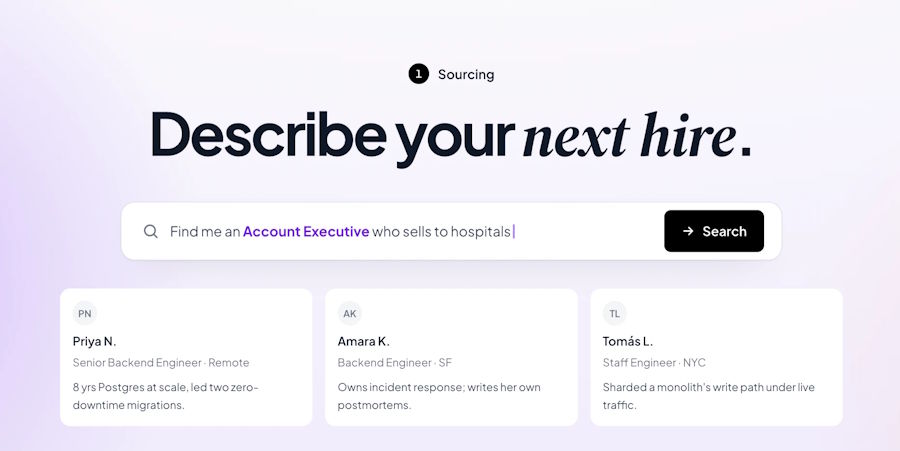
Hiring qualified talent often feels like an uphill battle. Human resources professionals and hiring managers spend countless hours sorting through stacks of resumes, emailing candidates back and forth to schedule interviews, and manually updating internal spreadsheets. When key roles sit vacant for weeks or months, overall productivity drops and existing team members experience burnout.
Modern human resources departments are turning to recruitment automation software to solve these persistent challenges. By substituting manual, repetitive tasks with programmatic workflows, organizations can reduce their time-to-hire, lower cost-per-hire, and deliver a superior experience to applicants. This article covers what the category includes, the components of a modern talent acquisition technology stack from sourcing to offer, the measurable benefits, the features to look for, and a step-by-step approach to implementation.
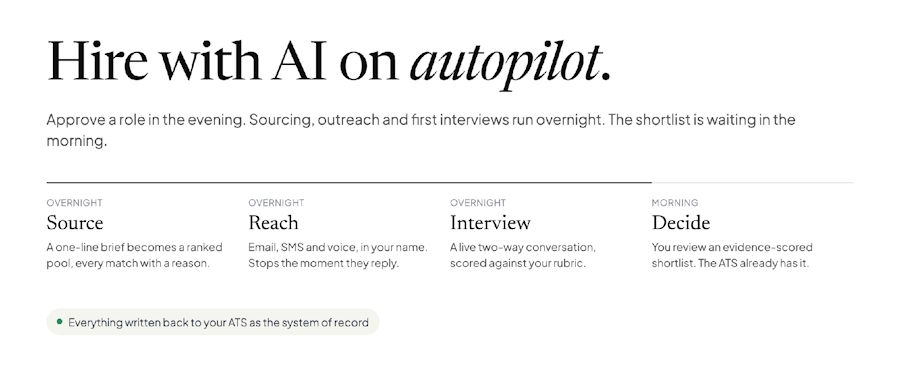
Hire with AI on autopilot: sourcing, outreach, interviews and shortlists run themselves overnight, and the recruiter starts the day with candidates already waiting.
What Is Recruitment Automation Software?
At its core, recruitment automation software refers to technology designed to handle routine talent acquisition tasks without requiring continuous human intervention. Instead of an HR specialist manually copying candidate details from a web form into a database, automated systems handle data entry, resume parsing, status tracking, and candidate communication automatically.
This software does not replace human judgment. Instead, it elevates the role of the recruiter. When technology handles mechanical processes, talent acquisition professionals can dedicate their energy to high-value activities, such as interviewing promising applicants, building relationships, and making strategic hiring decisions.
The scope of recruiting automation has also widened. First-generation recruitment automation tools automated what happened after someone applied: parsing, tracking, scheduling, replies. The current generation starts earlier. It finds candidates who never applied, contacts them, screens them in a live conversation, and hands the hiring manager a shortlist, with the applicant tracking system as the record of all of it. The difference matters, because for most technical roles the people worth hiring are not in the applicant pile.
Key Components of Talent Acquisition Technology
To build a fast and fair hiring pipeline, organizations rely on several interconnected systems. Modern talent acquisition technology brings these capabilities together under one roof, whether it is sold as recruiting software, talent acquisition software or a recruitment automation platform.
1. Automated Applicant Tracking System
An automated applicant tracking system serves as the central hub for all hiring activity. It collects incoming applications, organizes candidate profiles, and records every interaction between the hiring team and the applicant. Modern applicant tracking systems use rules-based triggers to move candidates through different pipeline stages automatically. ATS software from Greenhouse, Lever, Ashby or Workable is where most technology companies start, and the automation layers below should write back into it rather than replace it.
2. Candidate Screening Automation
One of the biggest bottlenecks in recruitment is reading hundreds of resumes to find a handful of qualified candidates. With candidate screening automation, software scans resumes for specific qualifications, years of experience, certifications, and relevant skill sets. Candidates who meet the necessary criteria move forward instantly, while unqualified applicants receive polite, automated updates regarding their status.
Good candidate screening software goes past keyword matching. A resume parser turns every application into the same structured profile; the screening step then compares that profile with the role’s requirements and marks each one as supported, unsupported, or not stated, so the recruiter sees the reasoning rather than a bare score.
3. Interview Scheduling Tools
Coordinating schedules between multiple interviewers and a candidate frequently leads to endless email chains. Automated scheduling tools integrate directly with internal calendar systems. Applicants receive a link, select an available time slot that fits their schedule, and receive instant calendar invites with remote meeting links included. Interview scheduling software of this kind is the quickest automation win most teams have, because the saving shows up in the first week.
4. AI Recruitment Tools
Advanced platforms now incorporate AI recruitment tools to assist with complex tasks. These capabilities include writing clear job descriptions, evaluating skill assessments, matching candidate experience to detailed role requirements, and predicting candidate success based on historic hiring data. The newest AI recruiting tools add an AI recruiter that conducts a live, two-way interview: a real conversation that follows up on each answer and scores it against a fixed rubric, so every candidate on a role is compared on the same criteria.
5. Automated Candidate Sourcing and Outreach
The component the first four leave out is the one that decides who is in the pipeline at all. An AI sourcing tool starts from a brief in plain words, say site reliability engineer, Kubernetes, on-call experience, Toronto or remote Canada. It converts that into criteria about the engineer and about where they work, treats the non-negotiables as gates and the rest as ranking signals, widens the search by itself when the pool is thin and reports what it widened, and attaches a short justification to every person it returns. Outreach automation then messages the candidates the recruiter has kept, by email, SMS or a call, signed by the recruiter, and ends the sequence the instant anyone responds. Replies are triaged interested-first. Sourcing and outreach are where recruiting automation software returns the most hours, because they are the tasks a recruiter cannot scale by working harder.
The Measurable Benefits of Automated Hiring Workflows
Upgrading your recruiting process offers clear operational benefits across every level of the organization.
Faster Time to Hire
Speed is critical when competing for top talent. High-performing candidates rarely stay on the job market for long. By removing manual delays in resume reviews and interview scheduling, hiring workflow software shortens the timeline from initial application to final offer letter. When sourcing is automated too, the clock starts earlier: a requisition approved after hours has a ranked pool waiting before the first coffee.
Improved Candidate Experience
Applicants frequently complain about falling into a “black hole” after submitting an application, never hearing back from the employer. Automated workflows send timely status updates, confirmation emails, and interview reminders. Consistent communication builds a positive employer brand and keeps candidates engaged throughout the evaluation process.
Reduced Bias in Initial Screenings
Manual resume screening can introduce unconscious bias regarding background, education, or non-essential details. Automated candidate evaluations focus strictly on objective job requirements and verified skill sets, creating a fairer evaluation process for all applicants. A fixed rubric with the evidence for each score recorded also makes the process auditable, which a panel scoring from memory cannot offer.
Lower Recruiting Costs
Manual labor carries a high price tag. When recruiters spend 20 hours a week on basic administration, labor costs mount quickly. Automating administrative tasks allows HR teams to manage a higher volume of open requisitions without needing to increase headcount.
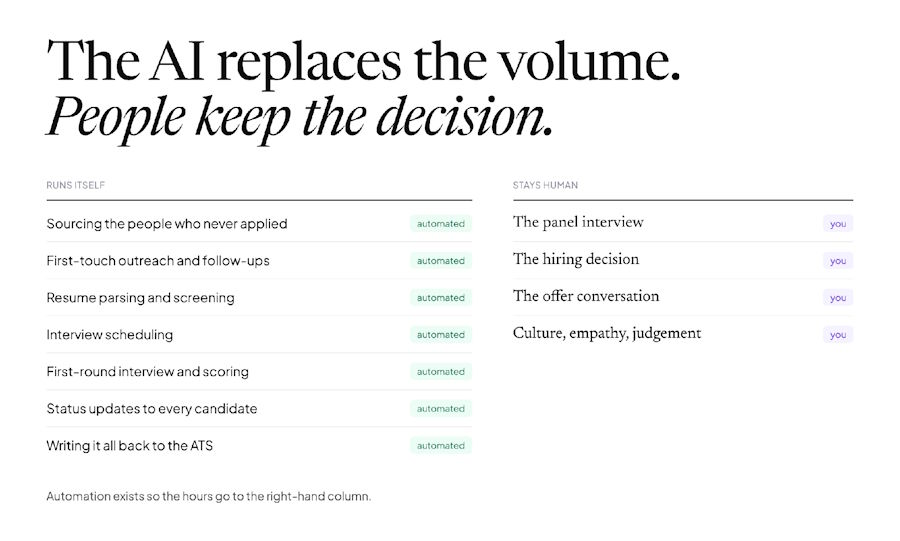
What runs itself and what stays human: automation takes sourcing, outreach, parsing, screening, scheduling and updates; people keep the interview panel, the decision and the offer.
Core Features to Look for in Modern Software
Selecting the right recruitment software requires a clear understanding of your organization’s specific needs. When evaluating available tools, consider looking for the following capabilities:
- Seamless CRM and ATS Integration: Your software should sync effortlessly with your existing human resource information systems to keep employee records updated without double entry. Ask for the integration list by product name, and confirm the ATS connection is two-way.
- Customizable Workflow Triggers: Every company has a unique hiring process. Choose software that allows you to build custom stages, automated email templates, and conditional rules.
- Omnichannel Communication: Candidates interact through various channels. Look for platforms that support email, text messaging, and direct portal messaging, and that stop an automated sequence the moment a candidate replies.
- Data Analytics and Reporting: Clear dashboards help track important metrics like conversion rates, source of hire, time-to-fill, and candidate drop-off points.
- Explainable Matching: For any automated ranking, the tool should show why a candidate ranked and what it does not know about them. A score without a reason is a ranking your recruiters will not trust.
I run The Cognitive, and the five components above are the shape of our own product: a sourcing engine that searches ~900M profiles from a brief, verified contact reveal, outreach that ends on reply, a live two-way AI interview, and an evidence-scored shortlist pushed back to the ATS. Take that as one vendor’s version of what recruitment automation software now spans, and put us through the implementation steps below like any other candidate tool.
Step-by-Step Approach to Implementing Recruitment Automation
Transitioning to automated recruitment processes requires careful planning. Following a structured approach makes sure your team adopts the new tools smoothly.
Step 1: Audit Your Current Hiring Pipeline
Map out your existing recruitment process from end to end. Identify the exact stages where delays occur most frequently. Are resumes sitting unread for days? Is interview scheduling taking up too much time? Is the top of the funnel simply thin for the roles you most need to fill? Pinpointing these bottlenecks helps you determine which tasks to automate first.
Step 2: Establish Clear Objectives
Define specific targets for your software implementation. You might aim to lower your average time-to-hire from 45 days to 20 days, or increase candidate response rates by 30 percent. Measurable goals allow you to evaluate your return on investment later.
Step 3: Configure Communication Templates
Automated communication must still feel personal and respectful. Draft warm, professional email and message templates for every stage of the application lifecycle. Include personalized tokens like candidate names, role titles, and specific timeline expectations to maintain an authentic connection. For sourced candidates, go further: the message should reference something the person actually did, drafted from their profile and the brief, or it will read as the template it is.
Step 4: Train Hiring Managers and Recruiters
Software is only as effective as the people using it. Conduct structured training sessions for recruiters, HR generalists, and hiring managers. Make sure everyone understands how to move candidates through the software, review automated candidate scores, and manage interview feedback within the platform.
Step 5: Review and Refine
Monitor your recruitment metrics regularly after deployment. Review candidate feedback and gather input from your internal hiring teams. Adjust screening parameters, workflow rules, and message templates based on real-world outcomes to keep improving your results. The best recruitment automation platforms do part of this themselves: each shortlist or pass decision re-ranks the next search for that role, so the tenth search is sharper than the first.
Balancing Technology with the Human Touch
While recruitment automation software streamlines complex logistics, recruitment remains fundamentally human. Candidates want to connect with real prospective colleagues, understand company culture, and feel valued during the hiring process.
Automation should handle administrative work so humans can focus on relationship building. Use software to take care of resume intake, qualification checks, calendar management, and form collection. Leave candidate assessment interviews, final selections, and offer negotiations to human professionals who can assess cultural fit, empathy, and subtle interpersonal nuances. The AI replaces the volume; the people keep the decision.
Final Thoughts
Adopting modern hiring software is no longer just an optional convenience for growing companies. It is a practical necessity for teams that want to remain competitive in securing top talent. By using an automated applicant tracking system alongside tailored candidate evaluation platforms, organizations cut unnecessary administrative overhead, deliver better applicant experiences, and build strong teams quickly. Investing in the right technology today builds a flexible hiring foundation for the future.
Recruitment Automation Software FAQ
What is recruitment automation software?
Recruitment automation software is technology that runs routine talent acquisition tasks without continuous human intervention: resume parsing, candidate screening, interview scheduling, status communication, and, in current platforms, candidate sourcing and outreach. The applicant tracking system usually remains the system of record, with automation layers writing into it.
What is the difference between an ATS and recruitment automation software?
An ATS stores and tracks applicants who applied. Recruitment automation software acts on candidates: it finds them, screens them, schedules them and communicates with them, often across several tools that connect to the ATS. Most teams run both.
What should be automated first?
The stage where your pipeline loses the most time. Interview scheduling is the quickest win. Sourcing and outreach return the most hours for technical roles, because the top of the funnel is usually the constraint.
Does recruitment automation remove the recruiter?
No. It removes the administration. Interviews with the panel, the hiring decision and the offer negotiation stay with people; the automation exists so they have time for them.
Sparsh Goyal is the founder of The Cognitive, which gives recruiting teams AI sourcing across ~900M profiles, verified contact reveal, outreach in the recruiter’s own name, and live two-way AI interviews, with every stage written back to the ATS.

