

How to Check and Update Your WordPress PHP Version Easily
Your WordPress PHP version is the release of the PHP programming language that runs your site on the server. WordPress is written mostly in PHP, so every page load, login, and form submission passes through it. Like any software, PHP follows a lifecycle: newer releases add features and fixes, while older ones eventually stop receiving security patches.
This article shows four ways to check your WordPress PHP version, explains which release to aim for in 2026, and walks through the update in cPanel, Plesk, and popular managed hosts. You'll also get a pre-update checklist, a testing routine, and a rollback plan for when a plugin misbehaves. It's written for site owners rather than developers, and every fact or example carries its source in brackets.
Last reviewed September 18, 2026. Version facts come from PHP.net, WordPress.org, and the WordPress Hosting Handbook. Several how-to sources (TeamUpdraft, WP Rocket, WP Creative, Kinsta, DreamHost, and the hosts named below) sell WordPress products or hosting.
Key takeaways
- Check your WordPress PHP version in Tools > Site Health > Info > Server.
- PHP 8.4 is a sensible target. PHP 8.1 and older are end of life, and 8.2 loses security support December 31, 2026.
- Back up, update plugins, and test on staging before you switch.
- Speed gains are modest. Security and compatibility are the real reasons to update.
What Is PHP and Why Does WordPress Use It?
PHP is a server-side scripting language: it runs on your hosting server and builds each page before the visitor's browser receives it. WordPress core, your theme, and your plugins are mostly .php files.
What Does PHP Do in WordPress?
When someone opens a post, PHP queries the database for content, loads your theme's templates, runs plugin code, and hands finished HTML to the browser. It also powers contact forms and WooCommerce checkout (Source: WP Rocket), which is why your WordPress PHP version affects speed, security, and plugin behavior together.
How PHP Versions Work: Active Support, Security Fixes, and End of Life
Each PHP branch gets two years of active support, then two years of critical security fixes, then reaches end of life (EOL) and gets nothing (Source: PHP.net Supported Versions), so your WordPress PHP version has an expiry date even when the site looks healthy.
Why Updating Your WordPress PHP Version Matters
Security and compatibility are the strongest reasons to update. Speed is a smaller, situational bonus.
Stronger Security and Fewer Vulnerabilities
After end of life, the PHP project stops shipping fixes, so newly found flaws stay open, and PHP.net warns users of those releases that they may be exposed to unpatched vulnerabilities (Source: PHP.net Supported Versions). Plugin developers also drop support, and hosts can force the change: WP Engine upgrades sites automatically when a PHP version reaches end of life, and the upgrade can't be deferred (Source: WP Engine). A current release is only a foundation, so keep plugins updated and consider a security plugin such as Wordfence or Sucuri (Source: WP Rocket).
Faster Performance and Page Speed
The gain is real but modest. In Kinsta's lab test of a default WordPress 6.8 install, PHP 8.4 and 8.5 served about 6.6% more requests per second than PHP 7.4 (148 versus 139) (Source: Kinsta). Tideways found PHP 7.4 about 5% behind (Source: Tideways). WooCommerce gained roughly 23% for PHP 8.2 over 7.4 in Kinsta's test. Both companies sell related services, and results vary with page caching, plugins, and hosting.
Plugin and Theme Compatibility
Your WordPress PHP version also decides which plugin versions you can install. Developers raise minimum requirements over time, so on an old release an update may refuse to install or a theme may throw errors (Source: WP Rocket).
Which PHP Version Should You Use for WordPress?
WordPress.org recommends PHP 8.3 or greater, and its Hosting Handbook recommends 8.4 or later for production (Source: WordPress.org Requirements; WordPress Hosting Handbook). DreamHost suggests at least 8.4 (Source: DreamHost).
Supported vs. End-of-Life PHP Versions
Find your release below to see where your WordPress PHP version stands.
| PHP version | Status | Security support ends |
|---|---|---|
| 8.5 | Active support to Dec 31, 2027 | Dec 31, 2029 |
| 8.4 | Active support to Dec 31, 2026 | Dec 31, 2028 |
| 8.3 | Security fixes only | Dec 31, 2027 |
| 8.2 | Security fixes only | Dec 31, 2026 |
| 8.1 | End of life | Ended Dec 31, 2025 |
| 8.0 and 7.4 | End of life | Ended Nov 26, 2023 and Nov 28, 2022 |
(Source: PHP.net Supported Versions, checked September 18, 2026; end-of-life dates for 8.1 and older from the WordPress Hosting Handbook)
PHP 8.4 is a sensible default: the Hosting Handbook and DreamHost both point to it, and PHP.net supports it through 2028. PHP 8.5 is fully supported by WordPress 6.9 and later, so move there once your plugins confirm support (Source: WordPress Hosting Handbook). The right WordPress PHP version is the newest one your host, theme, and plugins all support.
How to Check Your WordPress PHP Version (4 Methods)
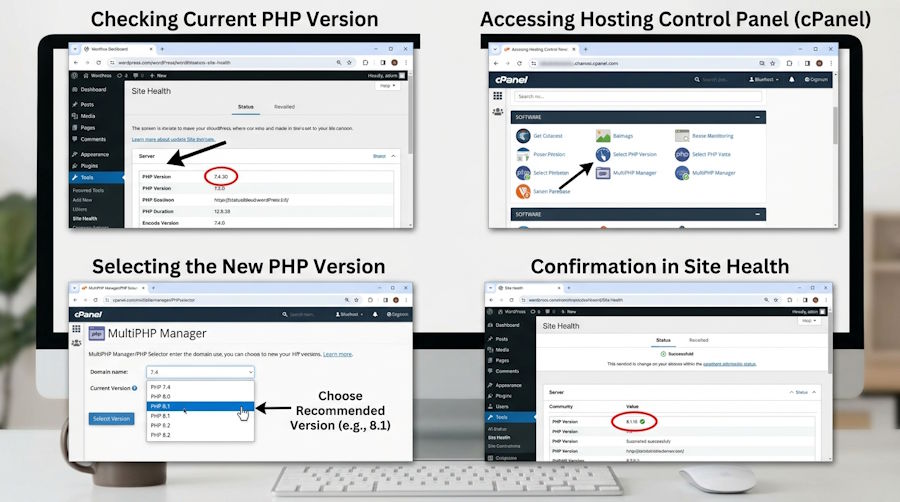
The quickest way to read your WordPress PHP version is Tools > Site Health > Info > Server, and it needs no extra software. Three other methods cover hosting panels, files, and the command line.
Method 1: Use the WordPress Site Health Tool
Site Health is built into WordPress 5.2 and later (Source: WordPress Hosting Handbook).
- Log in to your WordPress admin.
- Go to Tools > Site Health.
- Open the Info tab, expand Server, and read the PHP version row.
(Source: WP Rocket; TeamUpdraft)
Method 2: Check in Your Hosting Control Panel
In cPanel, open Software > Select PHP Version (Source: WP Rocket; WP Creative). Some hosts use MultiPHP Manager instead (Source: TeamUpdraft).
Method 3: Create a phpinfo File
Create phpinfo.php with the code below, upload it to your root directory (often public_html), visit yourdomain.com/phpinfo.php, and read the version. Delete the file right away, since the page exposes server details (Source: WP Rocket; WP Creative).
<?php phpinfo(); ?>Method 4: Use the Command Line
With SSH access, run php -v (Source: WP Creative). On hosts running several PHP versions, the command line can differ from what your site uses, so trust Site Health if they disagree.
What to Do Before You Update PHP in WordPress
Four checks come first.
Create a Complete Backup of Your Site
Before you change your WordPress PHP version, back up both the database and the files: plugins, themes, and uploads (Source: TeamUpdraft). UpdraftPlus is one option; its maker is also a source here, and any tool that captures both will do.
Update Everything and Check Compatibility
Update WordPress core, themes, and plugins first, so you test current code against the new PHP (Source: TeamUpdraft). Then screen for problems (Source: DreamHost):
- Replace themes and plugins that haven't been updated in the past year.
- Renew expired licenses on paid ones.
- Have a developer review custom PHP code.
Each plugin's WordPress.org page also lists the PHP version it requires (Source: WP Rocket).
Check Extensions and Your Database
WordPress uses PHP extensions when they're available, and a missing one can mean lost functionality. It requires mysqli and highly recommends others such as curl, imagick, mbstring, and zip (Source: WordPress Hosting Handbook). Ask your host about your database too, since MySQL 8.0 has an April 2026 end-of-life date (Source: WordPress Hosting Handbook).
Test on a Staging Site
A staging site is a private copy of your website, and many hosts, including Kinsta, SiteGround, and WP Engine, create one with a click (Source: TeamUpdraft; DreamHost). Set the copy to the new PHP version and click through it. On very old sites, Kinsta suggests stepping up one minor version at a time rather than jumping from 7.4 to 8.5 (Source: Kinsta).
How to Update Your PHP Version in WordPress (Step by Step)
You change PHP at your host, not in the WordPress dashboard (Source: TeamUpdraft; WP Rocket). Dashboards get redesigned, so treat these paths as a map. In each case, updating your WordPress PHP version means finding the PHP setting for your domain and choosing a newer release.
Update PHP in cPanel or Plesk
cPanel:
- Open MultiPHP Manager under Software.
- Tick the box next to your domain.
- Choose a release such as PHP 8.4 from the dropdown.
- Click Apply.
Some setups use Select PHP Version with a "Set as Current" button instead (Source: TeamUpdraft; WP Creative).
Plesk: open Websites & Domains, click PHP Settings for your domain, pick a version under PHP support, and click OK (Source: TeamUpdraft).
Update PHP on Managed WordPress Hosts
- SiteGround: Websites > Site Tools > Devs > PHP Manager, then the pencil icon beside the version (Source: SiteGround).
- Kinsta: MyKinsta > Sites > your site > Tools > PHP Engine (Source: Kinsta).
- Bluehost: Websites > Settings under your site > Settings tab > PHP Version > Change. Older cPanel accounts use a different path (Source: Bluehost).
- WP Engine: User Portal > your environment > PHP Selector (Source: WP Engine).
DreamHost customers should follow its help article; DreamPress has a separate one (Source: DreamHost).
How to Test Your Website After a PHP Update
After the switch, confirm the WordPress PHP version by repeating Method 1. Then test:
- several pages, the contact form, and design display (Source: WP Rocket)
- login and logout
- a test checkout, if you sell products
- the admin area, watching for warnings
Run PageSpeed Insights or GTmetrix before and after (Source: WP Rocket). Expect modest, variable differences, and test more than once.
What to Do If a PHP Update Breaks Your WordPress Site
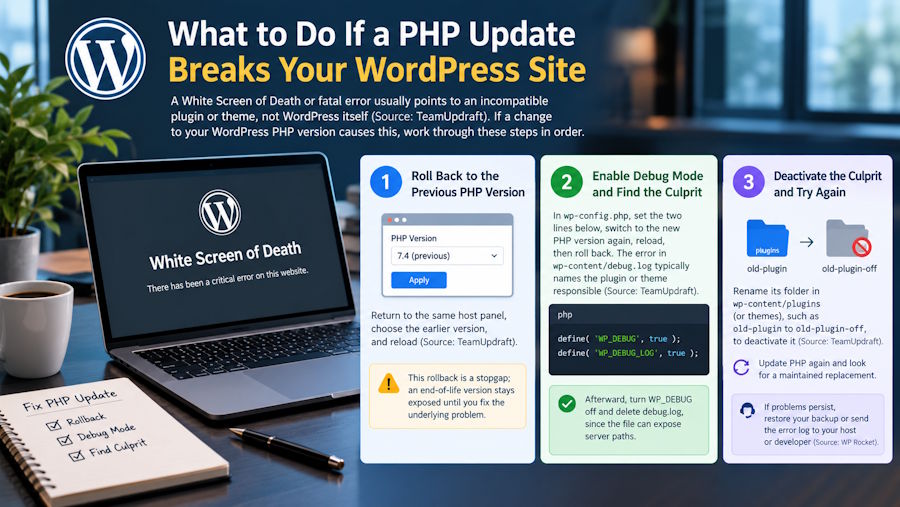
A White Screen of Death or fatal error usually points to an incompatible plugin or theme, not WordPress itself (Source: TeamUpdraft). If a change to your WordPress PHP version causes this, work through these steps in order.
Step 1: Roll Back to the Previous PHP Version
Return to the same host panel, choose the earlier version, and reload (Source: TeamUpdraft). This rollback is a stopgap; an end-of-life version stays exposed until you fix the underlying problem.
Step 2: Enable Debug Mode and Find the Culprit
In wp-config.php, set the two lines below, switch to the new PHP version again, reload, then roll back. The error in wp-content/debug.log typically names the plugin or theme responsible (Source: TeamUpdraft). Afterward, turn WP_DEBUG off and delete debug.log, since the file can expose server paths.
define('WP_DEBUG', true);
define('WP_DEBUG_LOG', true);
Step 3: Deactivate the Culprit and Try Again
Rename its folder in wp-content/plugins (or themes), such as old-plugin to old-plugin-off, to deactivate it (Source: TeamUpdraft). Update PHP again and look for a maintained replacement. If problems persist, restore your backup or send the error log to your host or developer (Source: WP Rocket).
Frequently Asked Questions About Updating PHP in WordPress
Do I need to update PHP for WordPress?
Yes, if your WordPress PHP version has reached end of life, because those releases get no security fixes (Source: PHP.net Supported Versions). On a supported release, you can plan the change instead of rushing it.
Is it safe to update PHP in WordPress?
It's low risk when you prepare. A backup, updated plugins, and a staging test catch many problems before visitors see them (Source: TeamUpdraft).
Can updating PHP break my WordPress site?
Yes, usually through an old plugin or theme that uses code newer PHP no longer accepts (Source: WP Rocket; TeamUpdraft). Roll back, read the debug log, and replace the culprit.
What is the recommended WordPress PHP version?
PHP 8.4 or later for production, per the Hosting Handbook. WordPress.org's baseline is 8.3 or greater (Source: WordPress Hosting Handbook; WordPress.org Requirements).
Is updating PHP enough to make WordPress fast?
No. A newer WordPress PHP version brings modest gains, and CSS, JavaScript, images, and caching still shape load times (Source: WP Rocket; Kinsta).
What should I do if my host only offers PHP 7.4?
Ask support for a modern version. TeamUpdraft says moving to a newer host is reasonable if it refuses (Source: TeamUpdraft).
Conclusion
Your WordPress PHP version is a maintenance item with a deadline, and updating it is a short, low-risk job when you prepare first. Open Site Health today and note your version. If it's 8.2 or older, set aside an hour this week to back up, test on staging, and move to PHP 8.4. On 8.3 or newer, calendar the support end dates so the next change is planned, not forced.
SEO Details
Meta title (56 characters): WordPress PHP Version: How to Check and Update It Safely
Meta description (153 characters): Learn how to check your WordPress PHP version, pick a supported release, and update it safely, with backup steps and a rollback plan if something breaks.
URL slug: /check-update-wordpress-php-version/
Focus keyword: WordPress PHP version

