

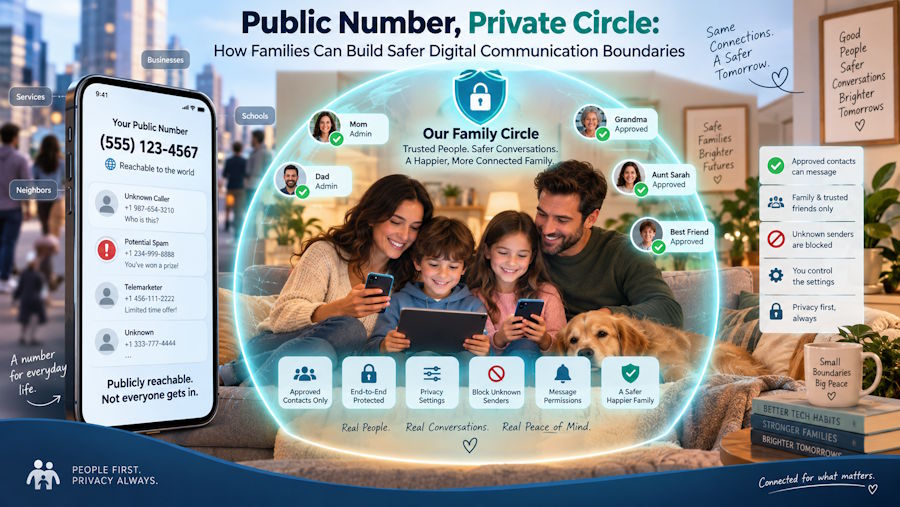
A single phone number often connects far more than family and friends. It may also be used for shopping accounts, school activities, delivery services, community groups, online marketplaces and account verification. While this is convenient, it can gradually blur the boundary between private family communication and public-facing interactions.
Families do not need a complicated security system to improve this situation. A more practical approach is to separate communication according to purpose. Public or temporary contacts can use one channel, while conversations with children and trusted relatives remain in a more controlled private space.
Identify Your Communication Circles
The first step is to divide contacts into three broad groups.
The private circle includes children, parents, grandparents and trusted relatives. These conversations may contain family photos, location details, schedules and other personal information.
The known community includes teachers, neighbours, activity organisers, babysitters and other parents. These contacts are familiar, but they do not necessarily need access to every private detail.
The public circle includes marketplace buyers, delivery drivers, temporary service providers, website registrations and unfamiliar online contacts. Communication with this group is often short-term and should reveal as little personal information as necessary.
Using the same number for all three groups makes it difficult to control who can continue contacting the family. Separating them creates clearer boundaries and makes suspicious activity easier to recognise.
Keep Public Contacts Away From Your Primary Number
A primary mobile number is frequently connected to important accounts, including banking, email recovery and personal messaging. Publishing it in marketplace listings, public profiles or community directories can increase exposure to spam, unwanted calls and social-engineering attempts.
Parents who regularly use online marketplaces, local groups or registration services may prefer a separate number for public-facing accounts instead of publishing the same number used for private family communication.
A second number can be useful for temporary enquiries, customer conversations, online registrations and situations where a person needs to receive calls or messages without immediately disclosing their main number. It also makes it easier to silence non-essential communication outside appropriate hours.
However, a second number should be managed carefully. Users should understand how long they can retain it, whether it can be reassigned and which platforms accept it. A temporary or potentially expiring number should not be the only recovery method for banking, government, medical or other critical accounts.
Verification codes must always remain private. No genuine buyer, group administrator or customer-support representative should need a code sent to someone else’s phone.
Create a Private Space for Family Communication
Public contact separation addresses only one part of the problem. Families also need a trusted environment where children and relatives can communicate without receiving random messages or invitations.
Conversations with children, grandparents and approved relatives can remain within a private family communication space that provides clearer contact boundaries and parental oversight.
When selecting a family communication platform, parents should examine how contacts are added, whether children can receive messages from unknown users and what controls are available to adults. Useful features may include managed contact lists, linked parent and child accounts, content warnings and a dashboard for reviewing account activity.
Parents should configure these controls before giving a child access. Approved contacts might include grandparents, close relatives and trusted family friends. New contacts should not be added simply because a child recognises a username or profile picture, as online identities can be imitated.
A private platform does not eliminate the need for guidance. Parents should regularly discuss who their children communicate with and encourage them to report anything confusing, upsetting or unexpected.
Review Permissions on Every Device
Communication apps may request access to contacts, photographs, files, cameras, microphones, notifications and location data. Some permissions are necessary for particular features, but they do not all need to remain enabled permanently.
Families should review permissions on every phone, tablet and computer connected to an account. Settings may differ between devices, even when the same application is installed.
Location sharing deserves particular attention. It should be enabled only when the family has a clear reason to use it and understands who can view the information. Message previews should also be reviewed because private conversations can appear on locked screens or during desktop screen sharing.
Old devices and inactive sessions should be removed. A phone or tablet that is no longer being used may still have access to messages, photographs and family account information.
Protect Account Recovery
Communication boundaries become ineffective if accounts can be easily taken over. Each adult should use a strong, unique password and enable additional authentication where available.
Recovery details should belong to the family member responsible for the account. Parents should retain control of recovery methods for young children’s accounts rather than relying on an email address or number the child may lose.
Families should also save recovery codes securely and review connected devices periodically. When a phone is sold, recycled or handed to another person, communication accounts should be signed out and personal data removed properly.
Teach Children Simple Privacy Rules
Children do not need to understand every technical risk before learning useful habits. A few clear rules can provide a strong foundation:
- Only communicate with people approved by a parent.
- Never share verification codes or passwords.
- Do not disclose a home address, school name or regular travel route.
- Ask permission before sharing family photographs.
- Do not open unexpected files or links.
- Tell a trusted adult when a message feels uncomfortable.
These conversations should be calm and ongoing. Children are more likely to ask for help when mistakes are treated as learning opportunities rather than reasons for punishment.
Review the Setup Regularly
Family communication needs change over time. New activities introduce new contacts, children become more independent and old devices are replaced. A brief monthly review can help families remove unused contacts, check active sessions, update applications and confirm that account recovery details are still correct.
The objective is not complete isolation. It is intentional separation. Public contacts should receive only the access they need, while private conversations remain within a trusted family circle. With clear communication layers, sensible permissions and regular review, families can stay connected without allowing every interaction to reach the same personal channel.

