

Retail customer service is moving beyond traditional call queues and IVR menus.
Modern AI call center platforms can now answer customer calls, understand natural language, retrieve order information, route conversations, summarize interactions and, in some cases, proactively call customers to recover revenue.
But the right platform depends heavily on the type of retail business.
An ecommerce brand running Shopify has very different requirements from a multinational retailer operating hundreds of stores and a 500-agent contact center.
What are the best AI call center platforms for retail businesses?
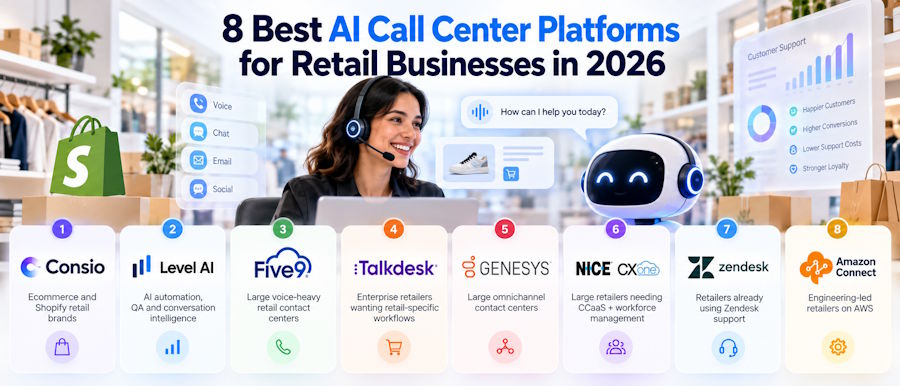
The best AI call center platforms for retail businesses in 2026 include Consio, Level AI, Five9, Talkdesk, Genesys Cloud CX, NICE CXone, Zendesk and Amazon Connect.
For ecommerce and online-first retail brands, Consio stands out because its AI phone system is built directly around Shopify customer, order, product and cart data. Large enterprise retailers may instead prefer platforms such as NICE CXone, Genesys or Five9 for workforce management, complex routing and enterprise-scale contact center operations.
Here is the short version:
| Platform | Best for | AI voice | Retail / ecommerce context | Outbound calling |
|---|---|---|---|---|
| Consio | Ecommerce and Shopify retail brands | Yes | Native Shopify commerce context | Yes — AI + human |
| Level AI | AI automation, QA and conversation intelligence | Yes | CRM / retail integrations | Depends on underlying stack |
| Five9 | Large voice-heavy retail contact centers | Yes | CRM and custom integrations | Yes |
| Talkdesk | Enterprise retailers wanting retail-specific workflows | Yes | Retail and commerce integrations | Yes |
| Genesys Cloud CX | Large omnichannel contact centers | Yes | Enterprise integrations | Yes |
| NICE CXone | Large retailers needing CCaaS + workforce management | Yes | Enterprise integrations | Yes |
| Zendesk | Retailers already using Zendesk support | Increasingly | Shopify + helpdesk context | Limited compared with phone-first tools |
| Amazon Connect | Engineering-led retailers on AWS | Yes | Highly customizable | Yes |
Retail-focused platforms increasingly compete on context continuity rather than just channel count: customer, CRM and order information needs to follow the shopper across conversations and channels.
What should retailers look for in an AI call center platform?
Traditional call center software mainly focused on telephony: answering calls, routing them to queues and measuring call volume.
AI changes the evaluation criteria.
For retailers, the strongest platforms should ideally combine AI voice automation, live customer and order context, human escalation, SMS or messaging, outbound capabilities and measurable business outcomes.
The crucial question is not simply:
Can the AI talk to customers?
It is:
Can the AI understand who the customer is, access the information needed to solve the request and take the correct action?
For an ecommerce retailer, for example, an AI agent becomes considerably more useful when it can identify the caller, retrieve their order, understand what they purchased, check relevant product information and send a useful link without requiring a human representative.
That emphasis on CRM, order-system integration and resolution is also central to current retail contact-center evaluation frameworks.
1. Consio — Best for ecommerce and Shopify retail brands
Best for: Online retailers that want AI phone support and outbound phone revenue workflows in the same platform.
Consio takes a different approach from traditional enterprise contact center software.
Rather than starting as a generic CCaaS platform and adding retail integrations later, Consio is built specifically around ecommerce phone conversations.
The platform connects directly to Shopify and brings customer profiles, orders, products, carts and customer segments into the phone workflow. Its AI Voice Agent can answer inbound calls while using ecommerce context to handle order, shipping and product questions.
The platform is particularly interesting because it brings AI agents and human agents into the same phone environment.
On inbound calls, AI can handle common customer questions around orders and products and escalate to a human when needed.
On outbound campaigns, brands can choose whether a customer segment should be handled by an AI agent or a human representative. Consio's ecommerce power dialer can run campaigns against Shopify and Klaviyo segments such as abandoned checkouts, VIP customers, churn-risk shoppers and win-back audiences.
During AI-driven outbound conversations, Consio says its agent can use cart and order history, answer product questions, create orders in Shopify, send payment links by SMS and transfer the conversation to a live representative.
That makes Consio especially relevant for retailers that see the phone as both a customer service channel and a revenue channel.
Why retailers might choose Consio
Its biggest differentiator is ecommerce context.
A generic AI receptionist may know the company's opening hours and return policy. An ecommerce-focused AI can potentially understand that the caller placed a particular order, purchased a specific product or abandoned a checkout.
Consio also connects conversations back to Shopify revenue, allowing teams to measure which calls and campaigns are generating orders rather than measuring only call volume.
Best fit
Consio is particularly suitable for Shopify and ecommerce retailers running use cases such as abandoned-cart recovery, inbound product consultation, order support, VIP outreach, replenishment, win-back campaigns and high-AOV sales.
It is less relevant for organizations looking primarily for a traditional corporate PBX or a massive workforce-management suite.
2. Level AI — Best for AI automation and conversation intelligence
Best for: Enterprise retail contact centers that want AI automation, quality management and conversation analytics.
Level AI combines virtual agents with quality assurance, agent assistance and voice-of-customer analytics.
Its retail proposition is centered on keeping conversations across voice, email, chat, SMS and social channels on a shared data layer. Its AI virtual agents can handle common retail intents and escalate more complex conversations to human agents with context attached.
One of Level AI's distinguishing features is what happens after the conversation.
The same interaction data can feed automated QA, coaching, sentiment analysis and conversation analytics, making the platform useful for larger organizations interested in measuring thousands of customer interactions rather than simply automating calls.
Level AI is therefore particularly relevant when AI phone automation is only one part of a broader contact-center intelligence strategy.
3. Five9 — Best for voice-heavy enterprise retail contact centers
Best for: Large retail contact centers with significant inbound and outbound call volume.
Five9 is an established cloud contact center platform with strong roots in voice and outbound calling.
Its platform combines inbound and outbound telephony with email, chat, SMS and other digital channels. Retail organizations can also use virtual agents, agent assistance, workforce management, quality management and conversation analytics.
Five9 is particularly well suited to more traditional contact-center environments where large numbers of agents need sophisticated routing, dialing and operational management.
Its strength is scale and contact-center infrastructure.
The trade-off is that ecommerce companies may require additional integrations or configuration to achieve the same degree of native Shopify context available in ecommerce-specific platforms.
4. Talkdesk — Best for retail-specific enterprise workflows
Best for: Mid-market and enterprise retailers wanting a retail-oriented CCaaS platform.
Talkdesk offers a dedicated retail proposition covering workflows such as order management, returns and store operations.
Its platform includes inbound and outbound voice, digital channels, Autopilot virtual agents, agent assistance, workforce management and analytics.
This makes Talkdesk attractive to retailers that need more than an AI voice agent and instead want a complete enterprise contact center.
For organizations operating a large customer-service team, its combination of automation and workforce functionality can be valuable.
For smaller ecommerce teams, however, a lighter commerce-native platform may be easier to deploy and operate.
5. Genesys Cloud CX — Best for large-scale omnichannel orchestration
Best for: Enterprise retailers managing complex customer journeys across many channels.
Genesys Cloud CX is designed around customer journey orchestration.
Voice, email, chat, SMS and messaging can operate inside the same contact-center environment, while predictive routing helps determine which agent or bot should handle an interaction.
The platform also includes AI voice bots, agent assistance, workforce management, quality management, summaries and conversation analytics.
For large retailers with distributed support teams, multiple regions and complex routing rules, that breadth is a major advantage.
The downside is complexity: smaller brands may not need the level of infrastructure and configuration associated with a full enterprise contact-center platform.
6. NICE CXone — Best for workforce-heavy enterprise environments
Best for: Large retail businesses that need AI, routing and workforce management together.
NICE CXone combines enterprise CCaaS capabilities with its Enlighten AI portfolio.
It supports voice and digital channels alongside conversational AI, routing, workforce management, quality management and interaction analytics.
This combination is particularly valuable for retail contact centers where staffing is itself a major operational challenge.
If a retailer needs to forecast large seasonal teams, schedule hundreds of representatives and manage complex queues during BFCM or holiday peaks, workforce functionality can matter as much as the AI agent itself.
For a five-person ecommerce support team, that same infrastructure may be unnecessary.
7. Zendesk — Best for retailers already using Zendesk
Best for: SMB and mid-market retailers whose support operations already live inside Zendesk.
Zendesk started as a ticketing platform and has expanded into messaging, voice and AI-assisted customer service.
For retailers, one of its strengths is ecosystem continuity: email, chat, social and voice conversations can stay connected to the same customer-support workspace.
Zendesk also supports Shopify integrations and can bring order and customer context into support workflows.
For an organization that already runs its support team in Zendesk, extending that stack may be operationally simpler than replacing it with a completely new contact center.
However, companies primarily interested in AI outbound calling or phone-driven revenue campaigns may want a more phone-first platform.
8. Amazon Connect — Best for engineering-led retail teams
Best for: Retailers with strong internal engineering teams and existing AWS infrastructure.
Amazon Connect provides cloud contact center infrastructure using a consumption-based model.
It supports voice, chat, email, SMS and task routing, while Amazon Lex and Amazon Q can add conversational AI and agent assistance. Contact Lens provides analytics and quality-management capabilities.
Amazon Connect is particularly attractive when a company wants to build a customized customer-service environment rather than purchase a highly opinionated application.
That flexibility comes with a trade-off: engineering work.
Retailers without internal technical resources may find a more packaged platform faster to deploy.
AI call center platform vs traditional retail call center software
The main difference is resolution.
Traditional contact center software is primarily designed to connect customers with employees.
AI call center software increasingly attempts to resolve the interaction before a human becomes necessary.
Consider an order-status call.
A traditional system may identify the caller, route them to the correct queue and display their CRM record to an agent.
An AI-native system can potentially identify the customer, retrieve the order, explain the delivery status, send the tracking link by SMS and close the interaction without entering a human queue.
That is why integrations matter so much.
Without access to CRM, commerce, order and knowledge-base data, even an excellent conversational AI remains limited.
Which AI call center platform should a retail business choose?
There is no single platform that fits every retailer.
For online-first Shopify and ecommerce brands, Consio is particularly relevant because the phone workflow is built directly around ecommerce customer, order and product data.
For large enterprise contact centers, Five9, Talkdesk, NICE CXone and Genesys provide deeper workforce, routing and operational infrastructure.
For retailers focused on AI analytics and quality management, Level AI is particularly strong.
For Zendesk-centric organizations, remaining inside Zendesk can simplify support operations.
And for engineering-led businesses that want maximum flexibility, Amazon Connect provides a highly customizable foundation.
The key is to evaluate the platform on the retail interactions you actually receive rather than on the total number of features on its pricing page.
FAQ
What is the best AI call center platform for retail businesses?
The answer depends on the retailer. Consio is designed specifically for ecommerce and Shopify retail brands, while platforms such as Five9, Talkdesk, Genesys and NICE CXone target larger enterprise contact centers. Level AI focuses heavily on AI automation, QA and conversation intelligence.
What is an AI call center for retail?
An AI call center uses artificial intelligence to automate or assist customer conversations over voice and other channels. In retail, AI can handle use cases such as order-status questions, returns, product questions, customer routing and, depending on the platform, outbound sales or retention calls.
Can AI call center software access retail order information?
Yes, if the platform is integrated with the retailer's ecommerce or order-management system.
The depth of that integration varies significantly. Some systems mainly connect to CRM records, while ecommerce-specific platforms can access live customer, order, cart and product information.
Can AI agents make outbound calls to retail customers?
Some platforms can.
Outbound AI can be used for scenarios such as abandoned checkouts, win-back campaigns, failed payments, replenishment, customer verification and proactive service.
Retailers should ensure these campaigns comply with applicable consent, telemarketing and calling regulations.
Can AI transfer a retail customer to a human agent?
Yes. Modern AI voice platforms can hand a conversation to a human representative when the AI cannot resolve the issue or when the customer requests a person.
For retail, the most effective handoff keeps the conversation and customer context attached so the customer does not have to repeat everything.
What should retailers compare before choosing an AI contact center?
Retailers should compare integration depth, AI voice capabilities, human escalation, inbound and outbound functionality, customer context, SMS or messaging support, analytics, security, pricing and implementation complexity.
For ecommerce specifically, test whether the platform can retrieve a real order and perform a useful action during the conversation.

