

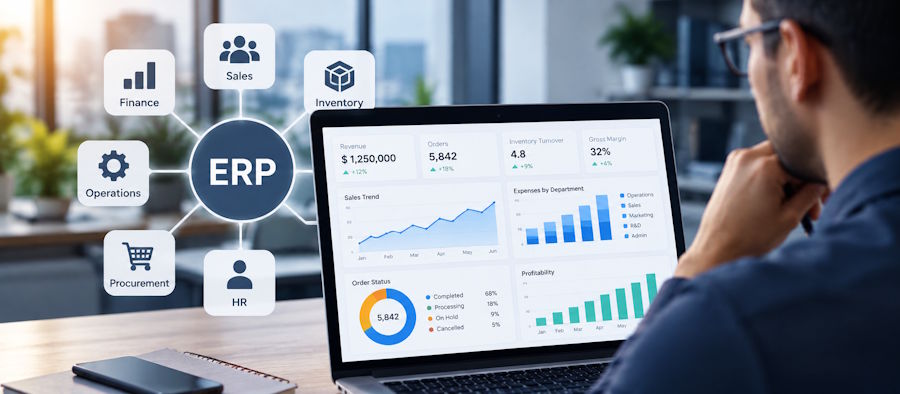
Ask most people why a business buys an ERP and they will say automation. Fewer manual steps, faster processes, less repetitive work. That is real, but it is not the biggest prize. The biggest prize is quieter and more valuable. For the first time, the whole business runs on one set of numbers everyone can trust. That single source of truth changes how a company makes decisions.
In a business held together by spreadsheets and disconnected tools, every number is slightly suspect. Sales says one thing, finance says another, and reconciling them eats hours. A well-implemented ERP ends that argument, and the reporting it unlocks is where much of the return actually lives. This is the payoff few people talk about before they buy.
Why disconnected systems produce numbers nobody trusts
Disconnected systems produce untrustworthy numbers because each one holds its own version of reality. The sales tool, the accounting software, and the inventory sheet all track overlapping data, and they drift apart the moment anyone updates one without the others. Nobody is lying. The setup simply guarantees that no two reports fully agree.
The cost of this is decisions made on shaky ground. When leaders cannot trust the numbers, they either wait for someone to reconcile them by hand, which is slow, or they act on a best guess, which is risky. Either way, the quality of decisions suffers, and the business moves slower than it should exactly when speed matters most.
What a single source of truth changes
A single source of truth changes decision-making because the numbers stop being a question. When sales, finance, inventory, and operations all draw from the same data, a report means the same thing to everyone who reads it. The argument about whose figure is right disappears, and the time once spent reconciling gets spent acting.
This also makes real-time visibility possible. Instead of waiting for a month-end scramble to know where the business stands, leaders can see the current position whenever they need it. Decisions that once waited on a manual report can be made on the spot, with confidence. The value is not just faster reporting, it is faster and better decisions across the whole company.
From reports to genuine insight
Once the data is unified and trusted, reporting can move from describing the past to informing the future. Consistent data across the business is the foundation everything else is built on. You cannot forecast well, spot trends early, or compare performance across departments when the underlying numbers do not agree. Fix the foundation and all of that becomes possible.
This is also what makes a business ready for more advanced analytics later. Clean, consistent, centralized data is the prerequisite for any serious use of forecasting or AI on top of it. A modern platform is often chosen partly for this reason, and evaluating a system like Acumatica Cloud on the strength of its reporting and data model is as important as judging its day-to-day features.
How to get the reporting payoff, not just the software
The reporting payoff is not automatic, it is earned during implementation. It depends on getting the data model right and migrating clean, consistent data into the system. A rushed data phase produces a fast new system full of the same messy numbers you had before, which wastes the biggest opportunity the move offers.
So treat the data and reporting design as a priority, not an afterthought. Decide early what the business needs to see and build toward it. Partners such as Sprinterra design the data foundation with the end reports in mind, because a system that produces numbers people finally trust returns far more than one that merely runs faster. Plan for the insight, not just the automation.
The bottom line
Automation is the obvious reason to buy an ERP and the smaller half of the prize. The larger half is a single source of truth that lets the whole business trust its numbers and decide with confidence. That payoff depends on getting the data and reporting right during implementation, not on the software alone. Build for trusted numbers and better decisions, and the ERP becomes a decision engine rather than just a faster way to do the old work.

