

There is something quietly frustrating about finding a game that looks genuinely fun, clicking play, and immediately hitting a wall that asks you to create an account before you can do anything. Enter your email, choose a password, verify through your inbox, agree to terms of service, and maybe fill out a profile before the game even acknowledges that you exist. By the time that process is done, the enthusiasm that made you want to play in the first place has usually evaporated.
The good news is that a growing number of Online Free Games have figured out that this friction is actively costing them players. The best multiplayer browser games today let you jump straight into a session without asking anything from you upfront. No email address, no password, no account creation process standing between you and actually playing. This guide is about finding those games and understanding what makes the no-account multiplayer experience worth seeking out specifically.
Why Account Requirements Drive Players Away
The instinct behind requiring accounts is understandable from a developer perspective. Accounts enable progress saving, leaderboards, friend systems, and data collection that helps improve the game over time. These are legitimate benefits, and for games designed around long-term progression, requiring an account makes sense.
But for multiplayer games where the primary appeal is jumping in and playing with other people right now, the account requirement creates a problem that outweighs those benefits. Most players discovering a new multiplayer game are not yet convinced it is worth the investment of creating an account. They want to try it first and make that decision afterward based on whether the game is actually fun.
When you require an account before that trial can happen, you are asking players to invest time and personal information in exchange for the possibility of enjoying your game. A significant percentage of players will not make that trade. They will close the tab and find something else instead, which means the game loses players who might have become genuinely invested if the barrier had not been there.
Online Games that have removed this barrier consistently report higher initial engagement numbers, which makes intuitive sense. When the cost of trying something is zero in every sense, including time and personal data, far more people will actually try it.
What No-Account Multiplayer Actually Looks Like in Practice
Removing the account requirement does not mean removing all structure from a multiplayer game. The best implementations find ways to deliver a complete multiplayer experience while keeping the entry point as frictionless as possible.
Room codes are the most common solution. One player creates a session, receives a short code, and shares that code with whoever they want to invite. Everyone else enters the code and joins the same session without needing accounts on either side. The entire invite process takes about 30 seconds and requires nothing beyond copying and pasting a string of characters.
Guest profiles are another approach. Some games let you choose a temporary username and avatar when you first open them, which gives you enough identity within the game to participate in multiplayer without tying anything to a registered account. Your progress might not persist between sessions, but for games where the session itself is the point rather than long-term progression, that tradeoff is perfectly reasonable.
Browser fingerprinting and local storage let some games maintain a degree of continuity for returning players without requiring formal registration. Your game recognizes you through your browser rather than through login credentials, which means returning players get some of their progress back without anyone going through a signup flow.
The common thread across all of these approaches is that the game prioritizes getting you into the experience first and worries about identity and persistence second, if at all.
The Multiplayer Games Worth Playing Right Now Without Signing Up
Knowing that no-account multiplayer games exist is one thing. Knowing which ones are actually worth your time is another. The category spans a huge range of quality, and the absence of an account requirement does not automatically make a game good. It just removes one obstacle. The game still has to be genuinely fun once you are inside it.
The multiplayer titles that consistently deliver without requiring registration tend to share a few characteristics. They are built around a core mechanic that is immediately engaging rather than slowly revealing its appeal over hours of play. The multiplayer integration feels intentional rather than bolted on. Sessions are short enough to complete in a single sitting but satisfying enough to motivate another round immediately after.
Casual games with multiplayer components are particularly well-represented in this space. Party games, racing games, physics-based competition, and platformer challenges all translate naturally to the no-account multiplayer format because the appeal is immediate and social rather than dependent on long-term progression that would require account infrastructure to support.
MEGA OBBY: 40 Courses of Pure Platforming Challenge
Obstacle course games have built a dedicated following for good reason. The appeal is straightforward in concept and surprisingly deep in execution. You navigate a series of platforms, jumps, traps, and moving obstacles using nothing but your timing, precision, and patience. Every failure teaches you something about the course, and every successful run through a section feels genuinely earned rather than handed to you.
MEGA OBBY on Astrocade takes this format and scales it up significantly. The game features 40 distinct obstacle courses, each testing your platforming skills in different ways through a combination of precision jumps, trap sections, and moving platforms that require you to read timing patterns before committing to movement. The difficulty increases as you progress through the stages, which creates a natural sense of escalating challenge that keeps experienced players engaged while giving newer players enough early success to stay motivated.
Beyond the core obstacle navigation, gems scattered throughout the courses give you something to collect alongside simply surviving each section, and unlockable pets add a progression layer that makes returning to earlier courses feel purposeful even after you have already cleared them. The visual presentation is vibrant and clear, which matters in a platformer because readable environments are essential to fair difficulty. When you fail in MEGA OBBY, it is because the course tested you and you fell short, not because the design was unclear about what it was asking you to do. The result is a classic obby experience with enough content to keep dedicated players busy for a meaningful amount of time, all running directly in the browser without needing anything beyond a willingness to try.
Playing With Friends Without the Setup Headache
One of the most underappreciated advantages of no-account multiplayer games is how much easier they make spontaneous gaming sessions with friends. The typical friction points that prevent these sessions from happening, one person does not have an account, someone cannot remember their login, the signup process takes too long, are completely absent.
When you want to play with friends online using games that require no registration, the entire coordination process collapses down to sending a link or sharing a room code. Your friend does not need to have encountered the game before. They do not need to have an account on the platform. They click the link, choose a temporary name if the game asks for one, and they are in the same session as you within a minute of receiving your message.
This is how spontaneous gaming is supposed to work. The decision to play together and the act of playing together should be separated by as little time and effort as possible. Every additional step in that process is an opportunity for enthusiasm to fade or for someone to get distracted by something else. No-account games eliminate most of those steps entirely.
For friend groups that game together regularly but have varied levels of technical comfort with gaming platforms, this accessibility is particularly valuable. Not everyone wants to manage another set of login credentials for a gaming platform they use occasionally. Removing that requirement makes the gaming session accessible to everyone in the group regardless of how seriously they take gaming in general.
What to Look for in a No-Account Multiplayer Game
Not every game that skips the account requirement does so because it is player-friendly. Some games skip registration because they are too low-effort to have built proper infrastructure. Others use the no-account entry point as a hook and then immediately start pushing you toward signing up once you are inside. Knowing how to tell the difference saves you from wasting time on games that do not actually deliver what they advertise.
Here is what genuinely good no-account multiplayer games look like:
- The multiplayer actually works without an account on both sides. Some games let you play without an account but require your friends to have one to join you. That is not truly account-free multiplayer. Both sides should be able to participate without registration.
- The core experience is complete without registration. If the game holds its best features behind an account wall while offering a deliberately limited version to unregistered players, the no-account experience is not the real game.
- Performance is stable without login infrastructure affecting it. Some games use account systems as part of their session management, and removing that layer can cause stability issues. Good no-account games handle sessions reliably without requiring registration to maintain connection quality.
- There is no aggressive upselling toward account creation during play. A quiet prompt at the end of a session offering to save your progress is reasonable. Pop-ups interrupting gameplay to encourage registration are a sign the game's priorities are not aligned with the player's experience.
- The game has been available for long enough to have proven its reliability. New no-account games with no track record are harder to evaluate. Titles that have been running stably for a year or more with active players have demonstrated that the model works.
The Platforms Making No-Account Gaming Easy to Find
Individual no-account games are valuable, but platforms that curate collections of them are even more useful because they solve the discovery problem. Instead of hunting individually for games that skip the registration requirement, a good platform gives you a library of options where that standard is already built in.
The social gaming platform model works particularly well in this context because it lets you maintain a social layer, seeing what games are popular, finding players to compete with, discovering new titles through community activity, without requiring every individual game to have its own account system. The platform handles the social infrastructure while the games themselves remain immediately accessible.
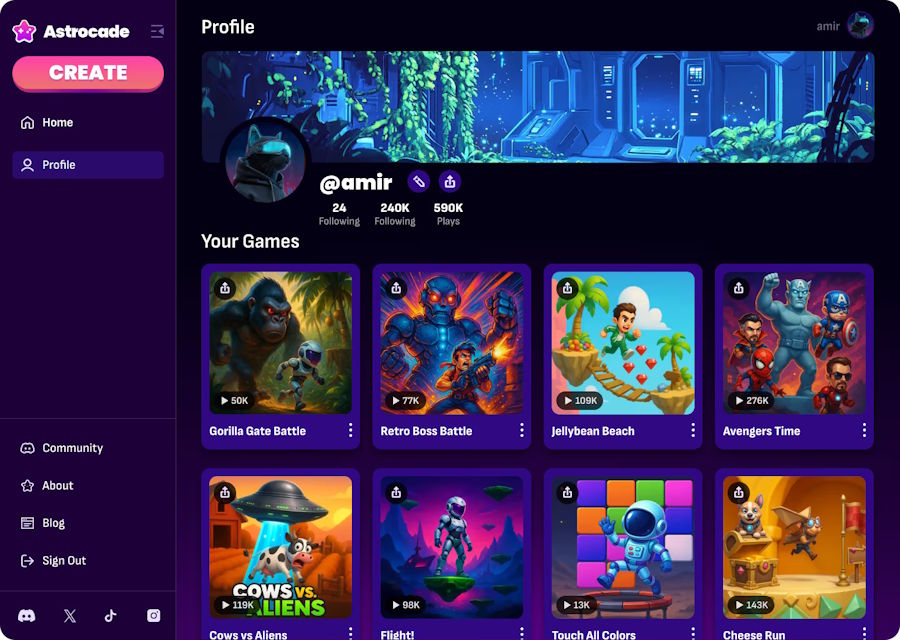
Astrocade operates on this principle. Games hosted on the platform are built to run in the browser and load directly into gameplay without requiring players to create platform accounts before they can start. The discovery, sharing, and playing all happen through the browser without registration gates blocking access to the actual game experience.
For players who are tired of managing accounts across multiple gaming platforms and services, this kind of approach is genuinely refreshing. You get access to a library of games through a single platform without that platform demanding your personal information as the price of entry.
The Longer Case for Frictionless Gaming Access
There is a broader argument worth making here about what frictionless access does for gaming culture generally. When games are easy to try without commitment, more people try them. When more people try them, communities around those games grow faster and more organically. When communities grow, the games get better through feedback, the player pools stay active, and the overall quality of the gaming ecosystem improves.
Account requirements are not inherently bad. For games built around long-term progression and persistent communities, they make complete sense. But applying that model to every multiplayer game regardless of whether it actually benefits the experience is a choice that has costs. It narrows the potential audience, slows down community growth, and creates friction that serves the platform more than it serves the player.
The no-account multiplayer model represents a different set of priorities, ones that put the player's immediate experience ahead of the platform's data collection interests. That alignment between player interest and platform design is part of why these games tend to have more enthusiastic communities despite often having smaller overall player bases.
Conclusion
Online Free Games that skip the account requirement are not a niche within the broader gaming world. They represent a genuinely player-friendly approach to multiplayer gaming that removes the obstacles standing between wanting to play and actually playing. Whether you are looking for something to share with friends on short notice, a quick competitive session without the commitment of platform registration, or simply a game that respects your time and your privacy from the first click, the no-account multiplayer space has strong options worth exploring. Find a platform that curates them well, bookmark the games your group enjoys, and enjoy the rare experience of a gaming session that starts exactly when you decide it should.

