

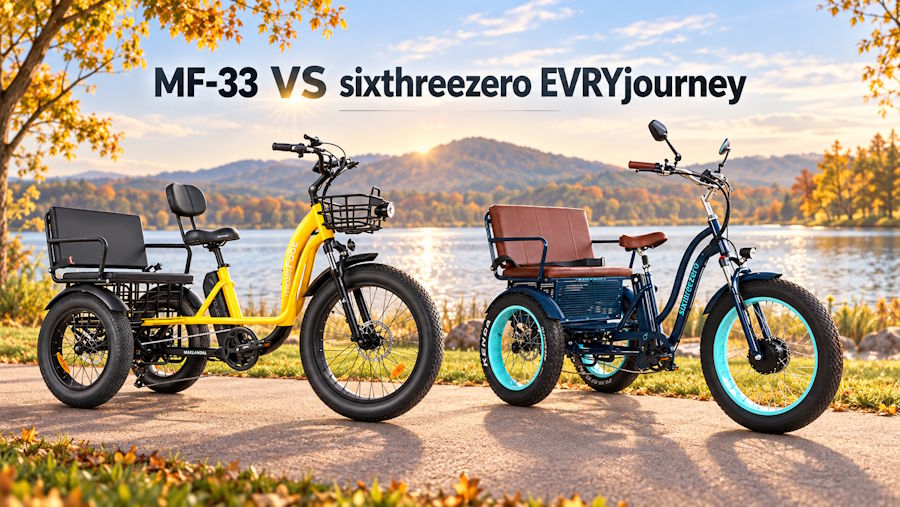
A family passenger e-trike has to do more than carry weight. It needs enough room for people, predictable low-speed handling, practical storage, usable range, dependable braking, and a layout that works for repeated short trips. The MaxFoot MF-33 and sixthreezero EVRYjourney 750W front-hub Rickshaw both target this category, but they solve the family-transport problem in different ways.
EVRYjourney emphasizes modularity. Its 2026 design adds a rear hitch that can accept compatible seating or cargo attachments. MF-33 emphasizes a purpose-built main passenger platform with rear drive, a differential, a 7A19 rear frame section, and a detailed 750W powertrain specification.
Family-Use Specification Comparison
| Family-use feature | MaxFoot MF-33 | EVRYjourney 750W |
|---|---|---|
| Total payload | 500 lb | 500 lb |
| Passenger focus | Integrated rear bench | 300 lb rear bench |
| Motor | 750W rear drive | Bafang 750W front hub |
| Peak / torque | 1,400W / 85Nm | Not published |
| Battery | 48V 20Ah / 960Wh | 48V 21Ah / 1,008Wh |
| Range claim | 85+ miles PAS 1 | Up to 50 miles |
| Rear differential | Yes | Not listed |
| Brakes | 3 x 180mm disc | 3 x 160mm hydraulic disc |
| Front suspension | 50mm | Suspension fork |
| Rear expansion | Standard passenger setup | Patent-pending rear hitch |
| Rear frame | 7A19 aluminum alloy section | Aluminum frame |
Seating: Both Are Built for Real Passengers
The most important similarity is that both trikes are designed around a proper rear bench rather than a small cargo rack with a cushion. EVRYjourney states a 300 lb capacity for its main bench and markets the seat for two adults or three children, subject to the complete vehicle's 500 lb load limit.
MF-33 is also designed to carry the rider plus rear passengers and has a 500 lb maximum payload. The rear seating area includes passenger-oriented support and restraints. For families, that means either model can cover use cases such as neighborhood rides with a spouse, taking children to a nearby park, campground transportation, or short errands.
Parents should still follow the manufacturer's age and restraint guidance and should never exceed the weight limits. A three-wheel e-bike is not the same as a car, and passengers should remain seated, balanced, and secured as intended.
EVRYjourney's Big Family Advantage: The Rear Hitch
The standout EVRYjourney feature is its 2026 hitch system. sixthreezero designed the rear of the trike so owners can add compatible subframes and accessories. Depending on the setup, the hitch can support additional seating or cargo-oriented components.
That flexibility makes sense for a family whose needs change. One day the trike may carry children, another day groceries or picnic gear. The hitch also gives owners a path to expand the platform after purchase rather than being locked into one rear configuration.
This is one area where MF-33 should not be presented as objectively superior. Its standard passenger setup is more integrated, but it does not offer the same published hitch ecosystem. For shoppers who specifically want a modular accessory platform, EVRYjourney has a meaningful advantage.
MF-33's Family Advantage: Rear-Drive Hardware
Why does that matter for a family trike? Because passengers and cargo often increase the load on the rear half of the vehicle. MF-33 puts the drive system at that end rather than in the front wheel. The differential then allows the two rear wheels to rotate at different speeds in a turn.
That combination is especially relevant when the trike is used frequently with passengers rather than occasionally. It gives MF-33 a coherent passenger-focused mechanical layout: rear passenger mass, rear drive, differential-equipped rear axle, and a specifically identified 7A19 rear frame section.
EVRYjourney uses a Bafang 750W front hub motor. It is a simple, familiar e-bike layout and keeps the motor separate from the rear bicycle drivetrain. But sixthreezero does not publish peak output, torque, or controller amperage for the current front-hub version, so buyers have fewer official power figures to compare.
Range for Family Errands
The manufacturer range claims reverse the order. sixthreezero lists up to 50 miles, while MaxFoot lists 85+ miles for MF-33 at PAS 1. Because the testing conditions differ, families should not interpret those figures as guaranteed real-world distances. A fully loaded trike using frequent throttle can consume energy much faster than a lightly loaded trike on low pedal assist.
For repeated local errands, either battery is substantial. For long recreational rides or RV-campground use, the MF-33's higher published PAS-range figure may give buyers more confidence, provided they understand it is a manufacturer claim rather than a direct controlled comparison.
Braking When Carrying People
A family trike needs three-wheel braking because the total mass can be much higher than a normal bicycle. EVRYjourney 2026 uses hydraulic disc brakes with 160mm rotors at all three wheels. Hydraulic operation can provide a light, consistent lever feel.
These systems have different strengths. EVRYjourney's hydraulic actuation is a clear comfort and maintenance advantage. MF-33's larger rotor diameter provides additional leverage and heat capacity. Families should pay attention to both brake type and rotor size rather than comparing only one label.
Comfort for the Driver and Passengers
Both designs use a 24 x 4-inch front tire and two 20 x 4-inch rear tires. The smaller rear wheels help lower the passenger platform, which can improve the feeling of stability and make it easier for passengers to get seated.
The rear passenger experience therefore depends heavily on the seat padding, fat tires, tire pressure, road surface, and how conservatively the trike is ridden. On rough roads, slowing down will often improve passenger comfort more than any single suspension specification.
Lighting and Visibility
EVRYjourney also includes lighting and places strong emphasis on mirrors and rider awareness in its current setup. Buyers should verify the exact accessory package on the version they purchase because family-use features can change by model year and bundle.
Storage and Ownership Practicality
Neither trike is small. A family should measure the garage, shed, gate, or RV storage area before ordering. The wide rear axle that makes a passenger trike stable also makes it harder to move through narrow doors.
EVRYjourney's hitch system is useful for owners who have space to store accessory modules and want to reconfigure the rear. MF-33 is simpler if the primary use will always be carrying one or two passengers on the main bench.
Maintenance also differs slightly. Hydraulic brakes and a front hub motor create one set of service considerations; a rear-drive differential system creates another. Buyers should choose a dealer or service plan that can support the specific system rather than assuming every bicycle shop will work on a heavy electric passenger trike.
Which Is More Practical for a Family?
MF-33 is the more drivetrain-focused option. The published 1,400W peak, 85Nm, 25A controller, rear drive, differential, 180mm rotors, 7A19 rear frame, and 85+ mile PAS 1 claim make a strong case for families expecting regular passenger use.
In other words, EVRYjourney is compelling when expansion and configuration flexibility come first. MF-33 is compelling when the buyer wants a passenger trike whose core hardware is centered on carrying load at the rear.
Final Take
The best family passenger e-trike is the one that matches the family's normal trip, not an occasional edge case. If the main goal is a flexible platform that can switch between people and cargo, EVRYjourney's hitch deserves serious consideration. If the normal trip involves adult passengers, longer distances, and a preference for rear-drive engineering, MF-33 offers a very clear alternative.
Both should be ridden at conservative speeds when loaded. Families should slow before turns, balance passenger weight, check tire pressure, inspect brakes regularly, and respect the total payload limit. With those basics in place, either model can turn short local trips into a practical alternative to using a car.

