

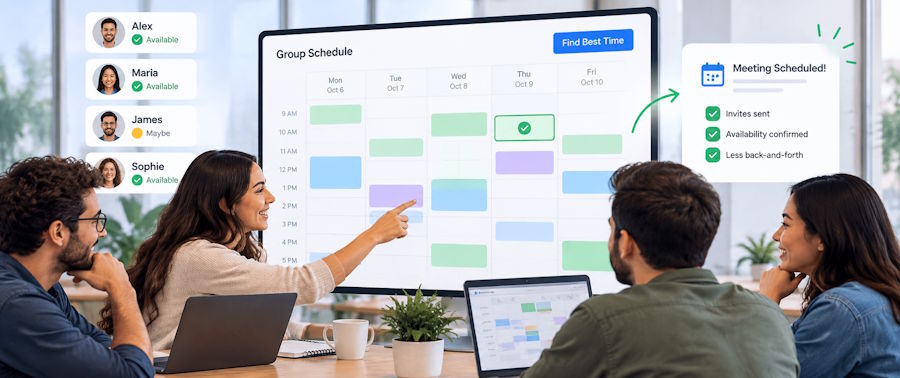
Finding a time that works for several people can become strangely difficult. One person is free Tuesday morning, another can only do Wednesday afternoon, somebody else needs to check their calendar, and by the time the final reply arrives one of the original options is no longer available. What started as a simple question can turn into a long chain of emails or messages. A group scheduling tool can reduce much of this back-and-forth by giving everyone a single place to indicate availability, view suitable options, and move towards a decision without requiring one person to coordinate every response manually. The larger or busier the group becomes, the more noticeable that difference can be.
The underlying problem is not usually that people are unwilling to cooperate. It is that conversational tools such as email and group messaging are poorly suited to comparing several calendars at once. Each person contributes another piece of information, but somebody still has to assemble those pieces into a workable answer. A message saying “Tuesday or Thursday works for me” is useful, but only after it has been compared with everyone else's response.
This creates an administrative role that is easy to underestimate. Someone becomes the unofficial scheduling coordinator, even when organizing the meeting is only a tiny part of their actual job. They send the first message, wait for replies, chase the people who have not responded, and then try to identify the time with the fewest conflicts. If no option works, the process starts again.
The inefficiency becomes clearer when information changes during that process. A participant who originally said they were free at 2 p.m. may accept another meeting while waiting for the group to decide. Another person might realize they overlooked a commitment. Someone who responded late may suggest an entirely new time, causing everybody else to revisit their calendars.
The conversation stays active, but progress can be surprisingly slow.
A central scheduling process approaches the same problem differently. Instead of asking each participant to describe their availability in a separate message, the organizer provides a set of possible times and allows people to respond within the same shared framework. The comparison happens as information is collected rather than afterwards.
That removes an important layer of translation. Nobody has to read eight different emails and turn them into a table. Availability is already structured, making overlaps easier to recognize.
For small groups, the time saving may appear modest. Coordinating three colleagues for a half-hour meeting is rarely a major challenge. Once six, ten, or twenty people are involved, however, the number of possible conflicts increases quickly. What used to take a few messages can turn into an extended discussion spread across several days.
This is particularly common when the group includes people from different teams. Colleagues who work closely together may already know each other's typical schedules, whereas participants from separate departments have fewer shared assumptions. External attendees introduce another layer because organizers may not be able to see their calendars at all.
A scheduling tool allows availability to be compared without requiring everyone to use the same internal calendar system. That can make it useful for meetings involving clients, committee members, volunteers, contractors, or other participants outside the organization.
The benefit is not limited to meetings either. The same approach can be applied to training sessions, group activities, interviews, workshops, and any situation where several people need to agree on a time. In each case, the objective is similar: replace repeated negotiation with a clearer decision-making process.
There is also a psychological advantage to seeing the options visually. A lengthy email conversation can make scheduling feel more complicated than it really is because every conflict receives its own message. A shared view may reveal that almost everyone is available at two particular times.
The problem suddenly becomes smaller.
Instead of asking, “When can everybody meet?” the organizer can make a more practical decision: “Which of these two times works best?”
That shift matters because not every scheduling decision requires perfect availability. Sometimes the priority is finding the time that works for the greatest number of people. In other situations, several key individuals must attend while others are optional. A useful scheduling system can help make those patterns visible so the organizer can apply judgment rather than simply collecting more replies.
Speed can improve as well. With an email chain, participants often wait to see what other people suggest before responding. This can create a sequence in which replies arrive one at a time over several days. A centralized process allows everybody to respond independently, so several people can provide availability within the same period without waiting for one another.
This becomes valuable when meetings need to be arranged quickly. If a decision is required tomorrow afternoon, spending half a day negotiating the meeting time wastes part of the limited window available for the actual work.
Clear deadlines for responses can make the process even more efficient. Participants know when their availability needs to be submitted, while the organizer knows when they can make the final decision. The schedule does not remain open indefinitely simply because one person has not replied.
Time zones provide another reason to move beyond conversational scheduling. A proposed meeting time that looks perfectly reasonable to one participant may fall very early or late in the day for someone elsewhere. When international teams try to arrange meetings through email, time-zone conversions can easily become another source of misunderstanding.
Scheduling systems that present options in the participant's local time can reduce this friction. People make decisions based on the time that actually applies to them rather than mentally converting from another region and hoping they have calculated correctly.
Even within one country, working patterns can differ considerably. Flexible hours, part-time schedules, remote work, and hybrid arrangements have made the traditional assumption that everyone is available between the same fixed hours less reliable. Teams may work productively together while having quite different patterns of availability.
Better scheduling recognizes this reality instead of treating every conflict as an inconvenience.
Recurring meetings introduce another type of back-and-forth. A weekly meeting scheduled at the same time can work well until several participants' responsibilities change. Continuing automatically may create poor attendance, yet finding a new recurring time through email can mean another lengthy negotiation.
A structured availability check gives the team a quick way to reconsider the schedule. Rather than discussing every possible alternative, participants can indicate which recurring windows would work and allow the organizer to see where the strongest overlap exists.
The same principle can help when organizing several sessions of the same activity. A training team might offer four possible workshops and need employees to choose one. Asking everyone to email a preference means the organizer has to count responses and monitor capacity manually. A scheduling system can make availability and remaining places visible from the beginning.
That distinction highlights an important point: reducing messages is useful, but reducing manual processing is the bigger benefit.
A perfectly organized email inbox does not solve the fundamental problem if someone still has to interpret every response individually. Efficiency comes from collecting information in a format that already supports the decision being made.
Notifications should support that process rather than recreate the noise the system is supposed to eliminate. A platform that sends constant updates every time somebody responds can become nearly as distracting as a group email chain. Organizers should consider whether participants receive the information they need without being drawn into every minor change.
Confirmation is more useful than conversation in many cases. Once the final time is selected, everyone needs a clear record of what was decided. Calendar invitations or automatic confirmations can make the result harder to miss than a final message buried beneath twenty earlier replies.
This also reduces the familiar problem of somebody remembering the discussion but not the outcome. They may recall that Wednesday and Thursday were both being considered but have forgotten which one eventually won. A clear final booking removes the ambiguity.
Changes after the decision should also be handled carefully. No scheduling system can prevent a participant from becoming unavailable later. What it can do is keep the current information clear.
If a meeting moves, participants should not need to reread the original conversation to establish which details are still correct. The updated appointment should become the new reference point.
This becomes increasingly important for organizations managing many group activities simultaneously. A single scheduling thread may be manageable, but several overlapping discussions can overwhelm even organized people. One person may be replying about a committee meeting, another training session, and a project workshop during the same afternoon.
Centralized scheduling separates these decisions from the surrounding conversation. Each activity has a defined place, its own participants, and a clear outcome.
That can also make responsibility less dependent on one organizer. If the person who originally arranged the meeting becomes unavailable, someone else can understand what has already happened without searching through their inbox. The information exists as part of the schedule rather than solely within one person's correspondence.
The best scheduling process should still leave room for human judgment. Software cannot decide which attendee is most important, whether a deadline can move, or whether a meeting is necessary at all. Those decisions belong to the people involved.
What technology can remove is the repetitive work surrounding those decisions.
There will always be occasions when a quick message remains the easiest option. Two colleagues who sit beside each other do not need a scheduling platform to arrange a ten-minute conversation. The value increases as coordination becomes harder: more participants, tighter calendars, different locations, or repeated activities.
That is why a good scheduling tool should not feel like adding bureaucracy to simple interactions. It should be available when complexity reaches the point where informal methods begin creating unnecessary work.
The real improvement is often visible in what disappears. There are fewer “What about Thursday?” messages, fewer requests to resend the final time, and fewer apologies from people who overlooked an earlier response. The organizer spends less time acting as the middleman between everyone's calendars.
Instead, participants provide the information needed to reach a decision, the overlap becomes visible, and the group can move on.
For busy teams, that may be the most valuable outcome of all. Scheduling should be the small administrative step that enables the work to happen, not a conversation that requires almost as much effort as the meeting itself.

