

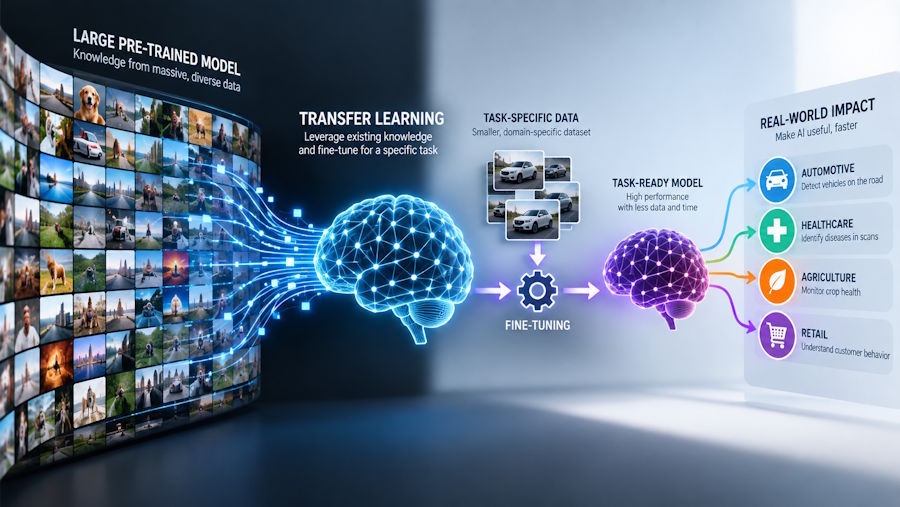
Transfer learning means taking a model that has already been trained on a large-scale task and modifying it so that it can be used for a new task which is related to the original one—in this way you end up requiring less data and less training time than you would if you had to begin from scratch. In practice, it's not really about taking shortcuts but rather about reusing knowledge: the model has already learned general patterns (for example, edges in images, grammar in text, and common shapes in signals), and you then adjust it to fit your specific problem. This is one of the most useful ideas for those who have studied a course in data science since it enables you to turn limited datasets into viable projects.
Why transfer learning is so effective when data is limited
A modern pre-trained model is like a well-trained generalist in that it has been exposed to a sufficient number of examples in order to develop reusable representations—internal features that capture patterns common to a variety of different tasks. When you carry out fine-tuning, you are not being asked to teach the model all that information again; rather, you are adjusting the model to match your new labels, business rules, and the specific characteristics of your data.
This is important since a great many organisations lack "big tech scale" datasets; instead, they have thousands of labelled examples rather than millions. Even when the amount of training data is greatly reduced, transfer learning generally maintains a high level of performance. A study from 2024 (which used common image models such as ResNet50 and VGG19) found that pre-trained models could achieve accuracy comparable to that obtained by training from scratch even though they needed as much as 89.3% less training data, the exact figure depending on the task configuration. While such a reduction isn't guaranteed to work in all situations, it does account for why transfer learning is now adopted as a standard starting point by many applied teams.
Where it shows up in real work: three concrete use cases
1) Customer support text classification and routing
A support team could automatically assign tags to tickets—such as those relating to billing, login, refunds, or technical errors—and direct them to the appropriate queue. It would be unrealistic for most businesses to train a language model from scratch. Using a pre-trained transformer model, you can adapt it to your historical tickets and obtain good results with only minor changes to the architecture. A classic example is BERT: the original paper demonstrated that a pre-trained model can be fine-tuned by adding a small task-specific layer and yet achieve state-of-the-art results on various NLP benchmarks.
You don't need to create a completely new model in order to achieve high accuracy.
2) Medical and industrial imaging with small labelled datasets
In the fields of healthcare and manufacturing, labels are expensive since a radiologist's time is costly and a quality engineer can only examine a finite number of images. Transfer learning is frequently used in such cases because it works well whenever there is a limited amount of labelled data; for instance, research on ImageNet-pretrained networks points out that when the number of images is small, transfer learning from ImageNet usually leads to better performance than random initialisation.
3) Time-series and sensor data in operations
Factories, together with their logistics fleets and energy systems, generate a large amount of sensor data, though it is not always accompanied by labelled results (such as failures, anomalies, or root causes). Transfer learning can be of assistance here by using data on general behaviour patterns (for example, normal operations) for pretraining and then refining it with the smaller dataset consisting of the labelled events. Even in a situation where you don't apply deep learning from start to finish, the approach based on transfer learning still holds: begin with a established baseline representation and then adjust it.
For many people taking a data scientist course in Pune, these examples have a common feature in that transfer learning makes it possible to carry out modelling when data collection is slow, privacy-sensitive, or costly.
How to apply transfer learning without making it fragile
Transfer learning is not a single technique but rather a family of methods. In practice, most projects adopt one of these patterns:
- Feature extraction: freeze most layers and train only the final classifier/regressor on your dataset. This is fast and stable when your dataset is small.
- Fine-tuning: allow more layers to update, usually starting from the top (closest to the output). This can yield higher accuracy, but it needs careful learning rates and validation.
A reliable workflow looks like this:
- Begin with a simple baseline (feature extraction).
- Measure this accurately (for example, by using a clean validation set, or by using cross-validation if the amount of data is limited).
- Make gradual adjustments, thawing out a few layers at a time.
- The most frequent cause of failure is track overfitting, especially when the amount of data is small.
- Record the changes made (for example, which layers, which learning rate, which augmentation, and which pre-trained checkpoint).
This prevents transfer learning from appearing 'magical'. It turns it into a controlled experiment which your team can carry out and audit.
The caution: transfer learning is powerful, but not universal
A worthwhile editorial point that is frequently overlooked is that transfer learning may fail if the source and target problems are too different or if the pretraining data causes the model to acquire biases which do not suit your domain. Recent research in the area of medical imaging shows that the advantages of using ImageNet pretraining are not general and can vary according to the difficulty of the task, the architecture chosen, the training time, and factors specific to the dataset—thus teams should assess rather than assume.
This is sometimes referred to as negative transfer: performance may stop progressing or even decline when the transferred features are not in line with the new task.
A practical safeguard is to test two baselines:
- fine-tuning from a pre-trained checkpoint, and
- training the same architecture from scratch (if that is possible).
- You'll quickly realise that pretraining isn't helpful before you've built up your entire pipeline around it.
Conclusion
The best way to grasp the concept of transfer learning is to think of it as a productivity multiplier within the field of applied machine learning—make use of what the model has already learned and then adapt it to fit your particular dataset, constraints, and business objectives. It is able to greatly reduce the amount of data required in some situations and has a well-documented track record in the areas of language and vision because of the use of pretraining and fine-tuning techniques. The important thing to remember is to approach it in the same manner as engineering, not as something rooted in tradition: start off simply, check thoroughly, make slow adjustments, and always make certain that transfer actually brings a benefit to your specific domain.
Business name: ExcelR - Data Science, Data Analyst Course Training
Address: 1st Floor, East Court Phoenix Market City, F-02, Clover Park, Viman Nagar, Pune, Maharashtra 411014
Phone: 09699753213

