

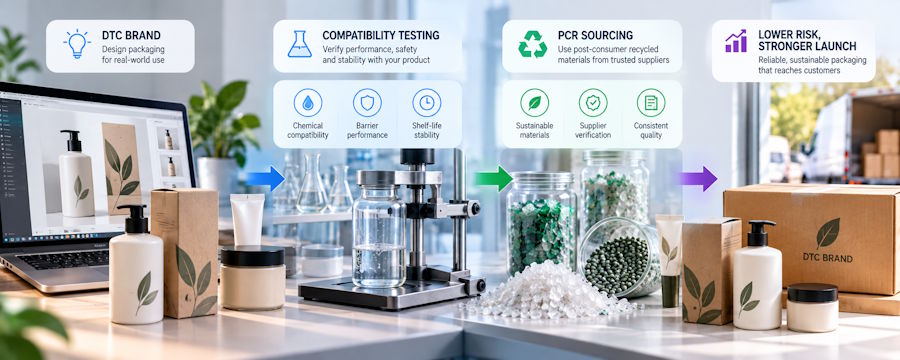
A packaging failure at scale costs far more than the testing that would have caught it. A leaking bottle or a resin swap that changes formula behavior can turn into a recall at full production volume. That's the risk compatibility testing exists to catch early. This guide breaks down what that testing actually involves and how PCR sourcing changes the equation.
Key Takeaways
- Compatibility testing checks how a formula behaves inside its actual packaging over time
- Switching resin vendors, even within the same material family, can change performance enough to require retesting
- PCR resin batches vary more than virgin resin, which raises the bar for incoming quality control
- California and Washington already mandate rising PCR content in packaging, with more states following
- The brands that scale packaging safely run their testing before the bulk order goes out
Does Switching to PCR Risk a Product Recall?
Switching to PCR packaging without a recall comes down to testing the actual resin batch. A brand moving from virgin resin plastic bottles to PCR should treat the switch like a vendor change. Testing the specific batch matters more than testing the material category in general. Resin compatibility packaging issues rarely show up as a dramatic failure. They usually show up as a slow color shift or a liner seal that fails months early. That means a fresh compatibility round, run before the new batch ships. Testing the specific batch early keeps that shift contained to a sample run instead of a warehouse full of finished product.
What Is Packaging Compatibility Testing?
Packaging compatibility testing checks whether a formula and its container interact safely over time. It covers changes like leaching and weight loss in the product. It's a separate question from formula stability. A product can look stable in a beaker and still react badly inside its actual bottle. Brands sourcing containers at volume typically build in why compatibility testing matters before committing to a full production run. A single failed batch caught here costs far less than the same failure showing up in customer inboxes.
Importance of PCR Sourcing for Packaging
PCR sourcing means buying resin that already had one life as a consumer product before it's reprocessed. That keeps material in circulation instead of pulling more virgin plastic out of the ground. Regulators increasingly require it too, which adds a second reason beyond emissions. The catch shows up in quality control. Ask for a document stating the resin grade and exact percentage.
Some PCR suppliers now carry FDA no-objection letters for food-grade resin, which helps close that documentation gap. PCR (post-consumer resin) packaging sources resin from mixed post-consumer streams. That means more batch-to-batch variation in molecular weight and melt viscosity than virgin resin sees. That's exactly why PCR sourcing for ecommerce brands in 2026 leans harder on supplier documentation.
How Long Does Compatibility Testing Take?
Compatibility testing usually runs from a few weeks to several months. The timeline depends on the formula and how aggressively it interacts with the packaging. Bulk order packaging testing on a stable formula might wrap up in a few weeks. A reactive formula, like an essential oil blend, can take much longer. Accelerated aging protocols still need real time at elevated temperatures to catch a slow leach. Building testing time into the launch calendar avoids a last-minute scramble before a product ships.
What Happens When a Resin Vendor Changes?
What happens when a resin vendor changes depends on how much actually shifted. Vendor switch packaging risk is highest when the resin grade or additive package changes. That's true even when the container's shape and dimensions stay identical. Packaging professionals in industry forums generally agree on one rule. Bridge test results only when the change is minor. Run a full compatibility round again whenever the resin source itself changes. That's where batch variability tends to hide. Ask the vendor for updated documentation whenever a resin source changes.
Recycled Content Laws for Packaging
Recycled content packaging law is no longer a future consideration for brands selling into major US markets.
- California's AB 793 requires 25 percent postconsumer recycled content in beverage containers as of 2025. That threshold rises to 50 percent by 2030.
- Washington's recycled content law follows a similar curve for beverage and personal care packaging. Its thresholds keep climbing through 2031.
- Other states are drafting similar recycled-content rules, so the compliance list is likely to grow.
Brands treating PCR sourcing as a testing exercise now avoid scrambling once compliance deadlines arrive.
Scaling DTC Packaging Without Recalls
Scaling DTC packaging supply chain operations without a recall starts with testing before the volume commitment. That means:
- Testing the exact resin batch and vendor going into a bulk order.
- Document the results before signing off on the order.
- Re-test any time the resin source or the vendor changes, even when the container looks the same on paper.
Recalls also cost trust that's much harder to rebuild than the batch itself. That discipline is what keeps a bulk order from turning into the exact recall this guide opened with. Testing earns its keep the one time it catches a problem before a bulk order ships.

