

Building interactive web applications requiring strict audio-visual synchronization presents significant engineering hurdles. Developers utilizing the Web Audio API alongside HTML5 video elements face an immediate dependency bottleneck. The core logic for detecting beat drops or frequency spikes must be tested early. However, engineering teams rarely have final multimedia assets during initial sprint phases. Writing state management or rendering logic against static placeholders fails to reveal runtime issues like rendering lag, buffering desynchronization, heavy DOM manipulation, or poor memory management.
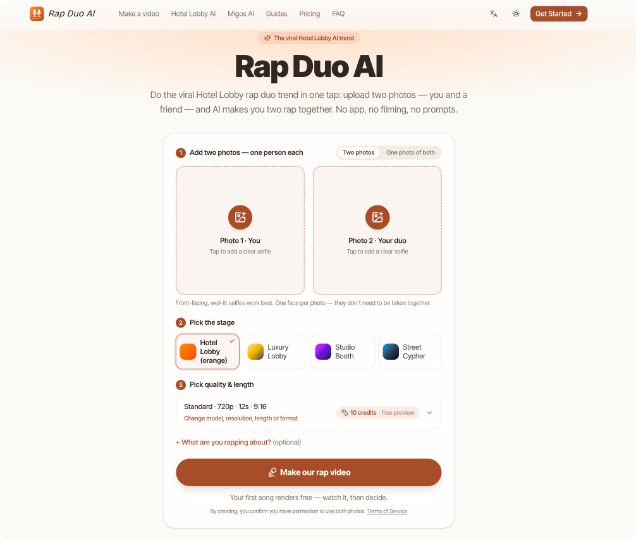
Relying on generic stock footage or waiting weeks for a motion graphics team stalls the engineering pipeline. Developers need immediate access to dynamically generated media reflecting the application's intended rhythm to validate their code. Integrating algorithmic generation tools directly into the development workflow provides a practical bypass for this dependency. Generating preliminary synchronized media with Rap Duo AI allows engineers to populate staging environments with rhythmically accurate video files. This enables rigorous testing of playback logic, buffering states, and event listeners long before the design team delivers final assets.
Mapping the Logic of Audio-Reactive Web Components
When an application reacts to sound—like a generative visualizer or rhythm game—the browser processes the media stream in real-time. This requires a robust pipeline routing an audio source through an analysis node before reaching the hardware destination. If the application merely plays video and audio simultaneously using basic HTML tags, network loading discrepancies will inevitably cause elements to drift out of sync. The application must programmatically tether visual state changes to the audio output.
To prevent drift, developers extract quantifiable data from the audio track, converting audible sound into an integer array representing frequency and amplitude at any millisecond. Parsing this array allows the application to trigger interface changes, like modifying CSS transforms, shifting WebGL colors, or scrubbing to timestamps in a video file. Designing this extraction layer requires understanding JavaScript's asynchronous execution and the browser's rendering cycle.
Establishing the Front-End Synchronization Architecture
- Initialize the Audio Context and Source Stream
The foundation requires instantiating an AudioContext object within the browser, serving as the primary processing graph. Developers must manage initialization carefully, as modern browsers strictly enforce autoplay policies requiring explicit user interaction before processing begins. Once active, the media element is passed into the graph using the createMediaElementSource method, securely linking the DOM node to the internal audio API for inspection. - Extract Frequency Data for Visual Mapping
With the source connected, the stream routes through an AnalyserNode before reaching the destination. This node performs a Fast Fourier Transform on the audio signal, breaking complex soundwaves into measurable frequency bins. Developers specify the size parameter to determine data resolution. An unsigned integer array then holds the frequency values, updating continuously during playback to provide the numerical data for visual triggers. - Calibrate the Render Loop for Smooth Execution
Reading data from the analysis node requires a high-performance loop matching the hardware refresh rate. Utilizing standard interval timers introduces micro-stutters and visual desynchronization. Instead, developers must wrap extraction and UI update logic within a requestAnimationFrame loop. This browser-optimized method ensures visual elements re-render precisely when the screen is ready, maintaining sixty frames per second while preventing garbage collection overhead that causes jitter.
Generating Test Assets for Pipeline Validation
Writing the render loop is only half the task; validating visual reactions requires media with clear rhythmic markers. Without rhythmically precise video files, verifying mathematical thresholds in JavaScript is largely guesswork. Developers need a method to rapidly produce test files without opening heavy video editing software. Testing code against flat, unmoving assets guarantees that timing bugs will inevitably emerge later in production.
Algorithmic media generation directly addresses this workflow gap. When setting up a staging environment, engineers can leverage Rap Duo Video AI to output targeted test videos. The process involves inputting the track's exact tempo and defining a kinetic visual prompt, like geometric shapes inverting on downbeats. The tool outputs a file with hard cuts mapped to those parameters. The developer mounts this file to the DOM and runs the frequency extraction logic. The critical check involves ensuring programmatic CSS transitions fire at the exact millisecond the generated video shifts visually, confirming the synchronization math is flawless.
Handling Media Playback Delays and Browser Constraints
Even with perfect calculation logic, network latency and browser resource management can disrupt synchronization. When hosting large media files, applications must account for buffering events. If a video stalls but the audio context continues processing time, visual triggers will fire out of sync with the stalled frame, breaking the illusion. Developers cannot assume a pristine local network environment translates to real-world usage on mobile devices.
To mitigate this, developers implement robust event listeners on HTML media elements, monitoring waiting, playing, and stalled events. When a waiting event fires, the application must pause the audio context or rendering loop until a canplaythrough event confirms enough data has loaded. Additionally, leveraging HTML preload attributes ensures the initial video chunk is available in the browser cache before the user initiates playback.
Finalizing the Technical Foundation for Interactive Media
Constructing a reliable audio-visual application depends on an architecture that handles media parsing and rendering loops efficiently. By routing streams through analysis nodes and binding updates to optimized frames, engineers eliminate the drift plaguing basic implementations. Validating thresholds early with rhythmically accurate, algorithmically generated test files ensures the underlying JavaScript is solid before heavy production design assets enter the repository.
Ultimately, writing performant media logic requires anticipating network limitations and strict browser constraints. Codebases that proactively manage buffering states and optimize data extraction avoid frustrating experiences caused by out-of-sync audio and visuals. Whether you are building an interactive audio visualizer or a fully-fledged AI Rap Video Generator, establishing this rigorous technical foundation guarantees the underlying engineering logic scales flawlessly across different devices, hardware capabilities, and varying network conditions upon final launch.

