


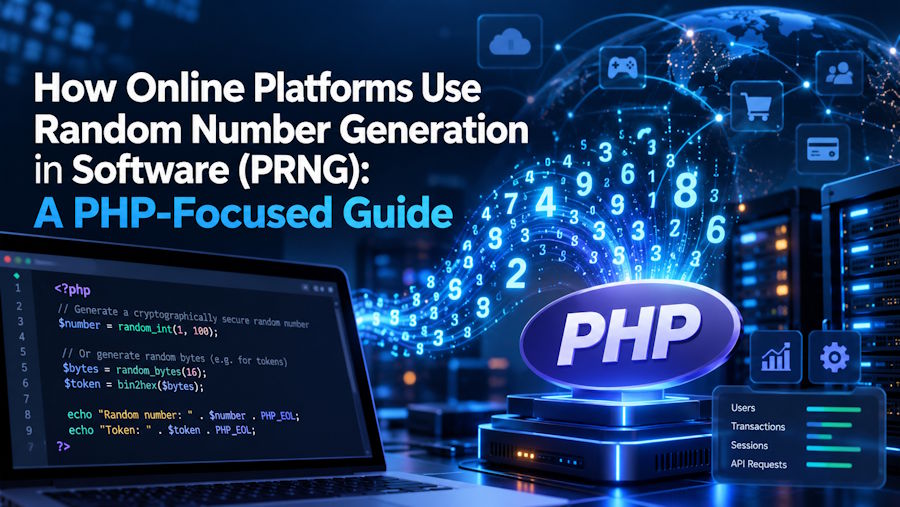
Even when users never see it directly, random number generation is a fundamental part of modern software. Online platforms rely on randomness for tasks ranging from generating secure authentication tokens and password-reset links to shuffling content, assigning users to experiments, selecting recommendations, simulating outcomes, powering game mechanics among a lot of other things.
Unlike a physical source of randomness, a PRNG uses an algorithm and an internal state to produce a sequence of values that appears random, making PRNGs fast, efficient, and useful for software, but it also means that different generators have different properties. Some are designed primarily for speed and statistical quality, while others are intended to resist prediction and are suitable for cryptographic purposes.
Understanding this difference is particularly important in web development for example. A generator that is perfectly acceptable for shuffling a list or simulating a dice roll, may be totally inappropriate for creating a session token or password-reset code. Similarly, deterministic randomness can be extremely useful in testing and simulations because the same seed can reproduce the same sequence of results.
Why Random Number Generation Matters in PHP
Random number generation is important in PHP because many web applications depend on values that must be either unpredictable, statistically random, or reproducible. PHP applications commonly use randomness for:
- Password-reset and verification tokens
- API secrets and temporary access codes
- Random content selection
- A/B testing
- Games and weighted outcomes
- Test data and simulations
- Random identifiers and filenames
The main challenge is choosing the right type of randomness for the task. Security-sensitive values require cryptographically secure randomness, while simulations and testing may benefit more from deterministic generators that can reproduce the same sequence. In practice, this means PHP developers should treat randomness as an engineering decision rather than simply calling whichever random function is most familiar.
What Is a PRNG?
A PRNG, or Pseudorandom Number Generator, is an algorithm that produces a sequence of values that appears random. Unlike true randomness, however, the values are generated mathematically. This means a PRNG is deterministic: if it starts with the same initial conditions, it can reproduce the same sequence of values.
How a PRNG Works
A PRNG usually starts from an initial value called a seed. The seed is used to initialize the generator's internal state, which is then updated every time a new random value is produced. Conceptually, the process looks like this:
Seed => Internal State => PRNG Algorithm => Random-Looking SequenceDifferent seeds generally produce different sequences, while using the same seed with the same algorithm can reproduce the same results. This behavior is useful in applications where repeatability matters, such as automated testing, simulations, debugging, and procedural content generation.
PRNGs Are Not Automatically Secure
An important distinction is that statistical randomness and security are not the same thing. A PRNG may produce values that look perfectly random while still being predictable if an attacker can determine its seed, internal state, or algorithm. This is why general-purpose PRNGs should not automatically be used for security-sensitive operations such as password-reset tokens, authentication secrets, or API keys.
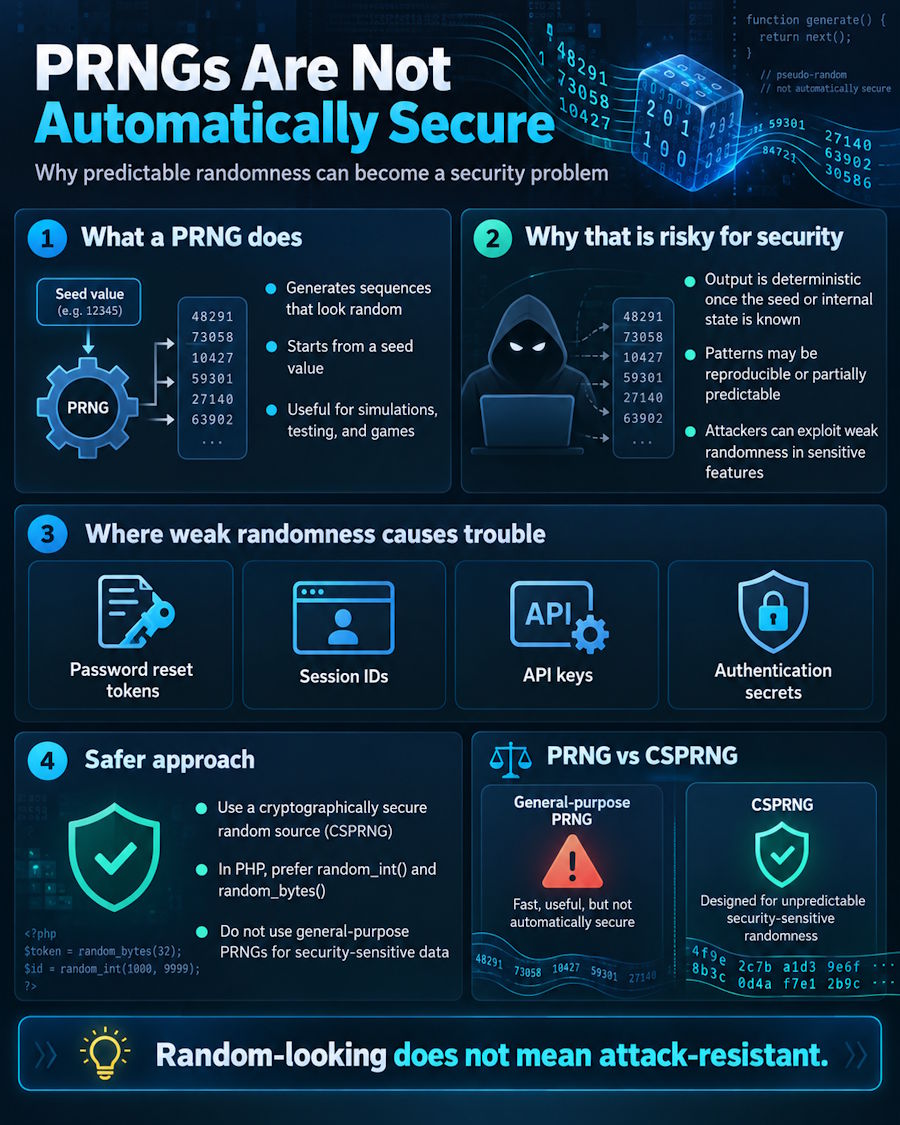
At this point, an important question comes up: if PHP uses random number generation for security-sensitive tasks, why should general-purpose PRNGs be avoided for things like password-reset tokens or API keys? The answer is that not all pseudorandom generators provide the same guarantees. General-purpose PRNGs are designed mainly for speed, simulation, or statistical quality, while cryptographically secure generators are specifically designed to make their output difficult to predict. PHP functions such as `random_int()` and `random_bytes()` rely on cryptographically secure randomness, which makes them appropriate for sensitive values.
How Random Number Generation Works in PHP
Random number generation plays a much larger role in PHP applications than simply producing an arbitrary number. In modern web platforms, randomness is used for security, experimentation, content selection, testing, games, recommendations, and many other features that require unpredictable or variable behavior. PHP provides several ways to work with random values, ranging from older pseudorandom functions to cryptographically secure APIs such as random_int() and random_bytes().
Randomness Is Important for Security
One of the most critical uses of random data in PHP is generating secrets that should not be predictable. For example in:
- Password-reset tokens
- Email verification tokens
- API credentials
- Temporary authentication codes
- Session-related secrets
- CSRF tokens
- Invitation codes
- One-time access links
If that token follows a predictable pattern, an attacker may be able to guess another user's token and gain unauthorized access to their account. For this reason, security-sensitive values should be generated with cryptographically secure randomness rather than general-purpose pseudorandom functions.
A common example used in PHP is:
<?php

$token = bin2hex(random_bytes(32));

echo $token;
random_bytes(32) generates 32 bytes of cryptographically secure random data. Because raw bytes may contain characters that are inconvenient to place inside URLs or databases, bin2hex() converts them into a hexadecimal representation. The resulting token contains 64 hexadecimal characters and represents 256 bits of random data.
The same general pattern can be used for password-reset tokens, email verification URLs, API secrets, and other values that must be difficult to predict.
Generating Secure Random Data With random_int() and random_bytes()
PHP provides two simple functions for generating cryptographically secure random data: random_int() and random_bytes(). They are designed for cases where unpredictability matters, such as authentication tokens, verification codes, API secrets, and other security-sensitive values.
Using random_int()
random_int() generates a secure integer within a specified range. For example, a six-digit verification code can be generated with:
<?php

$code = random_int(100000, 999999);

echo $code;
This function is useful when the application specifically needs a numeric value, such as:
- Verification codes
- Random indexes
- Bounded selections
- Random numeric challenges
Unlike older functions such as rand() or mt_rand(), random_int() is suitable for security-sensitive use cases.
Using random_bytes()
random_bytes() generates raw random bytes rather than an integer. This makes it especially useful for tokens and secrets:
<?php

$token = bin2hex(random_bytes(32));

echo $token;
Here, random_bytes(32) generates 32 secure random bytes, while bin2hex() converts them into a readable hexadecimal string. This is commonly used for:
- Password reset tokens
- Email verification links
- API keys
- Random filenames
- Temporary access tokens
Thirty-two random bytes represent 256 bits of random data, providing a very large space of possible values.
Understanding PHP's Random\Randomizer and Random Engines
Modern PHP provides the Random extension, which separates random operations from the algorithm used to generate the underlying random data. At the center of this design is Random\Randomizer.
What Is Random\Randomizer?
Random\Randomizer provides high-level methods for working with random values, such as generating integers, bytes, shuffled data, and random selections.
The important part is that Randomizer does not define the random algorithm itself. Instead, it receives a random engine.
Conceptually:
Random Engine → Randomizer → Application Logic
This separation makes it possible to change the source of randomness without rewriting the rest of the application.
What Is a Random Engine?
A random engine is responsible for producing the underlying random data. PHP includes several engines with different characteristics, including:
-
Random\Engine\Secure -
Random\Engine\Mt19937 -
Random\Engine\PcgOneseq128XslRr64 -
Random\Engine\Xoshiro256StarStar
For example, a deterministic engine can be initialized with a fixed seed:
<?php

use Random\Engine\Mt19937;
use Random\Randomizer;

$engine = new Mt19937(12345);
$randomizer = new Randomizer($engine);
echo $randomizer->getInt(1, 100);
Using the same engine and seed allows the same sequence to be reproduced, which is useful for tests, simulations, and debugging.
Secure vs Deterministic Engines
Different engines are appropriate for different tasks. Random\Engine\Secure is designed for cases where unpredictability matters:
<?php

use Random\Engine\Secure;
use Random\Randomizer;

$randomizer = new Randomizer(new Secure());
$value = $randomizer->getInt(1, 100);
Deterministic engines such as Mt19937, PCG, or Xoshiro are more appropriate when reproducibility or simulation performance matters. This distinction is important because an engine that is excellent for statistical simulations is not automatically suitable for generating authentication secrets.
Why This Design Matters
Separating Randomizer from the engine makes PHP random number generation easier to test and maintain.
A production service can use a secure engine, while automated tests can inject a seeded deterministic engine and reproduce the same results every time.
The main idea is simple: Randomizer defines what random operation the application performs, while the engine determines how the random data is produced.
Secure vs Deterministic Randomness
Not every application needs the same type of randomness. In PHP, one of the most important distinctions is between secure randomness and deterministic randomness.
Secure Randomness
Secure randomness is designed to produce values that are difficult for an attacker to predict.
This is essential for:
-
Password-reset tokens
-
API secrets
-
Authentication codes
-
Session-related values
-
Private access links
PHP provides secure randomness through functions such as random_int() and random_bytes(), as well as Random\Engine\Secure.
In these cases, reproducibility is not desirable. The goal is to make future outputs as difficult to predict as possible.
Deterministic Randomness
Deterministic generators behave differently. If the same algorithm starts with the same seed, it can produce the same sequence of values again.
This is useful for:
-
Automated tests
-
Simulations
-
Debugging
-
Procedural generation
-
Reproducible game states
PHP engines such as Mt19937, PCG, and Xoshiro can be used when repeatable pseudorandom sequences are useful.
Deterministic randomness is not inherently worse than secure randomness. It simply solves a different problem.
When to Use Each
| Use case | Recommended type |
|---|---|
| Password-reset token | Secure |
| API secret | Secure |
| Authentication code | Secure |
| Automated test | Deterministic |
| Simulation | Deterministic |
| Reproducible game state | Deterministic |
A single PHP application may use both approaches. For example, it could use secure randomness for authentication tokens while using a seeded deterministic generator for tests.
The key distinction is that secure randomness prioritizes unpredictability, while deterministic randomness prioritizes reproducibility. Choosing the correct one depends on what the application is trying to achieve.
How Online Platforms Use PRNGs in PHP
PRNGs are used across online platforms whenever software needs to introduce controlled randomness into an application. In PHP, this can range from something as simple as selecting a random article to more complex systems involving games, recommendations, experiments, and weighted outcomes.
Online platforms often use randomization to prevent users from seeing the same content repeatedly. A PHP application might randomly select featured articles, rotate promotional banners, shuffle recommendations, or assign users to different versions of a page during an A/B test.
In recommendation systems, randomness is often combined with ranking logic. Instead of always displaying the highest-ranked items in exactly the same order, a platform can introduce a small amount of random variation to improve discovery and content diversity.
Games and Random Outcomes
Gaming platforms are an especially clear example of why random number generation matters. Platforms such as Winshark provide games where outcomes can depend on RNG-based systems. Its own published material discusses the role of random number generators in online casino games and describes RNGs as part of how digital game outcomes are produced.
Behind an interface such as a slot game, the application may need to select symbols, determine combinations, trigger bonuses, or evaluate other randomized events. The visual animation shown to the player is separate from the underlying random selection that determines the result.
A simplified PHP implementation might look like this:
<?php

$symbols = ['Cherry', 'Bell', 'Diamond', 'Seven'];

$result = [];

for ($i = 0; $i < 3; $i++) {
    $result[] = $symbols[random_int(0, count($symbols) - 1)];
}

print_r($result);
This example simply selects three random symbols. Real gaming systems are significantly more sophisticated and may incorporate probability tables, game rules, payout calculations, auditing, and specialized RNG implementations.
Random outcomes do not always have equal probabilities. For example, a platform could define a reward system where:
- Common reward: 70%
- Rare reward: 25%
- Legendary reward: 5%
The random number generator provides the underlying random value, while the application's probability logic maps that value to an outcome. Ultimately, PRNGs give online platforms a controlled way to introduce variability. Whether the goal is content discovery, experimentation, simulation, or game mechanics, the important part is choosing a random generation method whose properties match the requirements of the system.
Why rand(), mt_rand(), and uniqid() Should Not Be Used for Security
PHP includes several older functions that can generate random-looking or unique values, but they should not be used for security-sensitive purposes.
Functions such as rand() and mt_rand() are designed for general-purpose randomness. They can be useful for simulations, games, test data, or other cases where unpredictability against an attacker is not required. The problem is that these generators are deterministic. In particular, mt_rand() is based on the Mersenne Twister algorithm, which is designed for statistical quality and speed rather than cryptographic security.
For that reason, they should not be used to generate values such as:
- Password-reset tokens
- API secrets
- Authentication codes
- Session-related secrets
- Private access links
uniqid() Is Unique, Not Secure
uniqid() is often misunderstood as a random token generator. Its main purpose is to produce identifiers based largely on the current time. That can help reduce collisions, but it does not make the resulting value unpredictable.
Even patterns such as:
<?php

$token = md5(uniqid());
should not be considered secure. Hashing a predictable value changes its representation, but it does not create new entropy.
Use Secure APIs Instead
For security-sensitive data, PHP provides dedicated cryptographically secure functions. For secure integers within a specific range, random_int() should be used instead. The key distinction is simple: while a value can look random or be unique without being difficult to predict, security-sensitive systems require unpredictability, which is why PHP's cryptographically secure APIs are the appropriate choice.
Randomness in High-Traffic PHP Applications
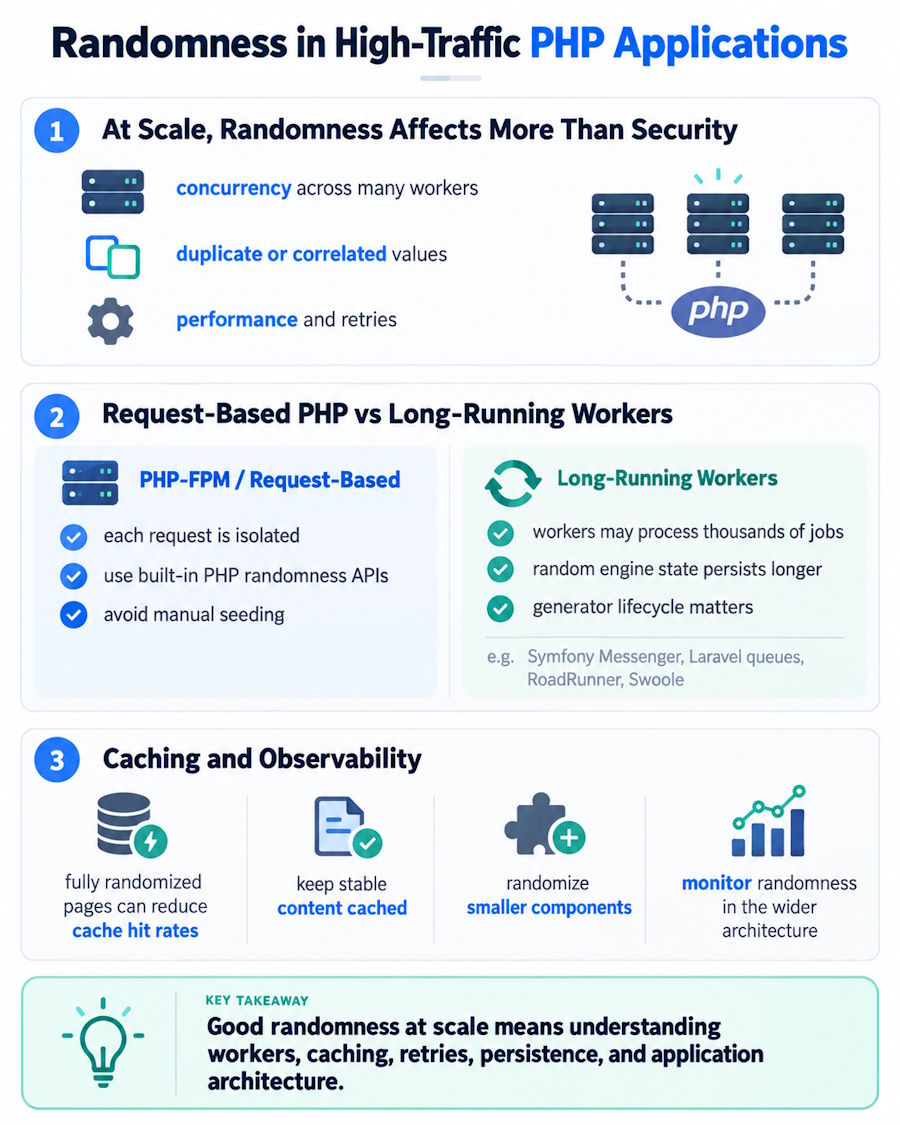
In high-traffic PHP applications, random number generation becomes more than a simple utility. Developers also need to consider concurrency, worker lifecycles, performance, caching, and the possibility of generating duplicate or correlated values across many processes.
Request-Based PHP vs Long-Running Workers
Traditional PHP applications often run through PHP-FPM, where each request is handled independently by a worker. In this model, developers should generally rely on PHP's built-in randomness APIs rather than trying to manage seeds manually.
Long-running environments such as Symfony Messenger, Laravel queues, RoadRunner, or Swoole behave way differently. A process may remain alive for thousands of jobs, meaning an explicitly created random engine can also preserve its internal state for a very long time. That is not necessarily a problem, but the lifecycle of the generator becomes more important.
Caching and Observability
Randomized content can also affect caching. If every request produces a different homepage, recommendation list, or promotional block, cache hit rates may decrease. For this reason, high-traffic applications often separate stable cached content from smaller randomized components. At scale, good random number generation is therefore not only about producing unpredictable values. It also involves understanding how randomness interacts with workers, retries, caching, persistence, and the broader architecture of the application.
Common PRNG Mistakes in PHP and Best Practices
Working with randomness in PHP is usually straightforward, but several common mistakes can make an application less secure, harder to test, or more difficult to scale.
Writing Custom Random Generators
Implementing a custom PRNG may seem simple, but it is easy to introduce predictable sequences, weak statistical properties, or subtle bias. For production systems, established PHP APIs and well-tested algorithms are almost always a better choice.
Assuming Random Means Unique
Randomness does not guarantee uniqueness. Even a well-designed random generator can eventually produce the same value twice. If an identifier must be unique, applications should use a sufficiently large random space and enforce uniqueness at the database level when possible.
Using the Wrong Function for Security
Functions such as rand(), mt_rand(), and uniqid() should not be used for security-sensitive values. Password-reset tokens, API secrets, authentication codes, and similar values should instead use cryptographically secure APIs such as random_bytes() or random_int().
Best Practices
The right approach depends on what the application needs:
| Requirement | Recommended approach |
|---|---|
| Security token | random_bytes() |
| Secure bounded integer | random_int() |
| Reproducible test | Seeded Random\Randomizer engine |
| Simulation | Appropriate deterministic PRNG |
| Unique public identifier | Large random space plus uniqueness checks |
The main rule is simple: choose the generator based on the requirement rather than convenience. Security needs unpredictability, testing may need reproducibility, and identifiers may need both a large random space and explicit collision protection.

