

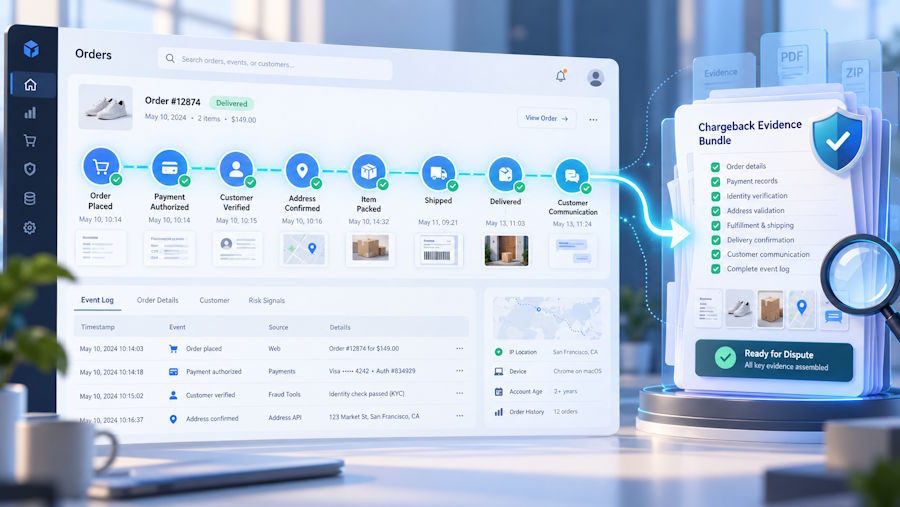
A chargeback evidence trail is a connected history of the events needed to explain a disputed purchase. For developers, the challenge is to make payment, fulfillment, access, and support records retrievable without turning application logs into a store of unnecessary sensitive data.
Chargeflow automates evidence preparation and chargeback responses. A merchant's engineering team can support that workflow by making source records accurate, consistent, and accessible through the systems already handling orders.
This article describes a vendor-independent design approach. The suggested event fields and controls are implementation recommendations, rather than a specification of any vendor's APIs or internal infrastructure.
TL;DR
- Use stable identifiers to connect orders, payments, deliveries, and customer messages.
- Distinguish an event's occurrence time from the time your system received it.
- Keep operational evidence separate from secrets and unrestricted application logs.
- Chargeflow can automate dispute work more effectively when connected source records accurately describe the transaction.
Define the Questions Before the Schema
A useful event model starts with the questions a reviewer will ask. What did the customer buy? Which payment belongs to the order? What terms were presented? When was the item delivered or the digital product accessed?
List those questions for each transaction model. A shipped product needs different supporting records from a software subscription. A refund dispute needs evidence that a credit was processed, rather than only a support message promising it.
Translate each question into a source of truth. Your payment provider owns the payment reference. Your fulfillment system owns the shipment record. Your application owns access events. Your support system owns the customer conversation.
The evidence service should connect those sources without claiming that one system proves facts it does not record.
Use Identifiers That Survive System Boundaries
Use an internal order ID scoped to the merchant or tenant, then map payment, customer, fulfillment, and subscription IDs to it. A display order number can collide across stores. An opaque processor transaction reference provides linkage without copying payment credentials into the event trail.
A practical event record can include:
- An event identifier and event type.
- The order and payment references.
- Occurrence time and ingestion time.
- The originating system.
- A reference to the underlying record.
- The record version when later changes matter.
Avoid placing a full customer profile in every event. Store only the information the event needs, and retrieve additional authorized context from the source when required.
Model payment-to-item and refund-to-item relationships explicitly. A $20 refund against one item in a $100 order is not a full-order refund. Preserve the amount, currency, payment reference, affected items, and completed refund event so the export cannot imply that every item was refunded.
Preserve Meaning When Events Arrive Out of Order
A carrier update may reach your application after a support complaint, even though the shipment event happened earlier. Displaying ingestion order as the customer journey can make the record confusing.
Keep occurred_at and received_at as separate timestamps, with a documented timezone convention. Reconstruct customer events by occurrence time; use receipt time to explain ingestion delays and what information was available when an operator acted.
A recommended deduplication key is the pair source_system and event_id. Enforce uniqueness within the tenant and make repeated delivery safe to process. An update that corrects an earlier event should retain a reference to that event rather than silently becoming unrelated history.
If a source corrects a delivery record, retain enough version context to explain the correction. Do not silently rewrite history in a way that makes the exported evidence inconsistent with the underlying source.
Separate Evidence Records From Debugging Output
The OWASP Logging Cheat Sheet organizes event attributes around when, where, who, and what. It also recommends sanitizing untrusted event data, including carriage returns, line feeds, and delimiters, to prevent log injection.
OWASP advises excluding access tokens, passwords, encryption keys, and payment-card data from ordinary logs. Record an authenticated download event using an account reference and timestamp; do not include the authentication secret that enabled it.
Apply access permissions to the evidence repository and record administrative activity. Set retention according to the business's documented obligations and operational needs, rather than storing every event indefinitely.
The design objective is a reliable account of the purchase. More data does not automatically mean stronger evidence, especially when the additional fields create privacy or security exposure.
Export a Case, Not a Data Dump
Build an export around the allegation. Delivery evidence connects an item, shipment, destination, and delivery event. Cancellation evidence connects the request, effective date, terms version, and later billing. A refund case needs the completed credit reference, not only an agent's approval.
For each exported fact, retain a source-system reference and retrieval time. Label a source fact, derived calculation, and agent interpretation distinctly. Include a missing-data indicator when a required record cannot be retrieved.
A chargeback software workflow benefits from this approach because it can retrieve a coherent set of inputs instead of a folder of disconnected screenshots.
Chargeflow Automation collects and enriches connected transaction records, assembles evidence, and submits chargeback responses. Engineers should test the data exposed by their supported integrations. The schema proposed here is a merchant design recommendation, not a Chargeflow API specification.
Test Missing Data as Well as Successful Data
Test a duplicate webhook, a late delivery correction, an item-level refund, a missing carrier record, and a cross-tenant access attempt. These cases test integrity and completeness rather than merely checking whether a normal order produces a file.
Ask how the system behaves when one source is unavailable. Does the export show an explicit gap, or does it produce an apparently complete story? The former is easier for an operator to assess and correct.
Test partial refunds and mixed orders separately. A fulfilled item and an undelivered item within the same purchase should not inherit one another's status.
Also check that a retry does not create duplicate evidence entries and that access permissions prevent one store's cases from appearing in another store's export. These checks address failure modes with real operational consequences.
Evaluate the Handoff to Dispute Operations
In an October 2026 review snapshot, Chargeflow had 4.7/5 from 278 G2 reviews. G2 reviewer Fehér T. rated it 5/5 and reported reduced manual dispute work. The relevant engineering test is whether correct source records reach the response workflow.
Use that reported benefit to define a practical acceptance test. Can the operator locate the required evidence without asking a developer to run an ad hoc database query? Can the team identify a missing field before the response deadline?
Agree on ownership for corrections. Engineering can maintain integrations and event reliability, while support and finance verify the customer and payment facts.
The platform can then fit into a workflow where evidence collection is repeatable and source problems have a clear escalation path. The event trail becomes part of operational infrastructure, rather than a rescue project assembled whenever a dispute arrives.
Questions Developers Ask
Does an Event Log Prove a Purchase Was Authorized?
An event log records what a system observed. It does not automatically prove authorization, delivery, or entitlement, so a dispute response should use the relevant records and context.
Should Every Customer Interaction Be Copied Into Application Logs?
Customer interactions should remain in appropriately controlled systems, with references available when needed. Unrestricted application logs are a poor default destination for personal messages or sensitive credentials.
Is This Event Schema a Chargeflow API Requirement?
This event schema is a recommended internal design pattern. Teams should use verified integration documentation to determine the actual requirements for connecting their systems to Chargeflow.

