

Audio and video have become essential parts of modern communication. Businesses record meetings, creators publish podcasts and interviews, educators produce online lessons, and marketing teams produce videos for multiple platforms. However, the information contained in these recordings is not always easy to access, search, or reuse.
Finding a specific detail in a one-hour interview often means listening to large portions of the recording again. Reviewing an important business meeting can involve the same repetitive process. As the amount of recorded content grows, managing it efficiently becomes increasingly challenging.
Artificial intelligence is changing this workflow. AI transcription technology converts spoken language into written text, making recordings easier to search, review, share, and transform into other formats.
Why Searchable Transcripts Are Becoming Essential
The main limitation of audio and video content is that information remains tied to a timeline. Unlike a written document, a recording cannot be quickly scanned for an important paragraph or specific quotation without additional tools.
Transcription addresses this problem by creating a text version of spoken content. Once a recording has been transcribed, users can search for particular words, identify important passages, and locate relevant sections without repeatedly playing the entire file.
This is especially useful for businesses that regularly conduct interviews, meetings, presentations, and training sessions. Instead of relying entirely on handwritten notes or personal memory, teams can maintain searchable records of important discussions.
Transcripts also make information easier to share. Someone who missed a meeting can review the written content, while a journalist can locate quotations from an interview without listening to the complete recording again.
How AI Transcription Works
Modern AI transcription systems use speech recognition models to identify spoken words and convert them into written language.
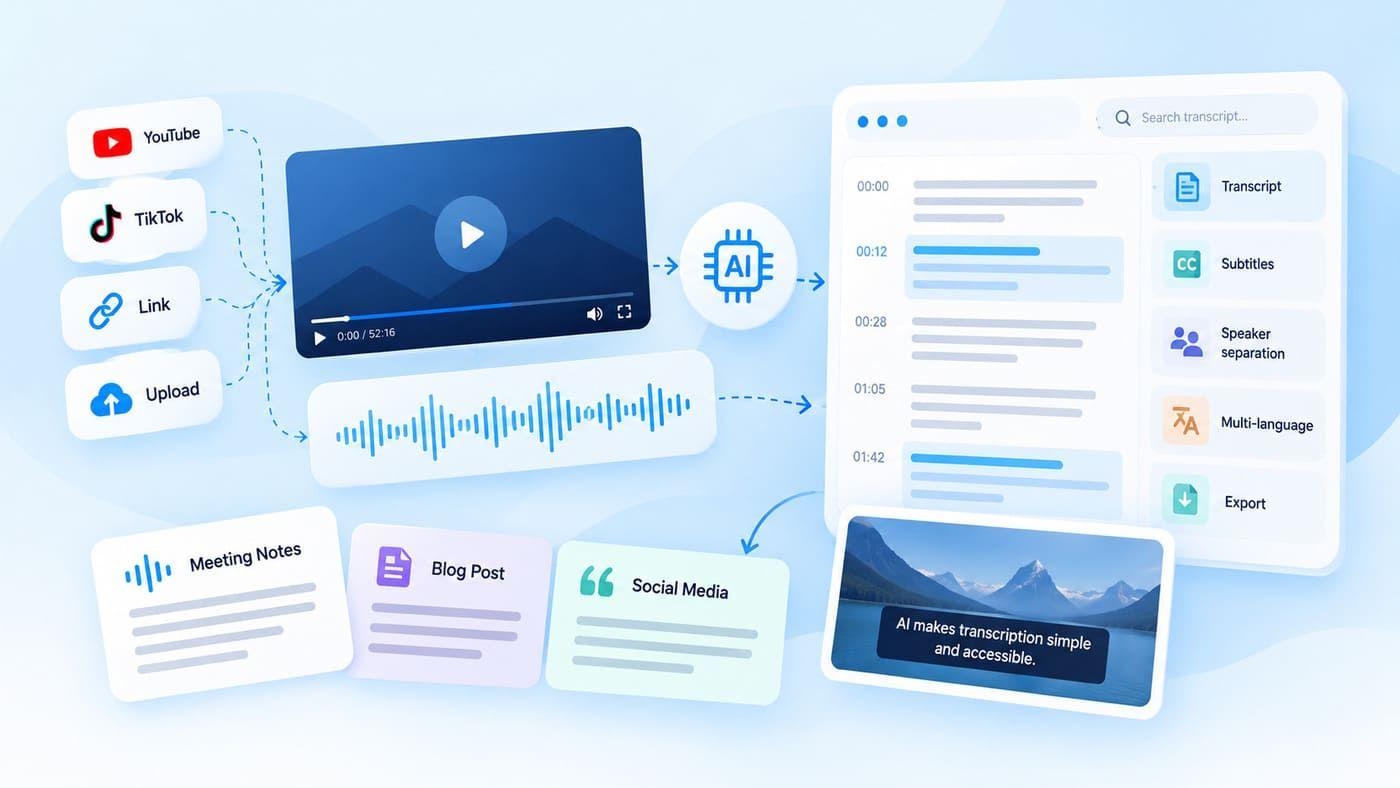
The process typically begins when a user uploads an audio or video recording. Some platforms also accept links to online videos, allowing users to work with content hosted on popular video-sharing services.
Tools such as GuruScribe make this process more accessible by combining AI-powered audio and video transcription with features such as automatic language detection, speaker separation, and subtitle generation. This allows users to turn recordings into structured text without manually transcribing every conversation or presentation.
The software analyses the audio track, identifies speech patterns, and generates a text transcript. Depending on the recording and the tool being used, the result may also include timestamps, punctuation, and speaker labels.
Speaker separation is particularly valuable for conversations involving multiple participants. It helps distinguish different voices, making interviews, podcasts, and meeting transcripts easier to follow.
Although AI transcription has improved considerably, accuracy can still be affected by background noise, overlapping speakers, strong accents, and poor recording quality. Reviewing important passages remains advisable, especially when transcripts are used for professional or public-facing purposes.
Turning Recordings Into Reusable Content
One of the most practical advantages of transcription is the ability to repurpose existing material.
A single recorded interview can provide the foundation for several pieces of written content. Instead of producing everything from scratch, creators can use a transcript to identify interesting ideas, extract quotations, and develop articles or social media posts.
For example, a marketing team might transform a recorded webinar into a blog article, a newsletter, and several short educational posts. A podcaster could use a transcript to prepare episode summaries, show notes, and website content.
Video creators can also benefit from written transcripts when preparing subtitles, descriptions, and supporting materials.
Transcription does not automatically turn every recording into publication-ready writing. Editing, fact-checking, and restructuring are still necessary. However, having the spoken material available as text provides a useful starting point and reduces the amount of repetitive work involved.
Making Audio and Video More Accessible
Accessibility is another important reason to incorporate transcription into digital content workflows.
Written transcripts provide an alternative way to consume audio information for people who are deaf or hard of hearing. They can also help users who cannot listen to recordings because of their surroundings or who simply prefer reading.
Subtitles serve a related purpose by displaying spoken dialogue while a video plays. They are especially useful for educational videos, interviews, tutorials, and social media content.
In international environments, transcripts can also support translation and localisation. Having an accurate written version of the original speech makes it easier to prepare content for audiences who speak different languages.
For organisations producing regular audio and video content, transcription and subtitles can therefore become important elements of a broader accessibility strategy.
Where AI Transcription Delivers the Most Value
AI transcription is useful across many industries because recorded communication is no longer limited to media production:
- Businesses and remote teams can use transcripts to document meetings, preserve important decisions, and make discussions easier to reference.
- Journalists and researchers can work with interview recordings more efficiently, identify relevant quotations, and organise material for further analysis.
- Educators and students can use written versions of lectures, tutorials, and presentations to review information and prepare study materials.
- Podcasters and video creators can convert episodes into show notes, articles, subtitles, and promotional content.
- Marketing professionals can reuse recorded webinars, customer interviews, and presentations when developing content for websites and campaigns.
Although these applications differ, they share the same principle: converting spoken information into text makes it easier to work with.
Choosing the Right AI Transcription Tool
Not every transcription platform offers the same capabilities. The most suitable solution depends on the type of recordings being processed and how the resulting text will be used.
Accuracy is an important consideration, particularly for recordings involving technical terminology or several speakers. Ease of use also matters, especially for people who need to process recordings frequently.
Support for different audio and video formats can simplify workflows. Tools that accept online video links may be convenient for creators who regularly work with material published on external platforms.
Other useful capabilities include subtitle generation, automatic language detection, speaker separation, and flexible transcript management.
When evaluating transcription software, it is also worth considering how easily users can review and correct generated text. Even advanced speech recognition systems occasionally misinterpret names, technical expressions, or conversations involving overlapping voices.
For organisations handling sensitive business information, data privacy and file management policies are additional considerations. Users should understand how recordings are processed, stored, and protected before uploading confidential material.
The best choice ultimately depends on recording quality, supported languages, the need for subtitles, and the amount of content being processed. Testing a tool with representative recordings is often the most practical way to evaluate its suitability.
The Future of Searchable Audio and Video
As businesses and individuals continue producing more recorded content, the ability to organise spoken information will become increasingly important.
AI transcription is already helping bridge the gap between audio, video, and written communication. Rather than treating recordings as files that must be watched or heard from beginning to end, users can work with their contents more like searchable documents.
Future improvements in speech recognition, speaker identification, and language processing may make transcription tools even more useful for everyday work.
For now, the benefits are clear. Searchable transcripts help people locate information faster, preserve valuable discussions, improve accessibility, and create additional content from existing recordings.
Turning audio and video into text is no longer simply a convenience. It is becoming a practical way to make recorded information more accessible, organised, and useful.

