

Installing via npm brings much more than is shown in the package file. Each package has dependencies as well. One of those dependencies is buried three layers in from top to bottom and is affected by a vulnerability on Tuesday, which nobody notices until several months later because a customer has a question.
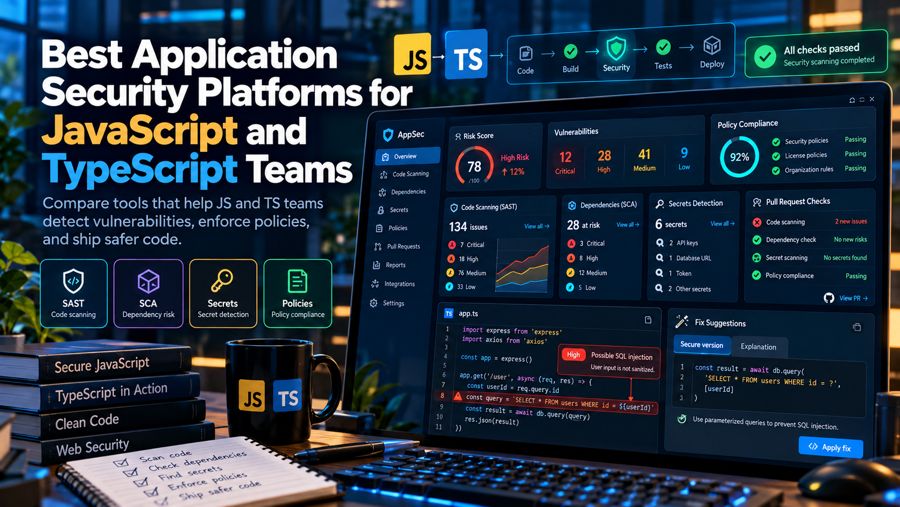
That is what JavaScript application security actually deals with. Frontend code. Node services. Dependency trees that grow with every sprint. Secrets tucked into environment files. Deployments happening several times a week.
Each layer is a doorway. Each layer is a hiding spot.
The application security platforms below plug into the moments where developers already spend their time.
What makes security different in JavaScript and TypeScript projects
Three things make this ecosystem different from most. Start with the packages. One install command pulls in a hundred modules you never asked for. Any of them can be carrying a known flaw. Worse, any of them can be carrying something planted on purpose by someone who took over a maintainer account. The lockfile changes, and the whole picture underneath it shifts. That is what npm dependency security looks like in practice.
Then there is the code your team writes. A value comes in through a route. It moves through middleware. It lands in a query built somewhere else entirely. Read any one of those files on its own and the trail goes cold.
And then there is everything source code cannot show you. A key sitting in a config file looks harmless until the app goes live and that key becomes a working credential. A missing security header only reveals itself when a real browser hits the endpoint.
A scanner that reads only source misses half of this. A tool that watches only the running app misses the other half.
Best application security platforms for JavaScript and TypeScript teams
Certain tools bundle several checks into one place, while others do one thing well. Each entry below follows how a developer's week actually moves.
1. Aikido: from pull request to production
A pull request lands on a Tuesday. Before a reviewer opens it, Aikido has already read the code. JavaScript static analysis followed a value from the route handler down into a query and caught the injection sitting there. The comment appears on the pull request. The fix takes two minutes.
That same commit also changed the lockfile. A package came in two levels down. Most teams would never spot it. Aikido would.
Software composition analysis traces the dependency graph to identify any known vulnerabilities. A reachability analysis discards the modules that aren’t called anywhere. Malicious package detection monitors the npm registry for packages that seem useful and come with a different payload. In the event a typosquatting package is detected in a build, Aikido’s Safe Chain plugin prevents installation. The same platform, the same screen, the same developer.
Now jump forward. The pull request is merged and deployed to staging. Somewhere in the config, an API key got committed three weeks ago, and nobody caught it. Secrets detection already flagged it. The finding sits in the same queue as the injection from this morning, ranked by how exposed the value actually is.
One more step. The app is live and taking real traffic. A malformed request hits an endpoint. Source review would never have caught this, because the problem only exists once everything is wired together. Dynamic application security testing sends that traffic against the deployed service and reports what breaks.
Four events in the same week for the same developer. Code review. Package installation. A leaked credential. A live endpoint. Each event is managed using a different tool, different authentication credentials, and a different level of severity. The findings do not make the connection from the leaked key on Tuesday to the vulnerable package on Monday.
Aikido puts all four stages in one place because the same developer deals with all four.
Aikido states its false-positive reduction reaches up to 85%. That is a vendor figure, not independent research.
Key capabilities:
- Static analysis for JavaScript and TypeScript, with pull request feedback
- Dependency scanning with reachability filtering
- Malicious-package detection for the npm ecosystem
- Secrets detection across code and configuration
- DAST and API testing for deployed applications
- Consolidated findings across all four stages
2. Snyk
Snyk built its name on packages. That focus never shifted. It scans manifests and lockfiles, flags known flaws, and suggests upgrades. Integrations exist for editors, code hosts, and build pipelines.
A deep dependency tree is where this helps. A frontend pulling in forty packages. A Node service pulling in sixty more. A build tool dragging in its own set. Snyk resolves the full tree, including transitive dependencies, and shows the path that introduced each flaw.
The fix workflow opens pull requests that bump vulnerable packages to safe versions. For direct dependencies, this is usually clean. For transitive ones, it may require upgrading the intermediate package, which Snyk suggests when a path exists.
The free tier caps tests per month for private projects. A team merging daily can burn through the limit fast. Public repositories get unlimited tests. Paid plans remove the caps and add features like package registry integrations for private npm registries.
Key capabilities:
- npm and package manifest scanning for known CVEs
- Transitive dependency resolution with path visibility
- IDE, repository, and CI integrations
- Upgrade pull requests tied to specific findings
- Container image scanning
- SAST via Snyk Code on paid tiers
3. Semgrep
Semgrep reads source. Its rules look like the language they check. A TypeScript security tools user opens a rule file and follows it without a reference guide. Tweaking one takes a couple of minutes.
That flexibility helps when a team has its own conventions. A rule catches patterns no vendor thought to include. Cross-file analysis traces values across modules, which is where a single-file scanner quits. That feature lives in Semgrep Code, not the free Community Edition. Community Edition is limited to single-function analysis.
Semgrep Code runs on full scans rather than pull request checks for cross-file dataflow. The Pro rules for JavaScript number over 250, and TypeScript has over 230.
Semgrep Supply Chain handles malicious package detection separately. It watches supported registries, including npm, for packages with known malicious intent. Reachability analysis is available for JavaScript and TypeScript.
The scope is source and packages. Secrets and deployed-app testing need other tools.
Key capabilities:
- Custom rule syntax that mirrors JavaScript and TypeScript
- Cross-file dataflow analysis in Semgrep Code (not Community Edition)
- 250+ Pro rules for JavaScript, 230+ for TypeScript
- Malicious dependency detection via Semgrep Supply Chain
- Reachability analysis for npm dependencies
- Free for up to 10 contributors on Semgrep Code
4. GitHub Advanced Security
The whole pitch is location. If code, reviews, and builds already run in GitHub, the security checks sit in the same window.
Three of them come built in.
CodeQL reads the pull request diff and drops its findings into the repository Security tab. JavaScript and TypeScript both get covered. The reviewer stays in the same page they were already on.
Secret scanning watches for credential patterns from more than 200 providers. AWS keys. Stripe tokens. Slack webhooks. When one shows up in a commit, push protection halts it before the branch updates and tells the developer what it caught.
Dependency review opens up the lockfile change. It shows the transitive packages nobody typed by hand, along with any CVEs those versions bring. Dependabot covers the rest of the year by opening pull requests when a package needs a newer version.
The catch sits in the plan. These features are free on public repositories. Private repositories need a GitHub Code Security or Secret Protection license before any of it turns on.
Key capabilities:
- CodeQL-based static analysis for JavaScript and TypeScript
- Secret scanning with 200+ partner patterns and push protection
- Dependabot for dependency updates and security alerts
- Dependency review showing new CVEs in a pull request
- Copilot Autofix for code scanning alerts
- Free for public repos, paid for private repos
5. Checkmarx
Checkmarx fits a specific kind of shop. Big enough to have a dedicated security group. Big enough to need evidence when auditors come asking. Reports and audit trails sit at the center of the product, not as an afterthought.
The scanner reads source directly. React, Angular, Node.js, plus more than 35 languages and 80 frameworks. No build step required before the engine can work.
Recent updates sharpened the paper trail. Every change to a finding gets recorded. Severity shifts. State changes. Notes added. Each entry captures the previous value, the new value, who made the change, and the timestamp. Scheduled scans get logged the same way.
The tradeoff sits in the clock. A full pass takes longer than the developer-first tools. Teams run it after hours rather than on every pull request. What comes back is depth and documentation that stands up to review.
One caution. The supported language and framework list shifts with each engine pack release. Check the version you actually run before trusting any published list.
Key capabilities:
- Static analysis across JavaScript, TypeScript, and 35+ other languages
- Framework coverage for React, Angular, and Node.js
- No compilation required for analysis
- Reporting and audit trails for compliance reviews
- Structured workflows for multi-application environments
- Integration with established build and release pipelines
Where each platform fits in a real JavaScript project
Take a typical setup. A Next.js frontend. An Express API handling requests. A worker pulling jobs off a queue. A lockfile with two hundred packages once you count the transitive ones. Deployments on merge to main.
- Monday morning. A pull request lands with a new endpoint inside. It reads a query parameter and feeds it straight into a database call. Before the reviewer opens the diff, the static check has already run. Aikido drops a comment on the pull request about the missing validation.
- Tuesday. Dependabot opens its own PR to bump a package. Snyk spots that the new version still carries a moderate CVE two levels down. GitHub Advanced Security shows the same warning inside the repository tab.
- Wednesday, someone runs npm install on a fresh machine. A new package appears in the lockfile. Semgrep will not catch this. Snyk might, if the package is on a known list. Aikido's malicious-package detection is built for this case, where a package looks legitimate but carries something it should not.
- Thursday, a developer commits a .env.local file by accident. Secret scanning catches it before the push finishes. Secure JavaScript development depends on this kind of catch happening automatically.
- Friday, the app sits in staging. A DAST scan hits the endpoints with simulated attacks. Runtime issues surface here that source reading would never reveal. Aikido covers this. Most others in this list do not.
That is the practical test. Not a feature matrix. Which of these moments does your setup handle, and which slip through?
Conclusions: Choose security that fits how your team ships
JavaScript and TypeScript security extends past static analysis. Flaws enter through application logic, npm packages, committed credentials, and issues that only surface once the app runs.
The platforms above take different angles. Aikido connects four stages, from pull request to deployed app, in one place. Snyk and Semgrep go deep on specific parts of the workflow. GitHub Advanced Security keeps everything inside the repository. Checkmarx serves larger programs with formal requirements.
Whatever you pick, test it against a real project. The lifecycle a platform covers should match the lifecycle your team runs.

