

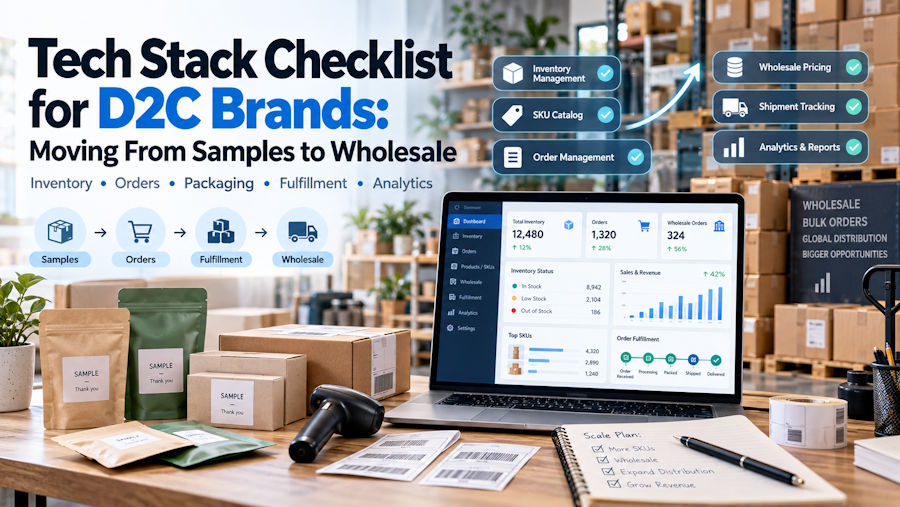
Your sample kits sell out every week. Then a boutique owner emails asking for 60 units on net 30 terms, and the store that handled $15 orders perfectly starts to buckle. That's the moment most founders realize their tools serve one kind of customer, while wholesale brings a second kind with completely different needs. This tech stack checklist for D2C brands covers what to add, what to replace, and what to leave alone as you make that jump.
TL;DR: A D2C brand moving into wholesale needs six layers working together: a commerce platform with native B2B features, an inventory system that tracks every unit of measure, shipping tools that handle both parcels and freight, a CRM that separates retail shoppers from trade accounts, finance software with invoicing and sales tax automation, and clean integrations between all of them. Upgrade in roughly that order, and hold off on enterprise software until your wholesale volume justifies it.
Why Your Sample Stage Shapes the Whole Stack
Sample orders are small, frequent, and cheap to ship, and the customer often hasn't decided what they want yet. Fragrance shows this clearly: a shopper exploring perfume samples might order five small decants, pick a favorite, and return weeks later for a full bottle. Your stack has to connect those two purchases, or you lose the most valuable insight you own, which is knowing which samples actually convert.
That same sample data becomes your wholesale pitch. When you can show a store which scents your sample customers reorder most, you walk into the meeting with evidence instead of hope. Track sample-to-full-size conversion from day one, even if it starts as a simple order tag and a spreadsheet.
Commerce Platform: Choose One That Handles B2B and B2C
Can your current storefront show different prices to different customers? If not, start here. Wholesale buyers expect tiered pricing, minimum order quantities (MOQs), net payment terms, and a private catalog that retail shoppers never see.
Shopify Plus and BigCommerce both include native B2B features that cover these needs without a second website. Smaller brands often begin on Faire, which works well for testing demand but takes a commission and keeps part of the buyer relationship.
The move toward wholesale isn't a fringe strategy. In a Glossy Research survey, 80% of brand respondents said they expected wholesale revenue to increase over the following 12 months. Your platform choice decides how painful that growth feels.
Inventory and Order Management: One Source of Truth
Wholesale forces the same product to exist in several forms. You might sell a single sample vial, a full bottle, and a case of 24 bottles. An order management system (OMS) or inventory tool such as Cin7, Linnworks, or Katana tracks all three as connected SKUs with different units of measure.
Skip that link, and overselling follows quickly. A wholesale order pulls 48 bottles from the warehouse, yet your storefront still lists them as available to retail shoppers. Lot and batch tracking matters too, because retailers will eventually ask about expiry dates or recalls.
Shipping and Fulfillment: Parcels and Pallets
Here's the thing about wholesale logistics: your shipping profile splits in two. Sample and retail orders still leave as lightweight parcels through tools like ShipStation, Shippo, or EasyPost, which compare carrier rates and print labels in bulk. Wholesale orders look nothing like that.
Retail accounts order by the case or the pallet, and they often need delivery inside a tight receiving window. Freight courier service options built around cargo vans fill the gap between a parcel carrier and a full truckload. They suit urgent restocks, trade show inventory, and first orders to a new regional account, where a missed delivery date could cost you the relationship before it starts.
As volume grows, many brands hand fulfillment to a third-party logistics provider (3PL) such as ShipBob or ShipHero. Before you sign, confirm the provider can process both parcel orders and B2B pallet orders, including retailer routing guides and EDI requirements.
Customer Data and Retention: Separate Your Buyers
A retail shopper and a boutique buyer should never receive the same email. Klaviyo handles consumer email and SMS well, including flows that nudge sample buyers toward a full-size purchase. HubSpot or a similar CRM fits wholesale better, since you need to track deals, reorder cycles, and notes for each store account.
Lulus shows why trade relationships deserve dedicated tools. The fashion brand, which went online only in 2008, grew its wholesale channel 143% year over year from 2024 to 2025 and expanded into every Nordstrom location. Growth like that depends on managing each retail partner as an account, not as one more name on a subscriber list.
Finance, Tax, and Payments
Wholesale changes how money arrives. Consumers pay at checkout, while retailers pay 30, 60, or even 90 days later. That gap means you suddenly need invoicing, accounts receivable tracking, and cash flow forecasting.
QuickBooks Online covers most small brands, and NetSuite makes sense once you run multiple warehouses or legal entities. For sales tax, Avalara or TaxJar tracks economic nexus across states, an obligation that took hold after the Supreme Court's 2018 Wayfair decision. These tools also store resale certificates, which you need on file for every wholesale buyer that skips sales tax.
The Quick Checklist
| Layer | What It Needs to Do | Example Tools |
|---|---|---|
| Commerce platform | B2B pricing, MOQs, net terms, private catalogs | Shopify Plus, BigCommerce, Faire |
| Inventory and OMS | Linked SKUs across units, lot tracking, channel sync | Cin7, Linnworks, Katana |
| Shipping | Parcel rate shopping plus freight for case orders | ShipStation, EasyPost, cargo van couriers |
| CRM and retention | Separate consumer and trade communication | Klaviyo, HubSpot |
| Finance and tax | Invoicing, receivables, nexus tracking | QuickBooks Online, NetSuite, Avalara |
| Integrations | Clean data flow between every layer | Native connectors, Celigo, Zapier |
How to Sequence Your D2C Tech Stack Upgrades
Think of wholesale as a stress test rather than a new department. The pressure hits pricing and checkout first, then inventory, then shipping, then finance, so upgrade in that order and fix each layer only when it starts to crack. Running wholesale through retail discount codes or buying an ERP before you need one only adds friction. Five strong tools that share clean data beat fifteen disconnected apps. The real job of any tech stack checklist for D2C brands is simple: let one product live in many forms, for many kinds of buyers, without your team losing track of a single unit.
FAQs
What is a D2C tech stack?
A D2C tech stack is the set of software a direct-to-consumer brand uses to sell, fulfill, and support orders. It usually includes a storefront, inventory system, shipping tools, CRM, and accounting software, all connected so data flows between them.
Can Shopify handle wholesale orders?
Yes. Shopify Plus includes native B2B features such as company profiles, custom price lists, quantity rules, and net payment terms. Brands on standard Shopify plans often add a wholesale app or use Faire until volume justifies the upgrade.
Do D2C brands need an ERP to start wholesale?
Usually not. Most early wholesale programs run well on a dedicated inventory or order management system paired with QuickBooks Online. An ERP like NetSuite starts to pay off when you manage multiple warehouses, entities, or complex manufacturing.
How should a D2C brand ship wholesale orders?
Match the method to the order size. Small trade orders can travel as parcels, while case and pallet orders move better by cargo van, LTL freight, or a 3PL that supports B2B fulfillment and retailer routing guides.

