

An enterprise with 1,000 to 2,500 employees will not get the most popular IT asset management software most vendors offer, since it's designed for smaller companies. Organizations in this range are too complex for lightweight asset trackers. They have thousands of endpoints, multiple offices, regulated data, and a steady flow of joiners and leavers. But they're much less likely to have a focused ITAM team, consultants, or budget, assuming they do, to support a platform developed for a 20,000-person corporation.
A 1,000-2,500 user enterprise can have the right ITAM platform to have a trusted record of every device, every license and every SaaS subscription. It connects that record to employees, cost centers, and locations, and keeps it up to date through integrations instead of manual updates. It should also be easy to deploy, user-friendly for Finance, HR, and Security, and able to generate audit evidence as needed.
In this post, we compare six enterprise IT asset management platforms against those needs, outline costs beyond the license price, and recommend a 90-day roll-out strategy.
What Changes When an Organization Passes 1,000 Employees
Asset management problems at this size have little to do with tracking a single laptop. They come from volume and from the number of systems involved.
Employee Turnover Becomes A Constant Workload. At a modest 12–15% annual attrition, a 1,500-person company handles around 180–225 leavers a year, roughly four every week. Each one has a laptop, accessories, and a set of SaaS accounts that someone must recover or revoke.
Data Sources Multiply. A typical enterprise in this range runs Intune or Jamf (sometimes both), an identity provider, an HRIS, a service desk, finance software and dozens of SaaS admin consoles. Each holds part of the asset picture, and they rarely agree.
Locations And Entities Split Ownership. Regional offices, subsidiaries and remote staff in several countries mean devices are bought, shipped and stored in different ways, and local teams often keep their own trackers.
Audits Stop Being Optional. Customers, insurers and partners increasingly expect ISO 27001 or SOC 2 certification. Both rely on an accurate, maintained inventory of information assets and evidence of who has access to what.
Software Spend Gets Big Enough To Matter. At this headcount, unused seats, duplicate tools, and missed renewal windows add up to a significant budget line, and CFOs start asking IT to justify it.
How We Evaluated These ITAM Platforms
We assessed each platform against six criteria that matter most at 1,000–2,500 employees:
- Coverage: whether it handles hardware, software licenses, and SaaS together, or just one of these
- Integration Depth: native connectors for MDM, identity, HR, and ITSM systems, so data stays current automatically
- Time To Value: how long it takes to reach an accurate, usable asset register
- Admin Overhead: whether it needs a dedicated platform administrator or consultants
- Governance And Compliance: asset registers, access records, role-based permissions and audit evidence
- Pricing Predictability: how costs change as headcount, devices and modules grow
The Best IT Asset Management Platforms for 1,000–2,500 Employee Enterprises
1. Setyl
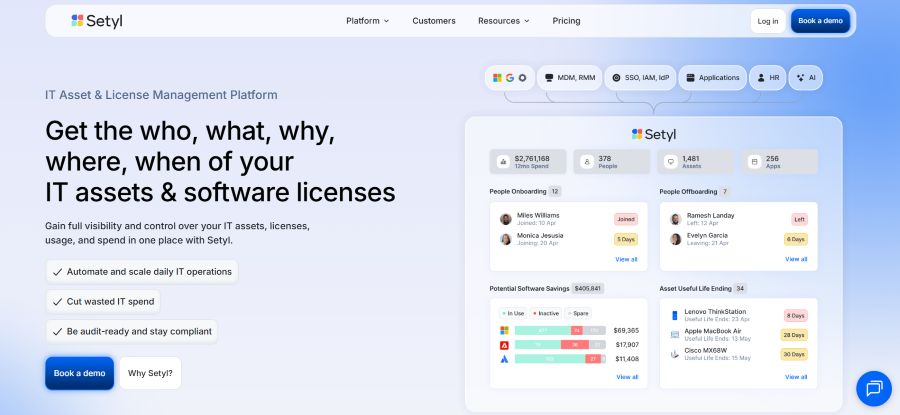
Setyl is the strongest all-round choice for enterprises with 1,000–2,500 employees because it was designed for this market segment. Setyl is an IT asset and license management platform for organizations of roughly 80 to 5,000 employees. It integrates hardware, software licenses, users, vendors, IT spend, and compliance into one system without the weight or implementation of a heavyweight enterprise suite.
Setyl offers three plans based on employee count, and all plans include unlimited assets and licenses. Useful for 1,000-2,500 employees, since it doesn't cost any extra to add peripherals or spares, or non-IT equipment.
- One Record Per Employee. Each person’s profile shows their laptop, phone, monitor, headset, software licenses, SaaS access, and the cost of it all. Cost-per-employee reporting comes from the same data.
- Data That Maintains Itself. More than 100 integrations pull in data from Microsoft, Google, Okta, JumpCloud, Intune, Jamf, Workspace ONE, NinjaOne, CrowdStrike, Meraki, ConnectWise, Zendesk, Jira Service Management, BambooHR, HiBob, and Workday. Records are created and enriched automatically, so the register stays accurate as people and devices change.
- Renewal And License Control. Upcoming renewals, inactive licenses, and seat counts are visible ahead of time, so contracts can be rightsized before they auto-renew.
- Audit Evidence On Hand. Setyl includes an information asset register, access controls, vendor due diligence, and a security audit checklist mapped to ISO 27001 and SOC 2. Teamwork uses Setyl to demonstrate its controls during audits and customer due diligence.
- Access Beyond IT. Role-based permissions let Finance review spend, Operations see stock by location, and HR follow onboarding and offboarding, without giving everyone full admin rights.
- AI Access To Asset Data. Setyl’s MCP connector lets teams query and act on asset and license data through AI assistants such as Claude and ChatGPT, for example, asking which leavers still hold active licenses.
Setyl has three plans priced by employee count, and every plan includes unlimited assets and licenses. That’s useful at 1,000–2,500 employees, because adding peripherals, spare stock, or non-IT equipment doesn’t change the bill.
Keep In Mind: Setyl doesn’t try to replace a service desk. Enterprises keep their existing ITSM tool and connect it to Setyl.
2. ServiceNow IT Asset Management
ServiceNow is the best-known name in enterprise IT, and its IT Asset Management products (covering hardware, software and SaaS) run on the same platform as ServiceNow’s ITSM, HR and security tools.
The Case For ServiceNow
With ITAM, if you already have ServiceNow for IT service management, asset data, requests, incidents, and changes are stored, managed, and deployed within a single CMDB and workflow engine. ServiceNow provides comprehensive license optimization, contract and vendor management, and customization. That's useful for companies that will expand beyond 2,500 people or have multiple business units on a single platform.
The Case Against ServiceNow
ServiceNow has 1,000-2,500 employees and may be too much for the organization to manage. Pricing is quote-only and will be based upon fulfiller (IT staff) licenses and modules. Implementation partners, training, and add-ons can cost a great deal in addition to the license. Experts often say that it requires a special administrator or specialist consultant to set up and use. They are usually renewed annually, and it is generally acknowledged as hard to relocate later.
Verdict: a strong option if ServiceNow is already your corporate platform and you have the in-house expertise; hard to justify as a first ITAM purchase at this size.
3. Ivanti Neurons for ITAM
Ivanti Neurons for ITAM focuses on detailed asset lifecycle tracking, with particular strength in the financial and contractual side of asset ownership.
Strengths
- Can be deployed in the cloud or on premises, which suits enterprises with data-residency rules
- Covers depreciation, disposal, leases, contracts and work orders, which appeals to Finance and Procurement
- Supports barcode and RFID scanning and has a mobile app for warehouse and site audits
- Reconciles discovered assets automatically and links to Ivanti’s service management CMDB
Trade-Offs
- Gets most of its value when paired with other Ivanti products, which encourages a wider platform commitment
- Pricing isn’t published and needs a sales conversation
- Configurable workflows bring more setup and admin work than simpler cloud tools
Fit: enterprises with physical stock rooms, leasing arrangements, or on-premises requirements, especially those already using Ivanti for endpoint or service management.
4. EZO AssetSonar
EZO AssetSonar is designed for larger organizations that have outgrown simple tools but aren't quite ready for a full enterprise suite. Suppose you have a company with 1000 employees in 3 countries, most of whom work remotely and use Macs. That kind of company can get a cloud inventory without network appliances with AssetSonar’s lightweight agent and MDM connections (Jamf Pro, Intune, Kandji, Mosyle, Workspace ONE, JumpCloud, and more).
Key capabilities include:
- Automated discovery of hardware and installed software
- License usage tracking that flags under-used software before renewal
- Warranty, maintenance, and depreciation tracking
- Built-in CMDB and a mobile app for audits
- Workflows for assigning and recovering equipment at onboarding and offboarding
Plans are split into hardware-only, software-only, and combined ITAM, with a free trial. Reviews indicate a learning curve when setting up BMC, a smaller integration catalog than some competitors, and limited custom reporting. The thresholds matter more as you approach 2,500 employees and need finance-grade or multi-entity reporting.
5. Device42
As a 2024 addition to Freshworks, Device42 is designed to discover and map complex infrastructure. It is about servers, virtual machines, cloud resources, networks, and their interactions.
Where It Shines
Device42's Application Discovery and Dependency Mapping (an add-on) identifies each business application's dependencies on services and servers. This is extremely helpful for data center consolidation, cloud migration planning, and change impact analysis. If the organization has an on-site data center or hybrid installation, that's where the ITAM tools fail to even try to come close to the level of infrastructure detail that can be provided.
Where It Struggles
But Device42 is not so much about the employee side of managing IT assets, such as who has which laptop, who still has access to SaaS, and what each department is spending on software. Software license management is an add-on and is priced by the number of devices (one tier covers 1501 to 2500 devices) plus the add-on. Readers also comment on the complexity of set-up.
Best Suited To: enterprises whose biggest asset challenge is infrastructure rather than endpoints and people. It’s often used alongside an employee-focused ITAM platform.
6. Josys
What Is Josys? Josys is a cloud platform, launched in 2022, that combines SaaS management with device management. It’s built around controlling which employees can access which applications.
What Does It Do Well? Josys discovers SaaS applications in use, including shadow IT, and connects with more than 350 SaaS apps. It automates provisioning and deprovisioning when people join, move or leave, and it analyzes usage to support license optimization. Device lifecycle tracking sits alongside the SaaS data.
Where Are The Gaps? Josys is primarily a SaaS governance tool, so detailed hardware lifecycle tracking, peripherals, warranty planning and ISO 27001-style information asset registers aren’t its focus. Pricing is quote-based, and its review base is smaller than those of more established ITAM vendors.
Is It Right For You? Josys is worth considering if your biggest risk is SaaS access sprawl and you already track hardware well somewhere else.
What ITAM Really Costs at 1,000–2,500 Employees
The subscription price is only part of the total cost of ownership. When you compare quotes, also budget for:
- Implementation Services. Platforms that rely on partners or professional services can add significantly in year one. Ask for a fixed-scope implementation quote.
- Admin Time. A tool that needs a half-time or full-time administrator costs far more than its license suggests. Ask existing customers of a similar size how many hours a week they spend maintaining it.
- Add-On Modules. Discovery, software license management, dependency mapping and AI features are often sold separately. Confirm what’s included in the tier you’re quoted.
- Growth. Model costs based on your headcount and device count in two years. Per-asset pricing rises with every new monitor and dock, while per-employee pricing with unlimited assets doesn’t.
- Contract Terms. Check for auto-renewal clauses, minimum terms, downgrade restrictions, and typical renewal increases.
- Switching Cost. Find out how easily you can export your data if you change platforms later.
A 90-Day Rollout Plan for a 1,000–2,500 Employee Organization
Days 1–30: Connect And Consolidate. Connect your identity provider, HRIS, and MDM tools first, then import existing spreadsheets. Reconcile duplicates and set naming conventions, locations, and cost centers.
Days 31–60: Fix The Costly Gaps. Review all SaaS renewals due in the next six months and remove inactive licenses. Run your offboarding process through the new platform for every leaver and measure how many assets are recovered.
Days 61–90: Govern And Report. Set role-based access for Finance, HR, and regional IT leads. Build the information asset register for ISO 27001 or SOC 2, and set up monthly spend and lifecycle reports for leadership.
A platform that can’t reach a reliable baseline within this window is likely to struggle long term at this company size.
Which Platform Should You Shortlist?
- You Want One Platform For Assets, Licenses, People, Spend, And Audits, Live Within Days: Setyl
- ServiceNow Is Already Your Enterprise Platform, And You Have Specialist Administrators: ServiceNow ITAM
- You Need On-Premises Deployment Or Detailed Depreciation And Lease Tracking: Ivanti Neurons for ITAM
- You’re A Remote-First, Mac-Heavy Company Still Under About 1,000 Employees: EZO AssetSonar
- Your Main Challenge Is Data Centers, Servers, And Application Dependencies: Device42
- SaaS Access Governance Is Your Main Concern And Hardware Is Already Under Control: Josys
Frequently Asked Questions
Is ServiceNow Necessary For A Company With 1,500 Employees?
Usually not. ServiceNow makes the most sense when it’s already the company-wide platform for ITSM and other workflows. A 1,500-employee organization without that commitment can typically get an accurate asset and license register faster and with less admin from a dedicated ITAM platform such as Setyl.
How Many IT Staff Do You Need To Run ITAM Software At This Size?
That depends on the platform. Tools with strong native integrations and simple interfaces can be run as part of an existing IT team’s workload. Heavily configurable enterprise suites often need a dedicated administrator. Ask vendors for references from organizations of a similar headcount.
Should Hardware And SaaS Licenses Be Managed In The Same Tool?
For most 1,000–2,500 employee enterprises, yes. Offboarding, cost reporting and audits all need to see a person’s devices and software access together. Managing them in separate tools brings back the reconciliation work an ITAM platform is meant to remove.
What Should An ITAM Platform Include For ISO 27001 And SOC 2 Audits?
At a minimum, the platform should provide a maintained information asset register with owners, a record of who has access to which systems, vendor information for due diligence, and evidence that assets and access are removed at offboarding. Setyl includes these features along with a security audit checklist mapped to ISO 27001 and SOC 2.
How Long Should ITAM Implementation Take For 1,000–2,500 Employees?
Cloud ITAM platforms with native integrations can produce a usable register within days and a fully governed setup within about three months. Enterprise suites that depend on custom configuration and implementation partners often take several months before they deliver reliable data.

