

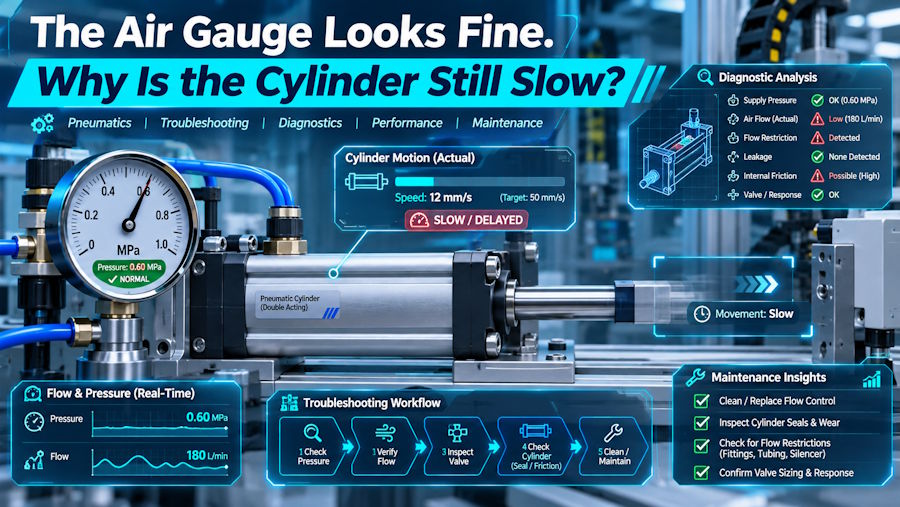
A pressure gauge can look reassuring while a machine is doing nothing. The more revealing moment may be when several cylinders move together. If pressure drops during that event, the idle reading has answered only part of the question.
Imagine a line that is steady at 6 bar between cycles but falls at the point of use during a high-demand step. This is an illustrative situation, not a diagnosis of a particular machine. Before turning up the regulator or ordering a larger cylinder, establish where the pressure changes and what the air is passing through.
Follow the air while the machine is working
The U.S. Department of Energy identifies filters, regulators, lubricators, hoses and couplings among the components that can cause pressure drop. Its guidance is to investigate restrictions and select components for the required flow, rather than automatically increasing compressor discharge pressure. [1]
For maintenance, that means arranging appropriate measurements upstream and downstream of suspected restrictions during the relevant machine cycle. The work should be done by qualified personnel using the site's procedures. Compare like conditions: a reading taken during a quiet interval cannot explain a problem that appears only when demand peaks.
If the drop is associated with an element that has become contaminated, maintenance may be the first answer. If it has always occurred at the required flow, the component selection or piping layout may need review. Either way, the finding is more useful than assuming that every slow movement needs a higher regulator setting.
AirTAC's GFR catalog illustrates why the flow condition matters: the published curves relate outlet pressure to flow at a stated inlet pressure. A catalog maximum or a static setting is not a promise of unchanged pressure at every demand. Read the curve for the relevant body size and operating condition. [2]
The connection size is not the whole selection
Two filter-regulators can accept the same nominal pipe size while having different bodies and flow characteristics. AirTAC lists GFR200-08 and GFR300-08 with 1/4-inch connections, for example, but they are not the same physical unit. Matching the fitting does not establish equivalent flow performance or a drop-in mounting fit. [2]
A useful review of AirTAC air filter regulators and FRL units therefore starts with the functions the machine actually needs. Is the task filtration and pressure control, or is controlled lubrication also required? Then compare body size, flow behavior, pressure range, drain configuration and the space needed for servicing.
Keep room below the bowl and around the drain. A treatment unit that can only be serviced after removing nearby equipment is harder to look after. The pipework and bracket arrangement should allow routine inspection without inviting an improvised repair under pressure.
A filter is not a dryer
The GFR catalog offers 5-micron and 40-micron filtration grades and describes separation of liquid from the passing air. Those are useful functions, but they should not be read as a guarantee that the downstream air is dry in every condition. [2]
Water vapor and liquid droplets are different problems. A separator can remove collected liquid; a drying stage is needed to control moisture vapor to the level the application requires. Air that later cools can still produce condensation if its moisture content has not been adequately controlled. The DOE sourcebook treats drying and filtration as distinct parts of air preparation. [1]
A finer element is not an automatic cure for wet piping, either. Choose filtration to match the downstream equipment and contamination problem, and check the associated flow performance. Do not describe a filter as providing oil-free or food-contact-quality air merely because its particle rating is small. Those applications need a documented air-quality specification and a treatment system selected to meet it.
Match the drain to the installation
Drain selection deserves a line on the purchase order. In the cited GFR catalog, GFR200 is shown with manual and differential-pressure drain options, while the larger GFR300, GFR400 and GFR600 groups also show an automatic option. The available choices are not identical across every body. [2]
The practical question is how collected liquid will leave the bowl under the machine's operating schedule. Consider access, the drain's required operating conditions and the destination of the discharged condensate. Confirm the selected version's instructions rather than treating a drain description as a promise that it needs no attention.
Before a bowl or element is removed, stored pressure must be controlled under the established isolation procedure. A gauge reading and a closed downstream valve are not substitutes for verifying the intended safe condition. [4]
Do not add lubrication simply to complete an acronym
FRL stands for filter, regulator and lubricator, but not every installation needs all three. AirTAC's 4V200 specification says additional lubrication is not required. It also says that once lubricated air is used, the same medium should be continued. Those are equipment-specific instructions, not a reason to change an existing machine's lubrication practice without checking all affected components. [3]
When contacting an AirTAC parts supplier, provide the existing full code, inlet pressure, required flow or duty information, desired outlet pressure, filter grade and drain type. Include the mounting constraints. That allows a replacement to be checked as an air-treatment assembly rather than simply 'a regulator with a quarter-inch port.'
The most useful pressure reading is the one connected to a known operating condition. Once the restriction, moisture requirement and maintenance needs are understood, choosing the treatment unit becomes a much more definite task.

