

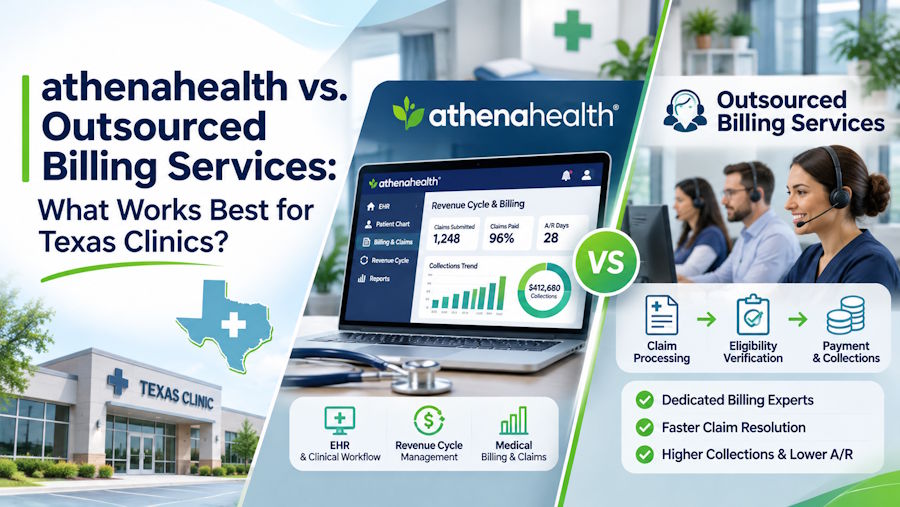
What athenahealth Handles on Its Own?
athenahealth is a cloud-based EHR and practice management company. Its athenaOne platform combines clinical records, scheduling, and billing in one system. The billing side covers claim creation, electronic submission, and a payer rules engine that checks claims before they go out. athenaOne also tracks claim status and posts electronic remittances.
For a small clinic with a simple payer mix, these tools cover most daily billing tasks. Front-desk staff verify eligibility, providers sign their notes, and the system builds claims from each visit. An in-house biller then reviews rejections and works the follow-up queue.
The software automates the claim pipeline. It does not appeal a denial, call a payer, or fix a provider's documentation habits. Those tasks still depend on trained people.
Where In-House Billing Gets Hard for Texas Clinics?
In-house billing gets hard when payer complexity grows faster than the billing team. Texas creates that pressure in three ways.
- Multiple rulebooks. Novitas Solutions processes Medicare Part B claims in Texas. Texas Medicaid runs through TMHP and a network of managed care plans. Commercial payers such as Blue Cross Blue Shield of Texas, UnitedHealthcare, and Aetna each apply their own policies.
- Medicaid managed care volume. Most Texas Medicaid members are enrolled in managed care programs such as STAR and STAR+PLUS. Each plan sets its own prior authorization and timely filing rules.
- Staffing pressure. Experienced billers are hard to hire and keep in large markets like Houston, Dallas, and Austin. One resignation can leave weeks of claims unworked.
A clinic on athenaOne still faces all three issues. The platform flags many errors, but a short-staffed team falls behind on denials and aging A/R.
What Outsourced Billing Services Add?
Outsourced billing adds a trained team on top of the same athenaOne platform. The billing company works inside the clinic's athenahealth account. It takes over coding review, claim follow-up, denial appeals, and A/R recovery. The clinic keeps its EHR, its data, and its workflows.
The main gains fall into four areas:
- Specialist knowledge: billers trained on athenaOne workflows and specialty coding rules.
- Denial recovery: dedicated staff who appeal denials and chase payers by phone and portal.
- Coverage without hiring: no gaps when an employee resigns or takes leave.
- Regular reporting: reviews of clean claim rate, denial trends, and days in A/R.
This is why many clinics already on athenaOne look for athenahealth billing services rather than switching systems. The software stays the same, and the team behind it gets deeper.
The trade-off is control. The clinic relies on an outside partner, so clear reporting and communication terms matter from day one.
In-House vs. Outsourced Billing on athenahealth: Side by Side
The table below compares both models across six factors that matter most to Texas clinics.
| Factor | In-house on athenaOne | Outsourced on athenaOne |
|---|---|---|
| Cost structure | Salaries, benefits, training, and software fees | A percentage of collections, commonly 4% to 10%, plus software fees |
| Control | Full, day-to-day control | Shared through reporting and agreed processes |
| Payer expertise | Limited to current staff | Built across many clients and payers |
| Denial follow-up | Competes with front-desk and admin work | Handled by a dedicated team |
| Staffing risk | High when one biller leaves | Low, since the partner covers gaps |
| Scalability | New hires for each provider or location | Grows with claim volume |
In-house billing favors control. Outsourced billing favors depth and stability as claim volume grows.
How to Decide Which Model Fits Your Clinic?
The right model depends on clinic size, specialty, and payer mix. In-house billing fits clinics with:
- 1 to 3 providers and a simple payer mix
- an experienced biller already on staff
- low denial rates and A/R under 40 days
Outsourced billing fits clinics with:
- 4 or more providers, or several locations
- heavy Medicaid managed care volume or complex specialty coding
- rising denials, staff turnover, or A/R above 45 days
A hybrid model also works. Some clinics keep front-desk tasks in-house and outsource coding, denials, and A/R.
Texas clinics comparing partners can start with providers that offer medical billing services in Texas and direct athenaOne experience. Ask each one for sample reports, references from similar specialties, and clear pricing.

