

Introduction
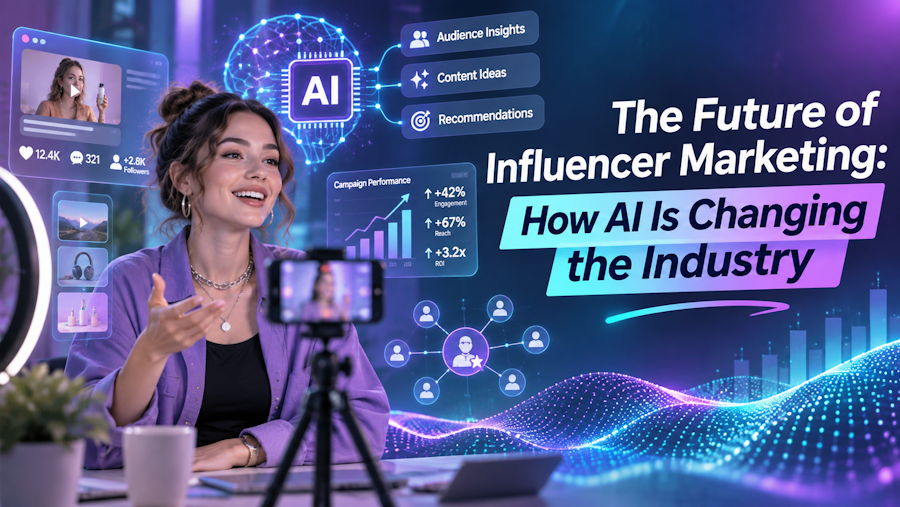
The use of influencers to market products or services has become an integral component of modern digital marketing, allowing companies to reach out to their audiences through reputable content creators and social media celebrities. With evolving consumer behavior, the use of artificial intelligence (AI) has changed the way that brands use influencers and conduct campaigns by influencing how campaigns are planned, the type of content created, and even measuring marketing performance. The role of AI within influencer marketing has introduced new ways to approach influencer marketing and new challenges for businesses.
The Growing Role of AI in Influencer Marketing
Influencer marketing is undergoing an evolution due to the emergence of artificial intelligence, through which businesses are able to make better choices when it comes to choosing the right influencers as well as developing promotional campaigns. Normally, brands would rely on things such as the number of followers of creators, their engagement rate, and recommendations from other creators in order to choose the appropriate influencers. According to the Interactive Advertising Bureau's 2025 Creator Economy Ad Spend and Strategy Report, 75% of brands use or plan on using AI in order to do creator marketing activities. This clearly indicates just how rapidly AI has been adopted into the world of influencer marketing.
Influencer Discovery and Selection Using AI
One of the key success components of a marketing campaign is the right choice of an influencer. An influencer who has millions of followers is not necessarily able to produce engagement and reach the target customers. Technologies for discovering influencers help assess the quality of an audience, relevance of content, patterns of engagement, and even results of previous campaigns.
It is possible to work with huge amounts of social media data and discover influencers whose audience will be relevant to particular products or services. Predictive analysis will allow marketers to estimate the possible results of the campaign before making an investment.
Thus, companies will have the opportunity to abandon the old way of choosing influencers and will focus on their audiences' relevance, credibility, and engagement. Further development of AI technology will bring even higher accuracy in selection processes.
Virtual Influencers
Eugene Leow, Head of Marketing at Solmi.ai, shared another major breakthrough in marketing driven by AI is the rise of virtual influencers. It refers to digitally developed influencers who make use of computer graphics, AI, and story-telling to create social media following and advertise products.
He explained, “virtual influencers give the companies control over the look, messaging, and advertising efforts of such people. They do not need any physical location or regular photo shoots, while content can easily be adjusted for various markets and marketing campaigns. Besides, companies can create digital personalities consistent with the brand image.”
According to studies in Acta Psychologica in 2025, the key element that influences trust of consumers regarding virtual influencers is authenticity, transparency, and culture. While virtual personalities are capable of attracting attention and fostering engagement, the audience may doubt the legitimacy of recommendations provided by such influencers. Therefore, companies should inform their audience about the artificial nature of virtual personalities.
Personalized Content and Increased Engagement
The concept of personalization is gaining popularity in the realm of influencer marketing. There is a much higher chance of increased engagement when people are provided with personalized content, taking into account the interests and preferences of particular audiences and the products that may be needed. Marketers are able to analyze the behaviour of customers and produce the right content strategies.
Influencers can make use of AI tools in order to see what topics work best, find the optimal posting schedule and get suggestions on how to come up with ideas for the video and captions. Also, brands will be able to launch customized campaigns using the customer data. Recommendation systems based on AI will help to discover new products.
Use of AI in Content Creation and Campaign Management
Jessica Shee of M3datarecovery.com said developing content that remains consistent and captivating requires significant effort and time. The use of AI by influencers and marketing personnel aims at making the process of editing, creating images, videos, captions, translating and planning content simpler.
With the help of generative AI tools, influencers and creators can develop ideas for promotion, adapt content for various social media platforms, and create multiple marketing materials. In this case, creators have the opportunity to focus on telling their stories, interacting with their audience and developing content.
Another application of AI in marketing campaign management involves automating routine tasks related to performance, analysis and reporting. However, companies should not completely rely on automated content. As stated by a 2024 study published in the Journal of Retailing and Consumer Services, the use of generative AI in the process of creating social media content decreases authenticity of the brands.
The Significance of Authenticity and Customer Trust
Even with advancements in technology, authenticity continues to be one of the greatest pillars of a successful influencer marketing campaign. Customers tend to trust the views, experiences, personality traits, and advice of the influencer. Too much automation and fake content tend to ruin these aspects of a good relationship.
Using AI in creating an influencer can offer some possibilities of creativity, but it is not always possible to make the same emotional connection as that between humans. According to a study conducted in the International Journal of Human-Computer Interaction in 2025, virtual and human influencers were observed, and it was noted that perceived authenticity positively correlated with trust, which in turn positively correlated with purchasing intentions. Brands need to be transparent about the use of AI in creating photos or videos. Human influencers need to express themselves honestly when selling products.
AI-Driven Analytics and Influencer Marketing Performance
Another field where AI has been playing an important role is the analysis of campaign efficiency. Classical approaches to measuring the success of influencer marketing campaigns would include such metrics as impressions, likes, comments, and followers. Still, these metrics cannot show whether the campaign brought any real-life benefits to the business.
With the help of analytics based on machine learning, the brand will be able to measure sentiment among the audience, the quality of engagement, traffic on its site, conversion rates, as well as the behavior of customers. These metrics can be used by businesses to refine their strategies, optimize ad budgeting, and make better-informed decisions. Predictive analytics can be applied for identifying risks and possible opportunities for the future campaign in advance.
Challenges in Using AI in Influencer Marketing
While there are many benefits associated with AI, there are some challenges involved in the application of this technology. Misleading or manipulating content could be one of the challenges. Generated content such as images, videos, or voices using AI would pose a challenge to audience members to differentiate real recommendations from the artificial promotion, said Matteo Valles of Vol Case.
He said, “privacy is another challenge since data generated using AI is used in marketing platforms to come up with personalized marketing campaigns. Businesses need to be careful when using customer data and should comply with relevant policies.”
Transparency and copyright are other challenges, and the effects of automation in creativity are also a challenge. Virtual influencers and endorsement using AI should be done by following certain policies for communication purposes. If not, it might hurt the relationship with customers.
The Future of Human and AI Collaboration
The future of influence marketing won’t rely solely on artificial intelligence or on content production. The success of any strategy will be a result of a combination of technologies driven by AI and people’s creativity and communication. While AI can handle the job of data analyzing, audience research, content optimization, and campaign performance, human influencers can offer unique experience, opinion, and emotions.
Moreover, businesses will start paying more attention to micro-influencers and niche content creators who have close connections with particular audiences. The potential for targeting marketing can be high, as the audiences are small but relevant enough. It will become easy for businesses to find such creators using AI. The combination of both approaches can allow the businesses to produce relevant campaigns and keep the personal touch at the same time.
Conclusion
The evolution of artificial intelligence is transforming the world of influencer marketing by enhancing the process of identifying creators, content creation, reaching the target audience, and evaluating the effectiveness of campaigns. Virtual influencers, analytics predictions, and individualized promotional strategies provide new ways for companies to communicate with their customers. However, the advancements of technology are not sufficient to ensure the success of marketing campaigns. Authenticity, transparency, creativity, and consumer trust will always be needed when developing relationships with the audience. Companies which will implement AI as an assistance but not as the substitute of creative minds will be in a favorable position in the digital marketing environment.

