

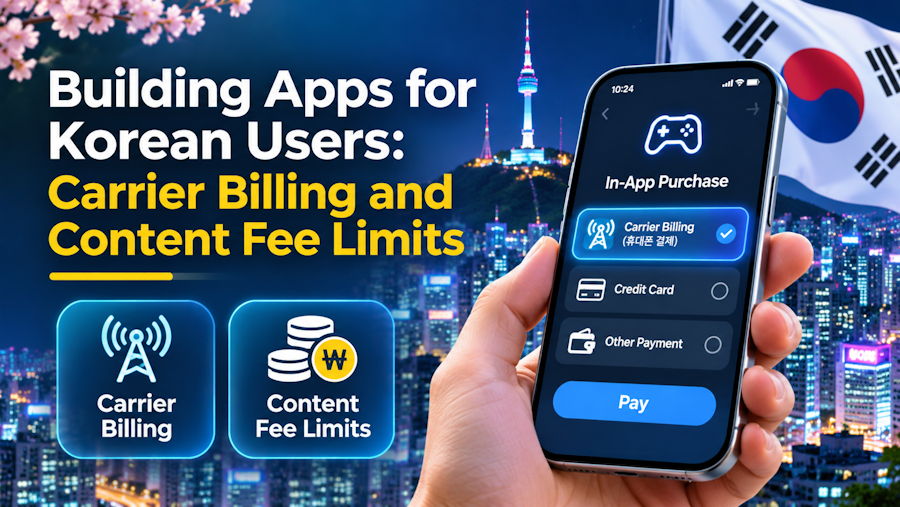
If you ship a game, a streaming service or a subscription app to South Korea, you will quickly notice that a large share of users do not pay with a card. They pay through their mobile carrier, and the charge lands on next month's phone bill. For developers this changes how payment failures look, how support tickets read and how conversion behaves at checkout. This article walks through the parts of Korean carrier billing that matter most when you are building and supporting an app.
How carrier billing fits into the payment flow
Korean carrier billing is handled by licensed payment intermediaries that sit between the merchant and the three major carriers, SK Telecom, KT and LG U+, plus budget carriers that run on their networks. From the app's point of view the flow is simple. The user selects phone payment, enters a mobile number, confirms a one-time code sent by SMS, and the intermediary returns an approval. Settlement happens later, after the carrier collects the bill.
When you sell through Google Play or the App Store, the store usually handles this for you and carrier billing appears as one of the store's payment methods. When you run your own web checkout, you integrate with an intermediary's API directly. Either way, the approval step depends on limits that live on the carrier side, not in your code.
Two limits, not one
The most common source of confusion is that Korean subscribers have two separate ceilings. The first is the overall monthly limit for phone-bill purchases. The second is a lower, separate limit for digital content charges, often called the content fee or the information usage fee in Korea limit. Game items, webtoon episodes, music and app purchases usually count against this second limit.
For developers this means a payment can fail even when the user insists their phone payment limit is fine. They may have raised the overall limit but never touched the content fee limit. Support teams that know about the two ceilings resolve these tickets much faster.
What failed payments usually mean
In practice, most declined carrier billing attempts fall into a few categories:
- The monthly content fee limit has been reached.
- The user or a family member switched off phone payments to avoid unwanted charges.
- A previous phone bill is unpaid, so the carrier has temporarily suspended the feature.
- The SMS verification code expired or was entered incorrectly.
- The merchant category is restricted for that subscriber, which is common on accounts belonging to minors.
Error codes from intermediaries do not always map cleanly to these causes, so it helps to log the raw response and show users a short message that points them to their carrier settings rather than a generic error.
Designing a better checkout for Korean users
A few small decisions make a measurable difference. Show phone payment as a visible option instead of hiding it behind a menu. Keep the SMS confirmation step on the same screen so users do not lose context. When a payment fails, explain that limits are set by the carrier and can be checked in the carrier app. And avoid retry loops that send multiple verification codes in a row, which both frustrates users and looks suspicious to fraud systems.
Security considerations
The weakest point of carrier billing is the verification code. Fraud usually starts when someone tricks a user into reading out or forwarding that code. Apps can reduce risk by never asking for the code anywhere except the official payment screen, by rate limiting payment attempts per account and device, and by sending a clear confirmation message after every successful charge. These measures protect users and reduce chargeback disputes with intermediaries.
Where users look for help
Korean users often search for plain-language explanations of their phone payment and content fee limits before they contact app support. Local information sites such as Cashday publish step-by-step guides on checking limits and understanding phone bill charges, which is a useful reference when writing your own help center articles. Linking your support documentation to clear carrier-side instructions reduces ticket volume and keeps users moving through checkout.
Conclusion
Carrier billing is not an edge case in South Korea; it is a mainstream payment method with its own rules. Knowing that there are two limits, that most failures come from carrier-side settings, and that the SMS code is the main security risk will help you design a smoother checkout and a more efficient support process. For any team planning a Korean launch, it is worth testing phone payments early and writing help content for them before the first wave of users arrives.

